
Graphisoft’s András Ferenczy explores how AI could consolidate AEC firms, reshape design practice and elevate full-stack designers, transforming BIM into an intelligent, integrated decision hub
There is broad agreement that AI will have a massive impact on the AEC industry. What remains unclear is how this transformation will unfold. The picture is still fragmented and often contradictory. One useful way to reduce this uncertainty is to examine past technological disruptions and draw lessons from them. At the same time, it is important to distinguish between two perspectives: the transformation of the AEC industry as a whole and the more focused — but equally profound — changes within the design domain.
Platform-driven consolidation
At an industry-wide level, AI is likely to function as a strong force of consolidation. The AEC value chain today is highly fragmented, with specialised actors operating in isolation across planning, design, engineering, construction, and operations. AI, together with shared digital platforms and standardised data models, has the potential to significantly reduce friction between these stages. As this happens, firms will increasingly face a strategic choice. They can either grow vertically by specialising deeply in niche domains or grow horizontally by expanding across multiple phases of the construction lifecycle and positioning themselves as multidisciplinary actors.
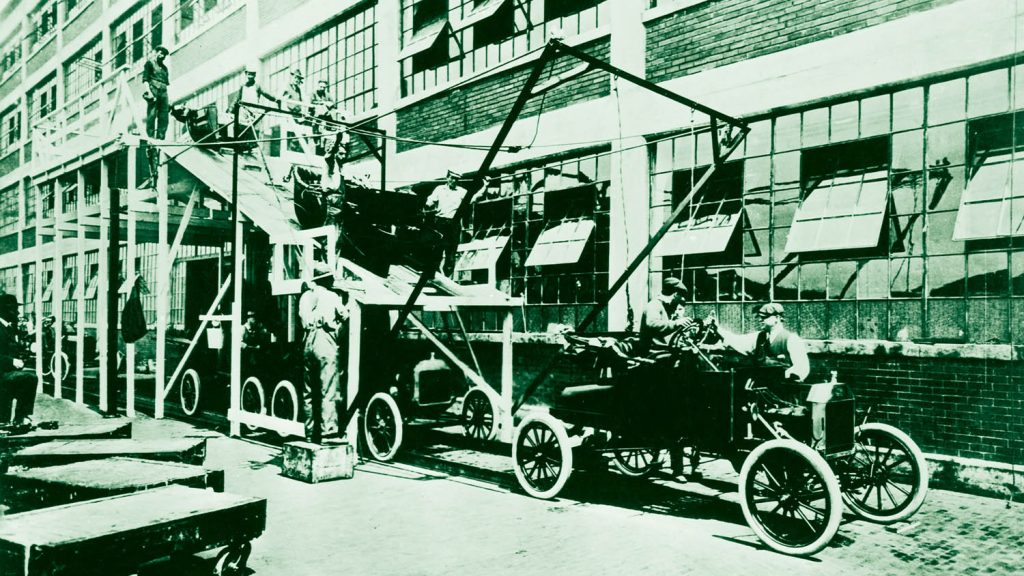
A useful analogy can be found in the automotive industry of the early 20th century. Around 1910, car manufacturing consisted of many small producers building bespoke vehicles. The introduction of the assembly line and shared industrial platforms radically reshaped the industry. Over time, a small number of large, vertically integrated “full-line” manufacturers emerged, alongside a parallel ecosystem of luxury and niche brands. BIM and AI represent a similar “assembly line plus common platform” moment for AEC. If history is any guide, this transformation is likely to produce a few dominant, integrated providers alongside smaller, high-end or highly specialised players.
Discover what’s new in technology for architecture, engineering and construction — read the latest edition of AEC Magazine
👉 Subscribe FREE here
Product-centric design teams
The more immediate question, however, is how these changes will affect design practice. Here, a strong parallel can be drawn with the evolution of software development organisations. Many software companies have moved away from large, functionally siloed teams — separating front-end, backend, QA, and operations — toward smaller, cross-functional, AI-first product teams that own features end-to-end. A similar shift is likely to occur in design firms.
Instead of organising around discrete disciplines such as architecture, interiors, visualisation, and BIM, AI-enabled design firms may increasingly organise around building types, client segments, or project “products.” These teams would own strategy, design, modelling, analysis, and documentation as a single unit, supported by AI systems that reduce coordination effort and automate routine work. In this model, design knowledge becomes a reusable asset. Just as software companies turn recurring solutions into SaaS products or reusable components, design firms could turn common building types into configurable design products — typologies, kits of parts, or parametric templates — selling adaptation and optimisation rather than one-off drafting.
Viewed more broadly, this evolution opens new positions in the value chain. Some design firms may move into real estate strategy and portfolio consulting, offering data-driven advice to investors and developers. Others may move downward toward design-to-delivery platforms, tightly integrated with contractors, or embedded within vertically integrated development groups. This mirrors developments in the software industry, where companies increasingly both design and operate the systems they build.


Crucially, this shift does not remove responsibility. Emerging AI liability and regulatory frameworks are likely to anchor accountability firmly in human professionals or organisations. This reinforces the continued need for named, accountable designers rather than purely tool-driven workflows. AI changes how decisions are made, but it does not eliminate professional judgement or responsibility.
The full-stack designer
AI will also reshape individual roles within design offices. Rather than simply freeing up time to focus on narrower tasks, AI is likely to drive role convergence. The industry is moving away from the traditional silos of designer, BIM modeller, visualiser, and analyst toward a model-centric “full-stack designer.”
Today, many firms still separate concept design, technical design, BIM modelling, visualisation, and sustainability or performance analysis into distinct roles. Junior staff often focus on execution — drafting, detailing, modelling, rendering — while senior staff focus on decision-making and client strategy. Generative design tools and AI-assisted BIM systems challenge this structure. These tools can already generate massing, plans, sections, 3D geometry, and visualisations within a single workflow, driven by one person’s prompts and constraints. This enables a new “design-technologist” role, in which a single professional steers concept, geometry, visualisation, and early performance checks rather than relying on multiple specialists.
The boundary between architect and analyst is also becoming more permeable. AI-enhanced BIM tools can run rapid daylight, energy, cost, clash, and basic code checks directly from the model. This allows architects to make more data-driven decisions early in the process, escalating only complex or high-risk analyses to specialists. Similarly, the distinction between project architect, BIM coordinator, and BIM lead begins to blur. As interfaces become more intuitive and automation handles documentation and coordination, these roles increasingly merge into a single, model-centric project leadership function.
Firms will increasingly face a strategic choice. They can either grow vertically by specialising deeply in niche domains or grow horizontally by expanding across multiple phases of the construction lifecycle and positioning themselves as multidisciplinary actors
The overall direction inside design offices is therefore not just task automation, but a re-bundling of previously fragmented responsibilities into fewer, broader, and more decision-centric roles. AI reduces the need for large production teams by amplifying individual capability rather than replacing expertise.
BIM as an intelligent design hub
This shift places significant pressure on design software vendors. As roles converge, tools must support seamless orchestration across modelling, analysis, visualisation, coordination, and documentation. Given the volume and complexity of information involved, this orchestration will rely heavily on AI. Tools that focus solely on geometry and metadata editing will struggle to meet these new demands.
In this context, a future design office using the Graphisoft portfolio may look very different from today’s norm. There would be fewer pure CAD or BIM operators and more full-stack designers who engage with clients, define and refine project constraints, run AI-assisted options and simulations, and curate outputs into coherent architectural narratives. Around them, a smaller ring of specialist cells — focused on sustainability, structure, code compliance, façades, or experience — would support many projects rather than duplicating work across every team.
In practice, this implies a stronger emphasis on AI features focused on creation, while also automating repetitive work, identifying discrepancies, and supporting documentation, compliance, and regulatory checks. Together, these capabilities significantly expand what can and should be addressed within the design environment.
Timing, however, is critical. Moving too fast, before the market is ready, risks turning investment into a disadvantage. Moving too slowly risks irrelevance. Managing this balance may be the greatest challenge ahead.
Ultimately, the goal is to transform BIM software from a geometry-plus-metadata editor into an intelligent design hub — easy to connect to other systems, easy to extend with specialised solutions, yet capable of delivering a coherent, integrated user experience. Design and model development will not rely on a single tool, but on an ecosystem of interconnected solutions. In that future, the role of the architect is not diminished but elevated: orchestrating tools, data, and decisions with knowledge, expertise, and responsibility at the centre of AI-supported design processes.
Main image: Ford assembly line Detroit, circa 1910