
If AI is going to matter in AEC, it should not begin with prettier geometry. It should begin by collapsing data latency and compressing cognition, writes Clifton Harness, CEO, TestFit
There is no shortage of excitement about AI drawing buildings. Faster renderings, more variations, fluid form at the speed of prompt — all make for persuasive demonstrations (yes an LLM suggested that emdash). Yet in real estate development, where capital is actually deployed and risk is priced, the binding constraint has rarely been geometry. It is decision velocity under pressure.
In early-stage feasibility, architects are not simply shaping buildings. They are compressing zoning code, construction pricing, financing assumptions, parking requirements, entitlement exposure, and timing risk into something a client can act on. Before anyone cares what a building looks like, a developer needs clear answers to four questions. What can we legally build on this site? What will it cost? Which configuration maximises return relative to risk? And how quickly can we know that with confidence?
Today that process remains fragmented. Zoning PDFs sit in one window, spreadsheets in another, sketch models in a third. Consultant calls fill the gaps, red lines circulate, assumptions are updated, and iterations stretch across weeks. In competitive land markets, that latency carries a cost. Options expire, sellers move on, and competitors who reach conviction faster gain the advantage. If AI is going to matter in AEC, it should not begin with prettier geometry. It should begin by collapsing data latency and compressing cognition.
Discover what’s new in technology for architecture, engineering and construction — read the latest edition of AEC Magazine
👉 Subscribe FREE here
Generative vs deterministic
A clearer philosophical split is now emerging in AI-enabled tools. On one side sit neural, generative systems. They sample from learned patterns, produce plausible outputs, and depend on large datasets to infer what a building might be. The results can be visually convincing, but they still require validation against regulatory and financial constraints. Plausible is not the same as compliant.
On the other side are deterministic systems that encode constraints directly. Setbacks, height limits, floor area ratios, parking ratios, unit mix rules, structural grids, and construction heuristics are formalised in software. The system does not guess at compliance and check it later. It enumerates what is buildable within the rules from the outset. In feasibility work, compliance is binary. A scheme that violates setbacks is not a creative provocation — it is unusable. A multifamily building that lacks the required parking count in Houston is not visionary — it is commercially dead.
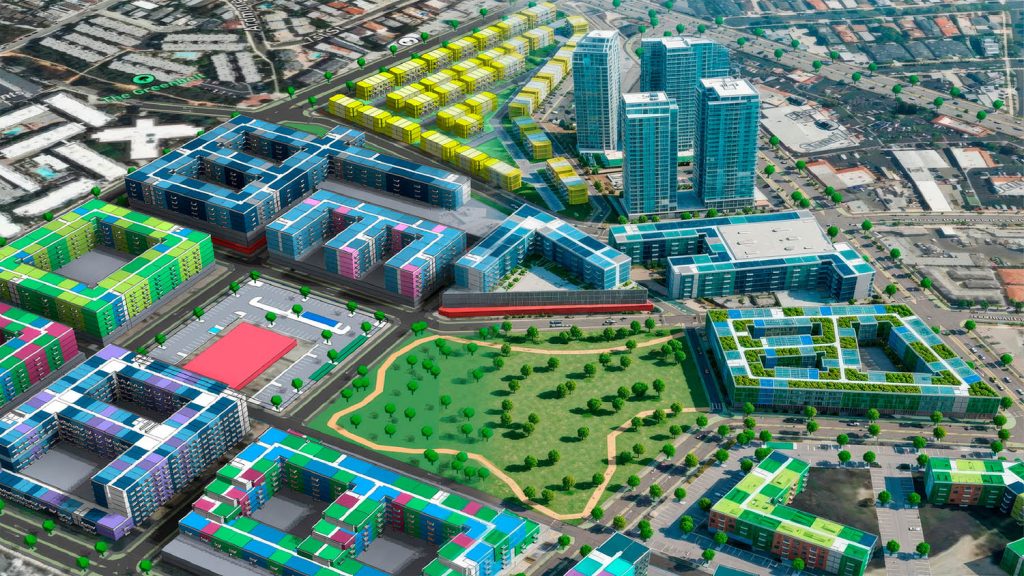
Companies such as TestFit have built around this deterministic philosophy. The configurator explores the feasible space inside encoded rules, producing geometry that is compliant for immediate construction. The breakthrough is not simply speed. It is speed with certainty. The cognitive load that once lived in the architect’s head — holding zoning, structural, and financial constraints in mind simultaneously — can now be embedded in a scalable system. That is what risk compression looks like in practice.


With constraint-driven solvers thousands of compliant permutations can be evaluated in seconds. This is not aesthetic noise or generative randomness. It is systematic exploration of feasible permutations under defined constraints
For decades, feasibility has meant three options. Three schemes prepared by hand, three iterations in CAD or BIM, each representing weeks of work. The team would select the most promising direction and refine from there, trusting experience to land somewhere near an optimum. The rest of the design space was invisible. Scheme 4 through scheme 999 were never considered.
Constraint-driven solvers alter that dynamic. Thousands of compliant permutations can be evaluated in seconds. This is not aesthetic noise or generative randomness. It is systematic exploration of feasible permutations under defined constraints. When you test three schemes, you rely on intuition. When you test thousands, blind spots shrink and outliers surface. Better yield no longer hides in unexplored geometry.
This saturation has implications beyond financial return. Sustainability metrics — unit efficiency, façade-to-floor ratios, embodied carbon proxies, parking intensity, building depth — can be measured across the entire feasible set rather than retrofitted onto a preferred scheme. Sustainability becomes a selection criterion, not an afterthought.
Unexplored geometry is often hidden risk and, frequently, hidden carbon. Coverage reduces both by exposing trade-offs quantitatively.
Large Language Models (LLMs)
Where, then, do large language models fit? They are powerful tools, but they are not geometry engines. They do not enforce zoning compliance, resolve parking layouts, or reconcile structural grids. What they do well is rank, filter, compare, and explain structured information.
The integration is sequential. First, a deterministic engine collapses the design space into thousands of compliant options. Then a language model interprets and prioritises that output against a developer’s stated objectives. The result is a defensible recommendation grounded in real constraints, not intuition alone.
In practice, this means surfacing insights: which schemes clear a target internal rate of return (IRR), which are most resilient to construction cost escalation, how reducing parking by ten per cent improves IRR while increasing entitlement exposure. The deterministic system removes risk from geometry. The language model removes friction from understanding it. The result is not automated design in the romantic sense. It is accelerated decision intelligence. The human armed with gigabytes of proof over a megabyte of vision.
Consider the traditional studio loop: a scheme is proposed, redlined, adjusted, and reissued. The process is healthy and necessary, yet it unfolds over days and weeks. With a constraint-based solver paired with a language layer, that loop can run at machine speed. Adjust parking ratios, re-run the feasible space, observe the impact on yield and unit count. Shift the unit mix, re-collapse the space, measure IRR sensitivity. Each iteration perturbs constraints and measures consequences across thousands of compliant outcomes. The system does not invent arbitrary geometry. It maps consequences consistently and at scale, while preserving the designer’s judgement over intent and trade-offs.
For developers, operators, and Real Estate Investment Trusts (REITs), the implications are direct. Faster land acquisition decisions, shorter pre-development cycles, fewer dead deals, higher portfolio throughput, quicker capital recycling. If a team can evaluate ten times more sites per quarter without increasing headcount, optionality expands dramatically. The advantage is not aesthetic. It is temporal. Time-to-confidence becomes strategic leverage.
The question of competitive moat also shifts. Access to foundation models is unlikely to be defensible over time — they are rapidly becoming commodity infrastructure. Durable advantage resides in the depth of encoded constraints, the accuracy of zoning and typology logic, solver performance under real-world complexity, tight integration with financial models, and structured outputs embedded in capital workflows. If the deterministic layer is weak, the language model amplifies noise. If the constraint layer is robust, the language model amplifies clarity.
Conclusion
This re-framing places AI in AEC on firmer ground. The debate is not about whether algorithms can draw more expressive buildings. It is about whether systems can compress risk and cognition at the moments that matter most — when capital is being allocated and timing defines opportunity. The most powerful role for foundation models may not be inventing geometry at all, but interpreting structured reality and accelerating defensible decisions. Collapsing cognition, not geometry, may prove to be the more consequential shift.