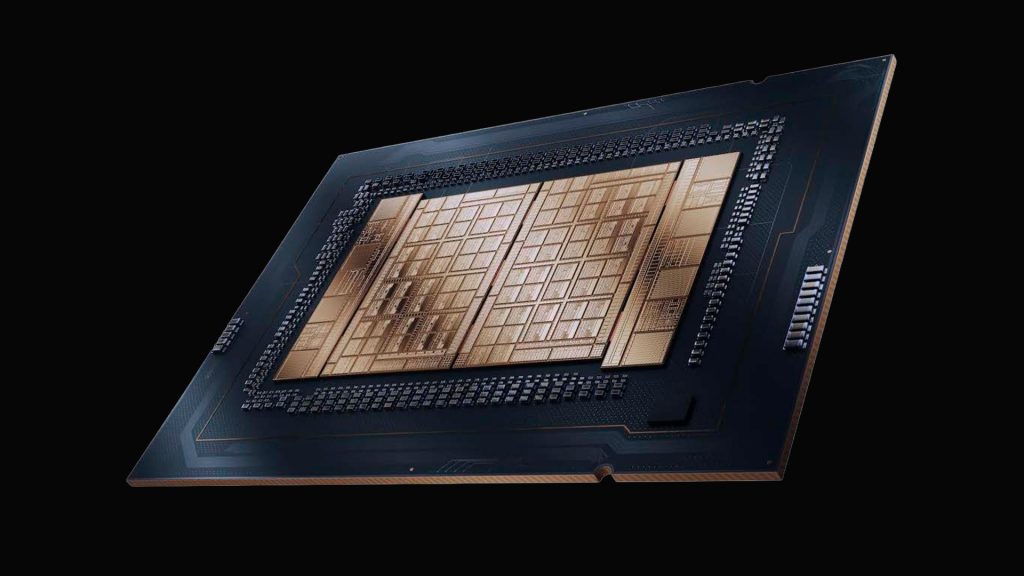

Intel looking to take on AMD Threadripper Pro with up to 86 cores, fast MRDIMM memory, and a unified Xeon 600 stack
Intel has launched its Xeon 600 Series processors for workstations, bringing the Granite Rapids architecture to desktops designed for heavy compute workloads such as simulation, rendering, and AI development.
The new chip family will replace the existing Sapphire Rapids‑based Xeon W-2500 and W-3500 Series workstation chips and will go up against AMD’s high-end workstation equivalent, the Ryzen Threadripper Pro 9000 Series.
Intel Xeon 600 features up to 86 “Redwood Cove” cores, up to 4.9 GHz Turbo frequency and boasts more L3 cache per core, and more memory bandwidth than Sapphire Rapids.
Read AEC Magazine’s Workstation Special Report 2026
Compared to the flagship 60 core ‘Sapphire Rapids’ Xeon w9‑3595X, Intel claims the 86 core Xeon 698X processor offers up to 9% higher single‑threaded performance and up to 61% higher multi‑threaded performance, as measured in rendering benchmark Cinebench 2026. The uplift in simulation software is not as big, with Intel reporting up to 27% faster FEA solve times in MFEM and up to 30% faster CFD solving in OpenFOAM. Intel did not show any comparisons between the Intel Xeon 600 Series and AMD Threadripper Pro 9000 Series.
Meanwhile, Intel’s new chips have a maximum base Thermal Design Power (TDP) of 350 W, down a little from 385 W with Sapphire Rapids.
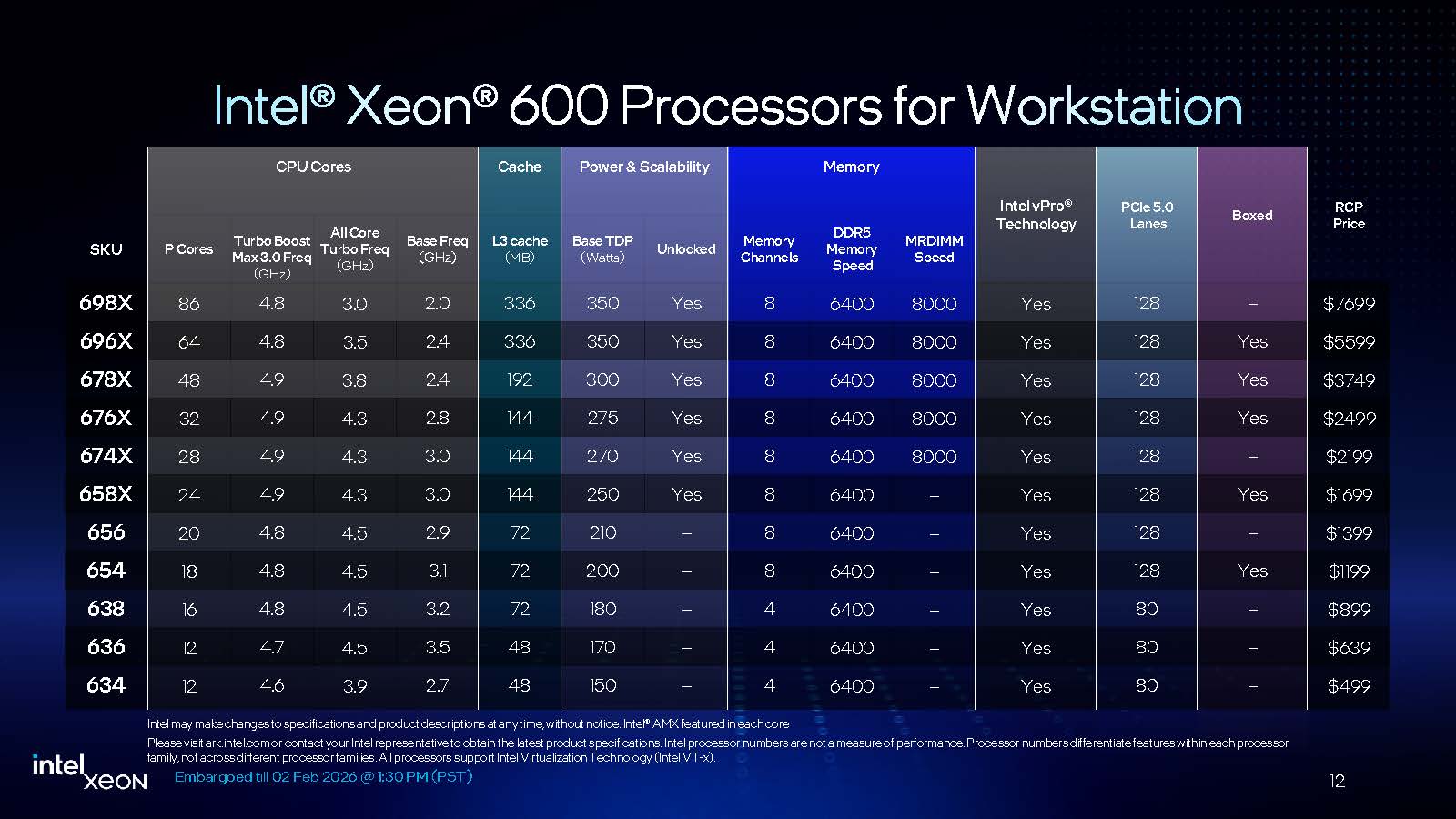
Memory is central to the new processor. Xeon 600 supports up to 4 TB of RAM via eight channels on most processor models, with some cost‑optimised chips retaining four channels to hit mainstream price points.
A notable new ingredient is Intel’s Multiplexed Rank DIMM (MRDIMM) technology, which pushes data rates up to 8,000 MT/s, compared with 6,400 MT/s for standard RDIMMs. Capacity is lower, and an MRDIMM‑equipped system cannot be configured all the way to 4 TB, but Intel sees the technology as an attractive option for bandwidth‑bound workloads, such as engineering simulation, when paired with SKUs with 28‑cores or more.
With Granite Rapids workstation, Intel is also simplifying its product story. The previous split between 2000‑series “mainstream” and 3000‑series “expert” Xeon W parts disappears in favour of a single Xeon 600 stack that runs from 12 to 86 cores.

Rather than defining mainstream and expert by arbitrary platform cuts, Intel now scales cost and capability via core counts, memory channels and PCIe lane counts, while keeping compatibility across the range. Entry chips with 12-16 cores offer four memory channels and 80 PCIe lanes to underpin mainstream towers, while the rest of the stack, from 16-86 cores, delivers eight channels and 128 lanes for higher-end builds.
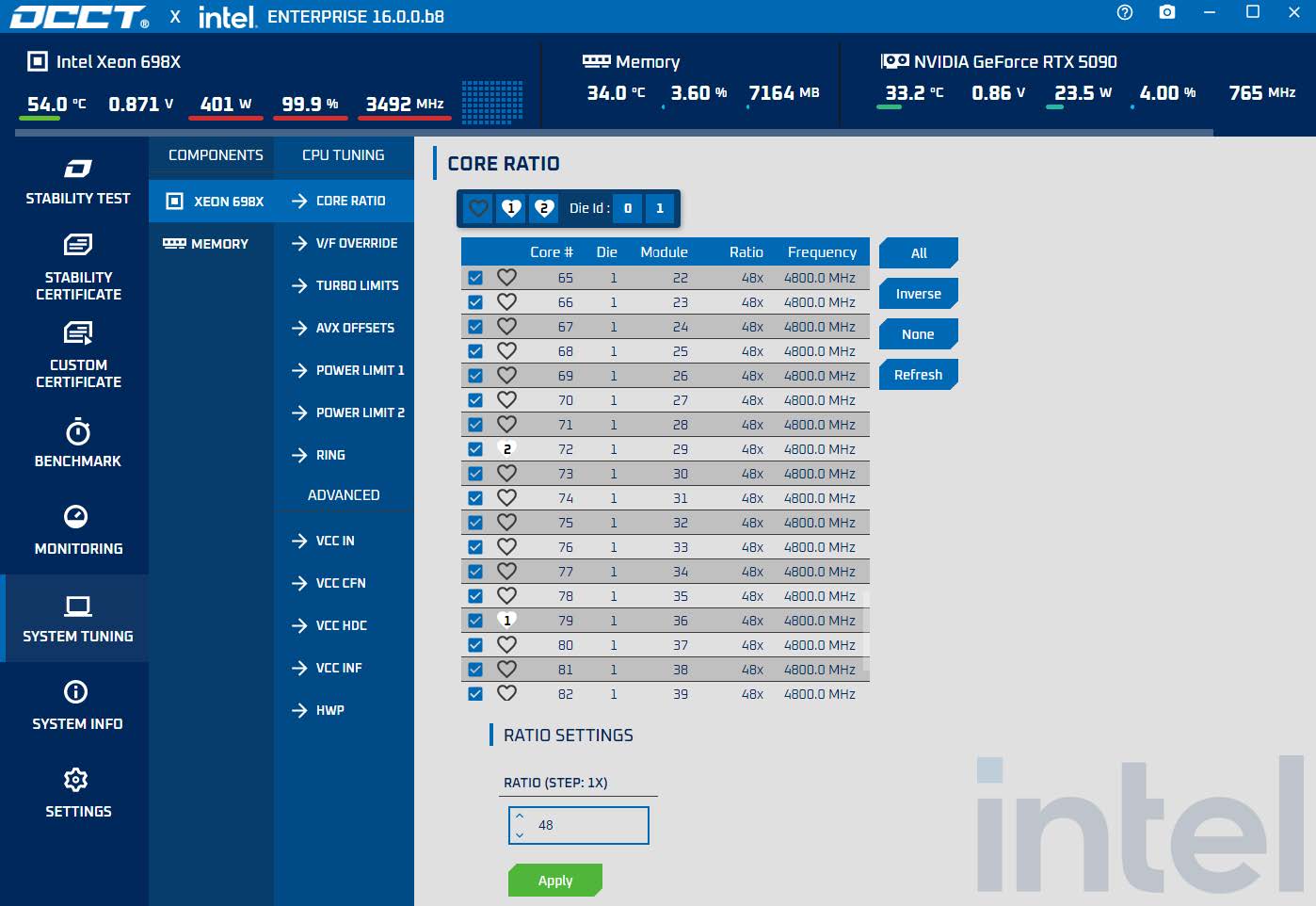
For boutique system integrators, Intel is offering six‘unlocked’ models for overclocking, denoted by an X suffix. To help with overclocking, Intel has worked with OCBase to integrate Granite Rapids control and monitoring into the OCCT application. However, as with Core desktop CPUs, pushing Xeon 600 beyond spec remains officially at the user’s risk and comes with warranty trade‑offs, which is why you won’t see the major OEMs – Dell, HP or Lenovo – offering overclocked systems.
System vendors are already on board, says Intel. Xeon 600 will underpin new workstations from Dell, HP, Lenovo, Supermicro and others, and will be available on discrete W890‑based motherboards from Asus, Supermicro and Gigabyte. Intel expects Xeon 600 workstation systems to begin appearing from late March, with more detailed OEM announcements to follow.
Looking ahead, the company also teased its Series 3 Intel Core Ultra “Panther Lake” processors for mobile workstations, with more information promised later in the quarter.