
The BIM platform is evolving into an intelligent system that continuously validates models, reducing errors and saving time, writes Qonic’s Erik de Keyser
When AI is discussed in construction, the conversation often drifts toward chatbots and image generators. However, its real potential lies somewhere far less glamorous, but far more transformative. It lies in eliminating the slow, manual, error-prone work that quietly consumes thousands of hours across every project.
For decades, BIM platforms have been understood as modelling environments, digital drafting boards with data. Yet most BIM professionals don’t spend their time drawing walls. Most of the time is spent ensuring that objects are properly classified, parameterised, compliant with standards, aligned across disciplines, and consistent in quantities.
In other words, BIM is heavily dependent on manual data validation, which is repetitive, mentally draining, and vulnerable to human error. Traditional BIM quality control follows a familiar rhythm: Model. Inspect. Fix. Repeat.
Discover what’s new in technology for architecture, engineering and construction — read the latest edition of AEC Magazine
👉 Subscribe FREE here
Problems are discovered after they are created. Errors are discussed in review meetings. Inconsistencies surface during quantity take-offs. Coordination issues appear when disciplines collide.
Qonic challenges this pattern: what if the BIM platform itself became continuously self-evaluating?
From reactive checking to autonomous validation
The next evolution of BIM platforms will embed intelligence directly into the model environment. Instead of quality control being a periodic activity triggered by users, it becomes consistent and autonomous.


Models examine themselves as they are being built:
• Assemblies recognise inconsistencies automatically.
• Suspicious quantities are flagged before a report is generated.
• Continuous coordination checks without manual trigger.
• Standards compliance is evaluated in real time.
This is Qonic’s foundation, not for automation that replaces designers, but for automation that eliminates repetitive, error-prone manual validation.
Why BIM data is harder than text or images
This requires acknowledging something fundamental: BIM data is not like text or images. Much of today’s AI progress is built on large language models or computer vision systems. But building models are geometrical, relational, hierarchical, and contextual. A pipe is not merely cylindrical geometry; it belongs to a system, connects to equipment, interacts with structure, and carries metadata.
Many off-the-shelf AI systems are trained to understand text or pixels, but Qonic approaches this through spatial encoding techniques that translate geometry into machine-readable representations capturing adjacency, orientation, and context.

Instead of merely recognising shapes, the system interprets how elements exist in relation to their environment.
This perspective led to our award-winning auto-classification technology. Classification, which is traditionally a slow and manual process, now becomes automated through geometric interpretation combined with contextual understanding. Machines do not “see” a door the way humans do; they detect curvature distributions, spatial boundaries, and relational positioning. When this intelligence is applied systematically, classification becomes both faster and more reliable than manual mapping.
Transparent AI: trusting the model
Yet intelligence alone is not enough. The construction industry does not accept black box AI systems, because model decisions affect budget, safety, compliance, and contractual obligations.
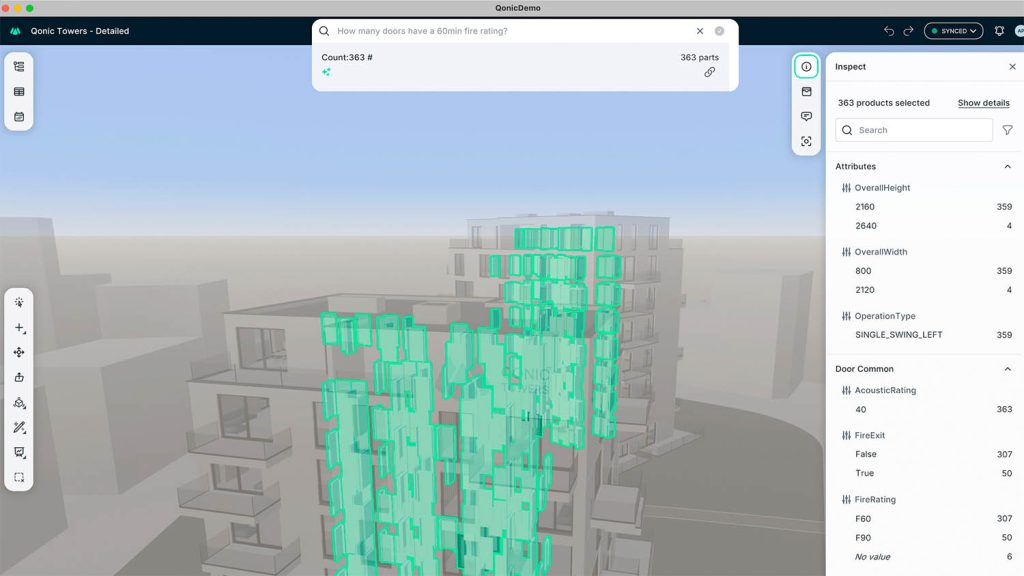
Qonic’s answer to this is that natural language interaction does not directly manipulate the model. Instead, the AI generates structured scripts that execute defined operations — querying data, applying rules, detecting clashes, or modifying parameters. This makes the logic visible, traceable, and reproducible. AI acts as a translator between human intent and structured model operations.
This transparency is essential if AI is to become part of professional workflows.
Moving beyond the PDF paradigm
The industry remains heavily focused on PDF outputs, which are static snapshots of dynamic information. This is a legacy of contractual structures, risk management, and regulatory frameworks.
But if intelligence is embedded in the model itself, the model becomes the primary source of truth. Changing this will require more than technology. It demands new procurement strategies, regulatory changes, and cultural adaptation.
If intelligence becomes embedded rather than added, BIM platforms will quietly transform from drafting environments into self-evaluating systems
The real question is not whether AI will enter BIM. It already has. The question is whether we will use it to generate images and summaries, or to fundamentally reduce friction in how buildings are designed, coordinated, and delivered.
If intelligence becomes embedded rather than added, BIM platforms will quietly transform from drafting environments into self-evaluating systems, with more reliable models, increased model density and quality, and increased confidence in quality and trust of the model for output. That may prove far more revolutionary than the visible AI tools we talk about today.
Qonic at NXT BLD
Watch Qonic’s NXT BLD 2025 presentation
Qonic will be presenting at NXT BLD 2026 in London 13-14 May