
Snaptrude has been pouring its AI investment into the conceptual and schematic design phases where architects spend the most time and legacy tools offer the least help. Martyn Day talked with CEO Altaf Ganihar to find out more
Snaptrude began life as a browser-based architectural modelling platform, the first of a handful of “BIM 2.0” challengers, alongside Arcol, Qonic and the forthcoming Motif, all built on modern codebases and aimed squarely at attacking Revit’s dominance. But when it comes to AI development, whilst several of its peers have spread their ambitions across the full BIM lifecycle, Snaptrude has made a deliberate strategic pivot: concentrating its AI investment on the conceptual and schematic phases of the architectural process, where the productivity gains are most dramatic and legacy tools are weakest.
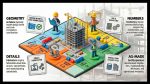
The technical foundation for this bet is what Snaptrude calls its Universal Graph Representation, which is the result of three years of R&D that treats a building not as static geometry but as an interconnected database of relationships.
The graph is abstract and element-agnostic; it doesn’t care whether a node represents a wall, a pipe or a room boundary. This allows designers to move fluidly between levels of detail (LoD) without losing context and, crucially, it gives AI agents a structured substrate to operate on.
Discover what’s new in technology for architecture, engineering and construction — read the latest edition of AEC Magazine
👉 Subscribe FREE here
Built for AI
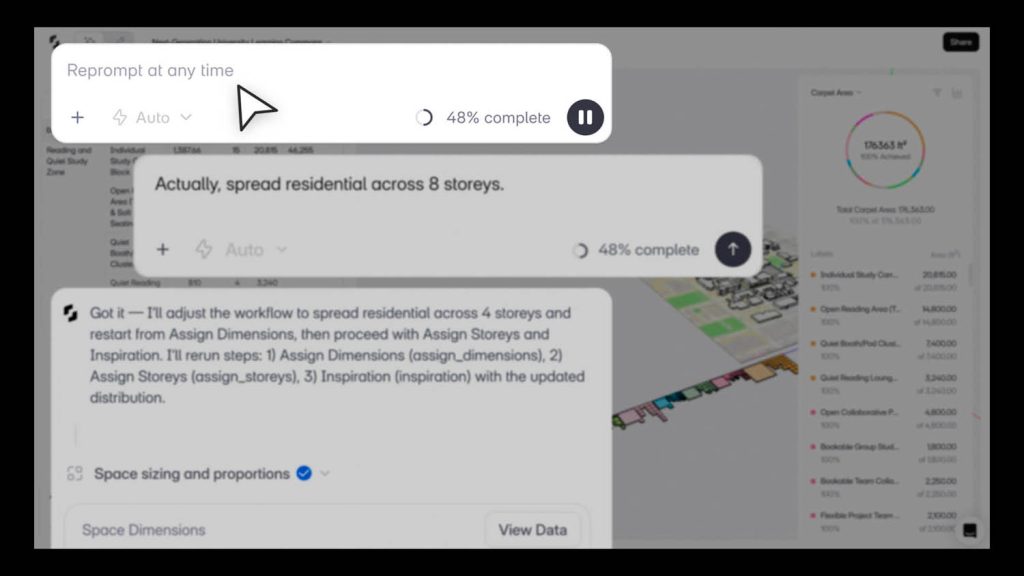
Where legacy platforms force AI to peer through what CEO Altaf Ganihar describes as a “keyhole” — seeing only one isolated file at a time — Snaptrude’s schema gives it full project visibility. That architectural difference has enabled Snaptrude to deploy a suite of modular AI agents, in clear iterative workflows, at a pace that would be impossible on a legacy codebase. Rather than attempting a single autonomous AI that architects weren’t ready for, the company shifted to providing specific “delegates” for the highest-friction tasks: healthcare programming, space planning, site analysis, zoning compliance.
According to Ganihar, customers are reporting 60–70 per cent reductions in concept design time and that average daily usage among its core customers has hit over 3 hours a day – that’s deep work sessions, not casual browsing.
“If you ask people, they’ll ask for a faster horse. They wouldn’t imagine the automobile,” says Ganihar. “We started with a vision and then iterated based on customer feedback.


“People don’t like autonomous AI models yet, so we made the agents more modular in nature, so they can use them whenever they want for specific tasks. People really love that.” Alongside the agents, sits what Snaptrude calls its Knowledge Module. This system goes beyond simple retrieval-augmented generation by connecting to a firm’s private data stores, whether Google Drive, Egnyte or soon Autodesk Construction Cloud (ACC) and Procore.
The practical result is that an architect can ask the platform to do complex tasks, like compare emergency room square footages across the firm’s last ten healthcare projects and get an evidence-based answer in seconds. It turns institutional knowledge, the kind that usually lives in the minds of senior partners, into a queryable asset.
Rather than attempting a single autonomous AI that architects weren’t ready for, the company shifted to providing specific “delegates” for the highest-friction tasks: healthcare programming, space planning, site analysis, zoning compliance
Towards “self-driving” design
The longer-term vision is more radical. Ganihar frames it as a shift from “manual driving” to “self-driving” design, where the architect acts as creative director while AI delegates handle the objective requirements, such as parking layouts, corridor dimensioning, code adherence. The platform splits work between what Ganihar calls the “subjective” layer, where LLMs interpret creative intent, and the “deterministic” layer, where parametric logic and code handle precise execution.
“Hiring an additional 50 people at the price of two people” is the ROI proposition Ganihar pitches to the Big 40 global firms, backed by SOC2 Type 2 and ISO 27001 certifications and private cloud deployment options for data-sensitive enterprises.
Embracing LOD 300–350
A major release scheduled for Spring 2026 aims to push Snaptrude’s capabilities to LOD 300–350, the point at which architects could remain within the platform through the end of schematic design and only hand off to Revit for final documentation – although Snaptrude does documentation too. If Ganihar delivers on that roadmap, Snaptrude won’t just be an AI-enhanced conceptual tool — it will be a serious contender for the early-stage workflows that Autodesk Forma was supposed to own.
Altaf Ganihar will be presenting at AEC Magazine’s NXT BLD 2026 conference in London 13-14 May.