
Speckle’s open-source data platform promises AEC users a chance to break free from proprietary lock-ins and acts as the connective tissue between multiple industry design and engineering tools. Martyn Day reports from the company’s annual meet-up
It was good timing for AEC Magazine that Speckle held its annual customer conference – SpeckleCon – at exactly the same time as we were deep-diving on data, data lakes and data lake houses. Executives at Speckle only had to wait 12 years for us to figure out that industry design data is being held captive in the wrong places and that some liberation effort is long overdue.
The company is driven by a core belief in the benefits of open-source software. Its BIM data platform is designed to move geometry, metadata and project information freely between common and uncommon software environments, including Revit, Rhino, Grasshopper, Archicad, Blender, Dynamo, QGIS, Python, and dozens more.
Speckle is a cloud-hosted environment, with plug-in connectors delivering multiple granular streams of versioned, structured data objects, not files, to its own database and visualiser.
Discover what’s new in technology for architecture, engineering and construction — read the latest edition of AEC Magazine
👉 Subscribe FREE here
But that’s just the start. Speckle has also built layers of super-useful capabilities that can be applied to this data. Once collated, teams can push, query, diff, fork and merge model data in much the same way as software engineers manage code. For computational designers, analysts and digital-delivery teams, this model-as-data approach removes the traditional bottleneck of proprietary formats and vendor-controlled interoperability.
At the SpeckleCons of the past, all presentations would be from generative and coding savvy architects/structural engineers, who had chanced upon Speckle and used the ‘Swiss Army knife’ nature of its tools to craft their own applications for design tasks. Let’s just say the crowds were very Python-savvy.
This year’s event represented a phase change, as amongst the Python-centric presentations, there were also substantially more enterprise deployments on stage, as well as design IT directors in the audience.
The secret, it seems, is out. Large firms are seeing broader benefits to Speckle as a corporate-wide tool to solve all sorts of problems and enable capabilities that were simply not possible using current technologies from traditional vendors. I think this is partly due to maturity and word-of-mouth, but also the development at Speckle of additional high-level capabilities. These offer the company more of a commercial opportunity than simply looking to support their development via hosting fees.
Virginia Senf is a newcomer to the Speckle team, joining as head of growth from Autodesk, where she was director of data strategy. Dimitrie Stefanescu remains as CEO and founder (after all, it was his PhD research that got the company started in the first place), but his co-founder Matteo Cominetti stepped down this summer.
Senf provides the drive to ‘productisation’ and commercialisation that was perhaps not obvious in the company’s previous, hacker-like mentality. Having customers such as Gensler and Suffolk Construction on stage was testament to the value that large firms are finding in Speckle.
For most of its existence Speckle looked like a handy ‘interoperability wiring loom’ to connect different applications through its own model definition. Today, it’s very clearly a data platform and an independent environment in which customers can actually do something useful with project data. This provides Speckle with the opportunity to develop application layers and capabilities for customers who have chosen to build a ‘shadow’ BIM data strategy. There has also been a lot of engineering work under the hood to get the platform to reach enterprise-ready status, such as support for SOC 2.
New features
Stefanescu demonstrated new capabilities, including 2D mark-ups on 3D views and support for embedding 3D models in Miro for whiteboarding and presentations.
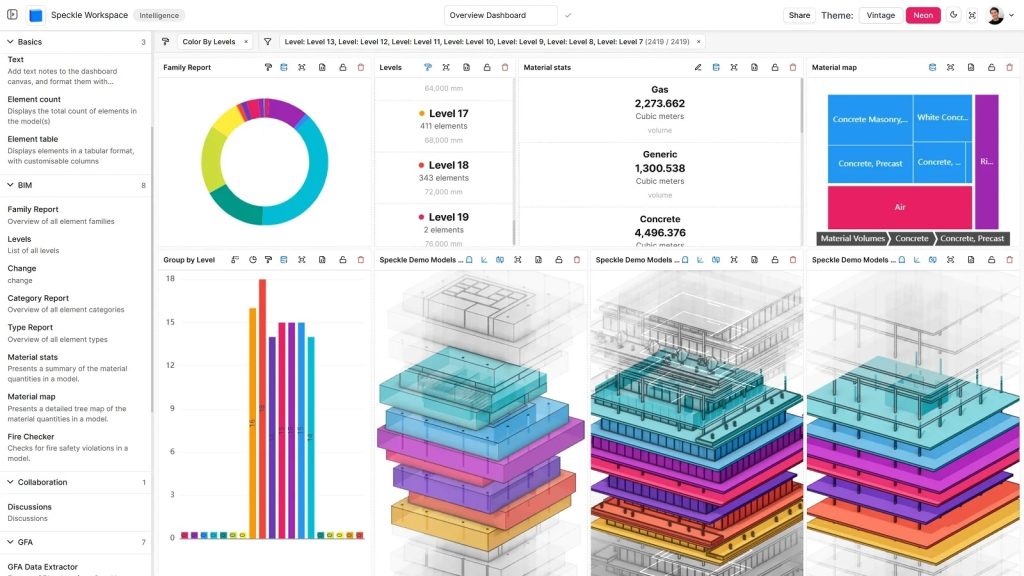
The biggest development, however, is Speckle Intelligence. This is a serious attempt to aggregate the sprawl of siloed BIM data into decision-ready project information. While the company frames the offering around five principles – visibility, versioning, versatility, validation and velocity – the underlying ambition is simpler. It’s to collapse the lag between a design change and a business decision.
Visibility exposes the basics that most teams currently struggle to see: what’s in the model, how many elements exist, how naming conventions diverge and where key KPIs sit, for example.
Versioning adds the temporal dimension, surfacing exactly what’s changed between iterations and, more importantly, why it matters to a programme, its cost or its compliance.
Versatility is its ability to extract insights from Revit, Rhino, Tekla, IFC and Autodesk Construction Cloud (ACC) with equal weight. That breadth matters, because firms increasingly operate multi-tool workflows and traditional analytics pipelines tend to collapse under inconsistent schemas.
Validation means models can be checked against project requirements or firm-wide baselines without the need to export them to secondary tools. It positions Speckle less as a transport layer and more as a governance layer.
It could be that Speckle has somewhat ‘crossed the chasm’ from being an expert user’s weapon of choice via a single seat subscription to becoming a layer of technology to which design teams can connect and share design information throughout a company
Velocity ties the system together. Insights can be consumed through Speckle dashboards or streamed outward to enterprise data stacks such as Snowflake, Databricks or Fabric, where firms increasingly consolidate cost, carbon and performance metrics. This closes the loop. Models become measurable, differences become explainable and decisions become defensible.
Speckle Intelligence integrates, then aggregates, and then offers PowerBI functions across all this federated data like dashboards. It comes with a whole host of industry related templates ready to go, simplifying the whole interrogation of project information without a Python script in sight. It’s possible to track modifications between model versions and validate models against standards. It’s a bit like ACC, plus Solibri plus Navisworks – but in one open-source, modern, easy-to-deploy solution.
SpeckleCon speakers
For a one-day event, Speckle brought together an impressive range of speakers from around the world, representing firms including Stantec, Herzog & de Meuron, HENN, Royal Haskoning, Suffolk Construction and Gensler. We expect that, as in previous years, these talks will be made available online and their availability posted on LinkedIn.
Topics covered were hugely varied, but all focussed on Speckle as a data aggregator that enables firms to develop and run their own applications, whether they be running bespoke Python code or iterative workflows through disparate applications, or providing a central tool for all project teams to visualise big data and extract business metrics.
At the end of the day, I hosted a panel discussion with Suffolk’s Murat Melek, Herzog & de Meuron’s Michael Drobnik, and Gensler’s Vignesh Kaushik. The baseline takeaway was that all of these firms are adopting data-centric mindsets. While authoring tools are still important to these firms, they are also the cause of some of the chaos involved in getting access to data, which is where the real value to their businesses resides. All firms need strategies on how they procure and analyse their company’s intellectual property.
As design director for Asia Pacific at Gensler, Vignesh Kaushik started his Speckle journey during Covid, using his own credit card to try out the technology. Impressed with its performance, he built out multiple uses for Speckle within Gensler, integrating the technology with the firm’s own applications and building on top.
I could see how this probably drove the development of BI dashboard capabilities. As a side note, I did ask Kaushik what’s the biggest problem he currently faces, and he responded, unprompted, that it’s EULAs (end user licensing agreements) and their data-grabbing terms. Being in charge of so many users, some unapproved installs can still creep in under the radar.
Suffolk, meanwhile, is a very unusual construction firm, in that while it uses all the standard digital tools, it also has a dedicated arm called Suffolk Technologies that tests and invests in interesting start-ups. The thinking here is focused on Suffolk solving its own problems, rather than waiting for help from the main vendors.
Dimitrie Stefanescu, CEO and founder, spoke at NXT BLD 2025.
Watch the full presentation here
Because pre-construction is completely disconnected from its model, the goal at Suffolk is to tap into source data directly, in order to get it into the data lake early. Speckle enables the firm to automate the process of getting that data in, which is crucial, because different architects use different software, descriptions and materials.
Once inside, AI algorithms decide the closest matching code based on the Speckle data, allowing the firm to programmatically move information to its estimation system. In some respects, Speckle is acting as middleware here – a harmonisation layer before important business automations get run.
It’s perhaps fitting that Switzerland-based Herzog & de Meuron uses Speckle like a Swiss Army knife. Drobnik, the company’s lead design technologies associate, explained the firm’s multiple uses of Speckle. This long list includes data collation for authoring tools, comparing iterations, standardising data, building in-house applications and storing and sharing assembly libraries. Herzog & de Meuron also uses Speckle to create dashboards, automate pipelines and act as a platform for running its CALC LCA tools. The firm has had a long-term engagement with Speckle and has always been liberal-minded, in that it needs an independent data platform to glue many data workflows together. And with AI and in-house training, said Drobnik, demand for quality data is rising.
Same but different
SpeckleCon 2025 was a case of ‘the same, but different’, in comparison to previous years. The product champions who made up the audience of prior events were joined by more BIM managers and global IT directors, both on stage and in the audience.
It could be that Speckle has somewhat ‘crossed the chasm’ from being an expert user’s weapon of choice via a single seat subscription to becoming a layer of technology to which design teams can connect and share design information throughout a company. I suspect the turnkey BI/dashboarding will win over even more fans as the movement to host all project data internally builds pace.
There was a lot of talk about how broken the federated BIM world is and how data just doesn’t flow well between design and construction. The important takeaway is that mature BIM firms want 3D, because what they can do with it is highly valuable. The whole 2D drawing/documentation approach only amplifies the duplication of effort to which the current standard workflow is glued. Speckle is making the right moves to connect up both internal functions and wider project teams.
Main image: Speckle Intelligence is designed to aggregate the sprawl of siloed BIM data into decision-ready project information