
Dell Pro Max with GB10 and GB300 are powered by Nvidia Grace Blackwell processors
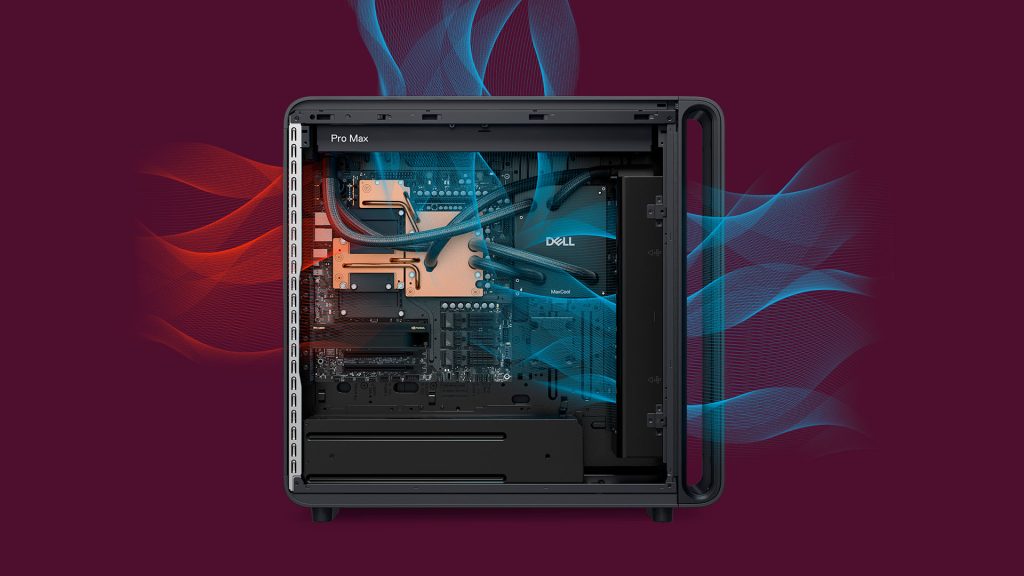
Dell has launched the Dell Pro Max with GB10 and GB300, a pair of purpose-built desktop ‘supercomputers’ designed to enable enterprises to build and run autonomous, self-evolving agents.
The machines are powered by Nvidia Grace Blackwell, an AI-optimised chip that combines an Arm-based Grace CPU and Blackwell GPU, and support Nvidia’s emerging agent ecosystem. This includes NemoClaw, an open-source stack that simplifies running OpenClaw always-on assistants, and OpenShell, an open-source runtime designed to provide a secure environment for running autonomous agents, and models like Nvidia Nemotron.
Learn more about AI Agents in AEC in this AEC Magazine article

The move builds on the rapid rise of autonomous AI agents — systems capable of executing complex, multi-step workflows with minimal human intervention.
Momentum accelerated earlier this year with the release of OpenClaw, which quickly gained traction among developers for its ability to write code, orchestrate sub-agents and interact with professional tools.
But while the potential is clear, so too are the risks. Autonomous agents require deep access to data and tools, raising concerns around security, governance and control — particularly in enterprise environments.
This is where Nvidia OpenShell comes in. According to Dell, OpenShell addreses such concerns by providing an infrastructure layer that runs any coding agent in its isolated sandbox with zero code changes. Agents start with zero permissions, inference stays private by default, and every action is policy-enforced at the infrastructure layer.
At the high end, the Dell Pro Max with GB300 is said to the first OEM desktop to feature the Nvidia Grace Blackwell Ultra Desktop Superchip. Delivering up to 20 petaFLOPS of FP4 AI performance and and 748 GB of unified memory, it is designed to bring datacentre-class capability directly to the desktop.
This level of performance is said to enable trillion-parameter-scale models to run locally, reducing reliance on cloud services while improving response times, data privacy and operational resilience — even when offline.