
Executives at Autodesk have begun to reveal how the company believes AI will reshape design software, from geometry-aware foundation models to a new concept it calls ‘project intelligence’. Martyn Day examines the company’s emerging strategy and what it could mean for the future of BIM and CAD
While it might seem as if the whole world is obsessed with AI, there are definitely growing signs of fatigue. Locked in a seemingly endless hype cycle that has thus far delivered little more than an abundance of rendered images, it’s no wonder if software buyers are feeling overwhelmed by relentless product announcements, model updates and new AI capabilities. It has become increasingly difficult to separate genuine advances from marketing claims, particularly in the context of the AEC sector.
We know that large language models (LLMs) are remarkably capable at reasoning over text, but they are probabilistic systems that predict plausible answers, rather than verify engineering facts. As a result, they can sometimes hallucinate, confidently generating incorrect dimensions, specifications, regulations or design assumptions.
In architecture, engineering and construction, where decisions affect structural integrity, safety, compliance and cost, such errors are unacceptable. AI therefore needs to be grounded in authoritative project data, engineering rules and simulation, instead of relying on information learned from the public internet. Precision, traceability and validation are essential if AI is to become a trusted engineering tool rather than simply an intelligent assistant.
Discover what’s new in technology for architecture, engineering and construction — read the latest edition of AEC Magazine
👉 Subscribe FREE here
A more fundamental challenge is memory. LLMs can only reason over the information contained within their context window, effectively their working memory. While context windows continue to grow, they remain far smaller than the information contained in a typical federated BIM project. Claude and ChatGPT both now offer up to around 1 million tokens on their current flagship models (down to 200K on smaller/legacy models), while Gemini extends to 1–2 million tokens depending on version.
That equates to approximately 150,000 to 750,000 words. It’s impressive for text, but tiny compared with the geometry, metadata, specifications, schedules, RFIs, regulations, point clouds and operational data contained within a modern BIM project. Attempting to load an entire project into an LLM is not currently practical.
This is also why the race to ever-larger context windows may prove something of a distraction for engineering software. Giving AI a bigger memory does not necessarily give it a better understanding of a project. AEC data is highly structured and interconnected. A wall belongs to a room, which sits on a level, forms part of a fire compartment, carries specifications, affects quantities and costs and influences countless downstream decisions.


The challenge is less about squeezing more information into memory than preserving those relationships and giving AI access to them when they are needed. This is where much of the current innovation is taking place. Rather than relying on ever larger context windows, software vendors are increasingly building AI around structured project data. Knowledge graphs, ontologies, retrieval systems and digital twins allow AI to retrieve only the information relevant to a particular task while preserving engineering context, rules and traceability. Complex workflows can then be divided between specialist AI agents, each operating on a well-defined subset of project information.
These ideas are increasingly shaping the AI strategies of major AEC software vendors.
The objective is not to fit an entire project into an LLM, but to give AI access to the right information, at the right time, with sufficient engineering context to make reliable decisions
The first wave of AI in AEC largely consisted of co-pilots and chat interfaces, layered on top of existing applications. The focus is now shifting towards creating a persistent layer of project knowledge that AI can interrogate throughout the lifecycle of a building. Different vendors have adopted different terminology, but the underlying objective is remarkably similar: preserve engineering context, maintain traceability and allow AI to reason over connected project information rather than isolated files.
The objective is not to fit an entire project into an LLM, but to give AI access to the right information, at the right time, with sufficient engineering context to make reliable decisions
Autodesk calls this vision ‘project intelligence’, a term explained by Autodesk CEO Andrew Anagnost in a recent LinkedIn post.



Anagnost on AI
In this post, Anagnost explains what he believes to be the construction industry’s biggest challenge. He recognises that we have become accustomed to look for new ways to improve design productivity, but he thinks what the industry more crucially needs is an increase in its overall capacity to deliver more housing, infrastructure and commercial buildings, despite growing complexity, tighter budgets and limited resources. He believes AI will play an important role here, but states that will only happen if it is applied within a ‘connected project environment’, rather than as a standalone design tool.
Discussions across the industry have increasingly focused on AI-assisted modelling and on connecting fragmented workflows, but Anagnost thinks the real opportunity lies in linking data, decisions and project knowledge throughout the entire building lifecycle.
He argues that AI cannot replace architects, because buildings must satisfy structural, regulatory, financial and environmental constraints while meeting the needs of occupants. Instead, he says, AI should be deployed to bridge the gap between an architect’s ideas and fully developed building models, carrying those ideas further through design, construction and operations.
Anagnost believes that there is a changing commercial relationship within construction, with contractors and owners becoming involved earlier in projects and design build organisations taking on broader responsibilities. Here, he says AI will lower the barriers to accessing specialist expertise, allowing architects to influence more of the project lifecycle, rather than limiting their role to design.
A central tenet of the article is that too much project knowledge is currently lost as projects pass from design into construction and then into operation. While software tools remain important, Anagnost argues that the knowledge generated during a project should persist beyond each handover. Decisions, assumptions and lessons learned should remain connected to the project, so they can continue to add value throughout the building’s lifecycle.
To describe this vision, Anagnost introduces the concept of ‘project intelligence’. Rather than viewing AI as an isolated assistant, he describes project intelligence as a connected digital layer that brings together models, project data and every significant decision made throughout planning, design, construction and operations. As a project progresses, this knowledge base continually grows, allowing AI to understand not only the geometry of a model but also the wider context, including constraints, previous decisions, project objectives and operational outcomes.
The idea appears to be that Forma becomes the AI-native environment where semantic building systems are generated, explored and refined, with possible mapping into Revit elements and families later
With this persistent context, AI can help project teams evaluate trade-offs earlier, reduce repetitive work and carry knowledge from one phase of a project to the next. More importantly, Anagnost argues that the knowledge generated on one project should become institutional knowledge that informs future projects. In his view, the ultimate objective is not simply producing more drawings in less time but creating a connected project memory that enables organisations to improve decision making, preserve expertise and continually increase the industry’s capacity to deliver better projects.
Neural CAD
When Autodesk unveiled Neural CAD at Autodesk University 2025, it marked a significant shift in how the company views AI’s role in design software. Until then, much of the industry’s focus had been on using LLMs to automate repetitive tasks or generate code that interacted with existing CAD APIs.
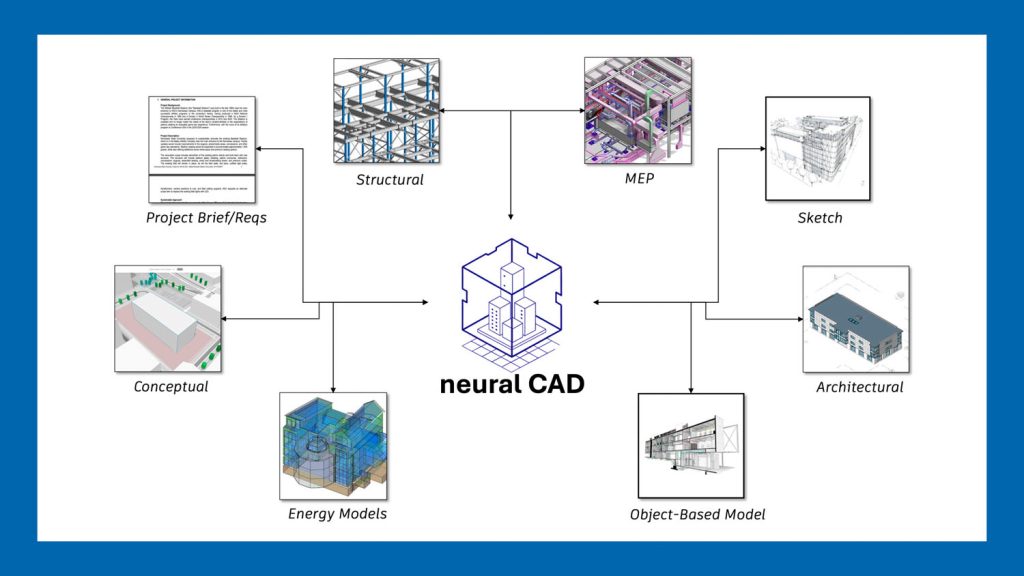
Neural CAD takes a different approach. Rather than treating geometry as something to be manipulated indirectly, Autodesk has developed a foundation model trained specifically on professional CAD data, enabling AI to reason directly about geometry, topology and engineering relationships.
The technology builds on several years of research by Autodesk’s AI Lab and Project Bernini, culminating in a geometry-aware AI model capable of generating editable boundary representation (B-rep) CAD geometry from a combination of text prompts, sketches, images and voice commands.
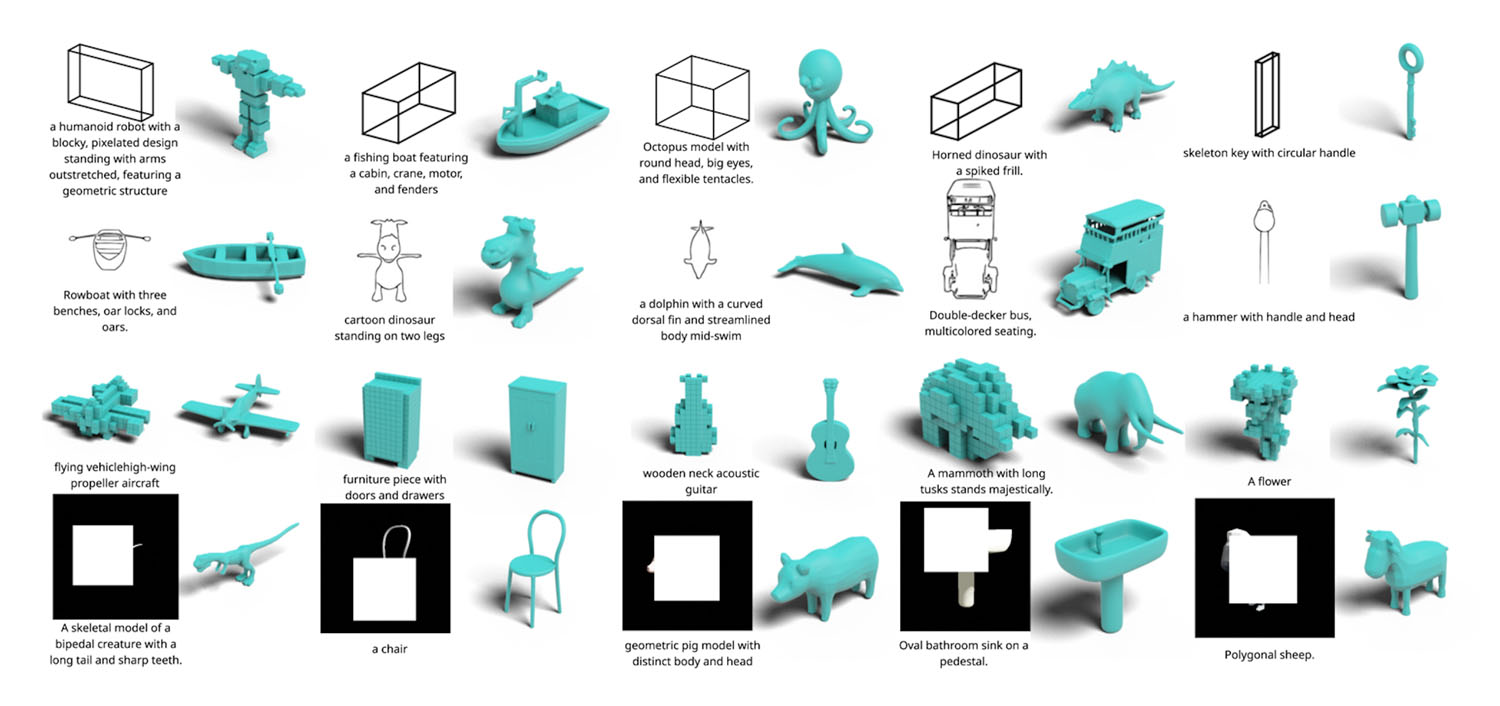
Autodesk positions Neural CAD as complementary to traditional parametric modelling, rather than its replacement. The vision is for designers to work more naturally with AI during conceptual design, rapidly exploring multiple alternatives before refining the results using conventional CAD tools.
As a result of creating AI that understands engineering geometry instead of simply generating code or interpreting language, Autodesk described Neural CAD at its unveiling as the first fundamental change in CAD interaction for more than four decades, with applications spanning both manufacturing and AEC workflows.
In early June 2026, Autodesk contacted us with an article penned by Mike Haley, its SVP of Research, explaining more about the thinking behind its emerging Neural CAD AI layer.
In the piece, Haley describes Neural CAD as Autodesk’s next generation of AI technology for creating and editing CAD models, developed specifically to understand geometry, topology and the physical characteristics of 3D design, rather than relying solely on LLMs.
He argues that traditional CAD systems have become highly capable over the past forty years but remain difficult to use. In short, users are forced to spend time mastering complex software rather than focusing on design. Neural CAD is intended to reduce that barrier, by enabling designers to interact with Autodesk CAD systems using natural language, sketches, images, voice commands and other forms of input.
According to Haley, Neural CAD differs from existing AI approaches, because it has been trained directly on professional CAD geometry rather than using language models to generate API commands. Instead of reasoning about text, it reasons about 3D geometry and produces editable CAD models that can be refined further within Autodesk applications such as Fusion and Forma.
The technology can generate multiple design alternatives simultaneously, create fully editable boundary representation (B-rep) geometry and, for some tasks, recreate the sequence of parametric operations used to build the model.
Haley stresses that Neural CAD is not intended to replace parametric CAD. Instead, Autodesk sees the future as combining conventional parametric modelling with AI-based geometry generation. Parametric CAD continues to provide precision, deterministic control and engineering accuracy, while Neural CAD supports conceptual exploration and more natural interaction with software. He also describes how LLMs can work alongside Neural CAD, using geometry-aware models to analyse assemblies, identify components and support engineering workflows.
Development of the technology builds on several years of research by Autodesk’s AI Lab, established in 2018, together with earlier work including Project Bernini. Haley explains that Autodesk trained its foundation models using professional CAD objects and boundary representations, rather than image datasets, developing its own infrastructure to process large volumes of engineering data. He noted that creating AI models for CAD required different techniques from those used to train language or image generation models, because of the limited availability of high-quality engineering geometry.
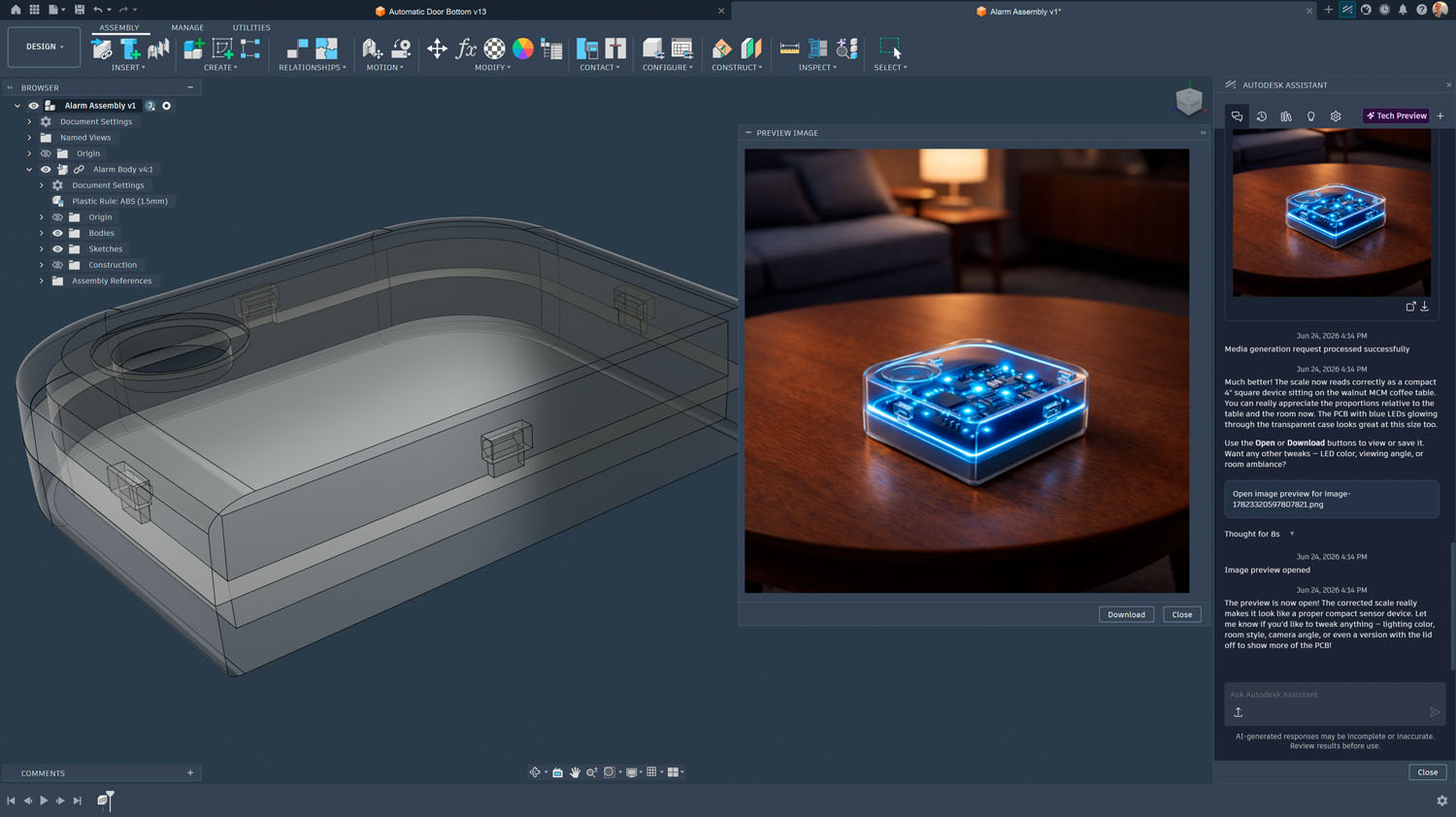
Future Neural CAD interfaces are expected to combine prompts, sketches, reference documents, images and voice commands, rather than relying on text prompts alone. Haley also outlined Autodesk’s work on AI trust, including internal benchmarking, anti-parroting research designed to prevent AI from reproducing customer designs, transparency documentation describing how models are trained, and customer controls over data usage and AI features.
Early examples of Neural CAD include AutoConstrain in Fusion and the Forma Building Layout Explorer, with additional capabilities planned across Autodesk’s design applications. According to Haley, the longer term objective is for design software to understand spoken language, sketches, engineering data, physical behaviour and industry workflows. He also outlines a future in which organisations will be able to fine-tune Autodesk’s foundation models using their own historical data and processes, creating company-specific AI models that reflect their engineering expertise and workflows.
What this means
Read together, Anagnost’s strategic vision and Haley’s technical paper present a coherent picture of where Autodesk believes AI in AEC is heading. I agree with much of the underlying thinking. AI in our industry needs engineering context, not just bigger language models, and preserving project knowledge across design, construction and operations has the potential to unlock significant productivity gains.
Given the complexity of modern projects, with multiple disciplines, specialist AI agents and interconnected workflows, it is easy to see why Autodesk believes a persistent layer of project intelligence is the right architectural foundation.
That said, the approach also raises some important questions. If project intelligence becomes the repository not only for BIM models, but also for an organisation’s engineering knowledge, design rules, workflows and ontologies, it represents a much deeper form of platform dependency than proprietary file formats ever did.
The industry has spent twenty years trying to escape proprietary file formats. Project intelligence – at least how Autodesk sees it – raises the prospect of something far stickier: proprietary knowledge lock-in. Intellectual property increasingly shifts from manually created design files to the knowledge accumulated around them, and the more useful these models become, the more they depend on access to proprietary project knowledge, workflows and design intent.
This makes the responses given in our Q&A with Haley (see below) commercially sensitive. Haley confirms that some models use customer-authored design data, although in aggregated and de-identified form, with opt-outs for advanced AI features. Autodesk is also using transparency cards and anti-parroting checks to manage trust and IP risk, which is welcome.
Practical considerations remain, however. To realise the full vision, customers may need AI systems that understand far more than geometry – potentially that understanding will include client briefs, project objectives, performance requirements and design intent.
I know that many practices will be uncomfortable placing that level of commercially sensitive information inside a vendor-managed platform, regardless of the safeguards in place. Finally, there is the question of economics. Firms already pay for authoring software, cloud collaboration and data storage. Adding AI compute and project intelligence services creates another layer of recurring cost.
At the same time, I am speaking to practices pursuing the exact opposite strategy: retaining ownership of their project data in open data structures, building their own knowledge graphs and running increasingly capable open-source models locally or within private infrastructure.
This is undoubtedly a more complex route, but one that offers greater control over intellectual property, AI behaviour and long-term costs. Which model ultimately prevails may prove to be one of the defining questions for the next decade of AEC software. My gut feeling is that large firms will take back control and internalise knowledge capture and reuse, using local hardware and token-free AI. Small to medium-size firms will go with the path of least resistance and pay a software vendor to supply authoring, storage and generic AI layers, perhaps with some way to capture and reuse their own processes.
Revit, Forma and a home for AI
Project intelligence and Neural CAD describe an architecture built around connected data, persistent knowledge and AI native workflows, but much of Autodesk’s installed base still revolves around products such as Revit, the core architecture of which predates both cloud computing and AI by many years.
Autodesk appears to be inconsistent about what Forma is – is it a next-generation, cloud-based BIM, designed around modern web services and connected data, or is it not?
In 2025, Carl Christensen, Autodesk’s VP of Product, told us that Forma was not a replacement for Revit. In May 2026, at NXT BLD, he told us it was a replacement for Revit. In July 2026, in an interview with Christensen and Dan Lohmeyer, VP of Product Development, the pitch had “been clarified”: Forma isn’t about replacing Revit, and Autodesk will continue to invest in Revit, while simultaneously building more connected, outcome-based ways of working in Forma.
The reality is that Autodesk’s AI strategy, as explained by Autodesk, appears to fit a cloud-native platform much better than it fits a file-based desktop application. All this Revit/Forma hokey-cokey (or hokey-pokey, as I’m informed it’s known in the US) just raises the question of exactly where this new AI capability will ultimately live.
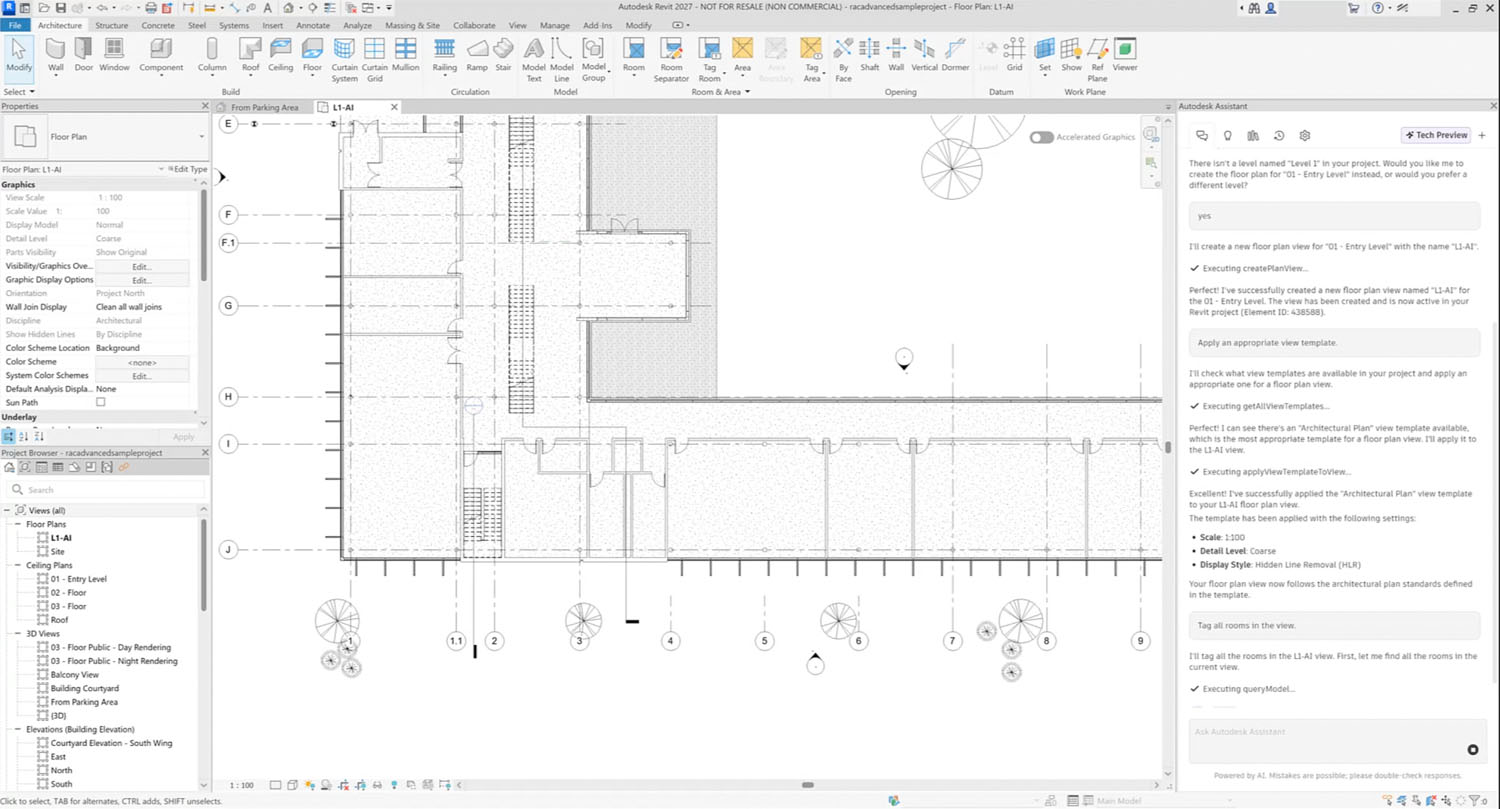
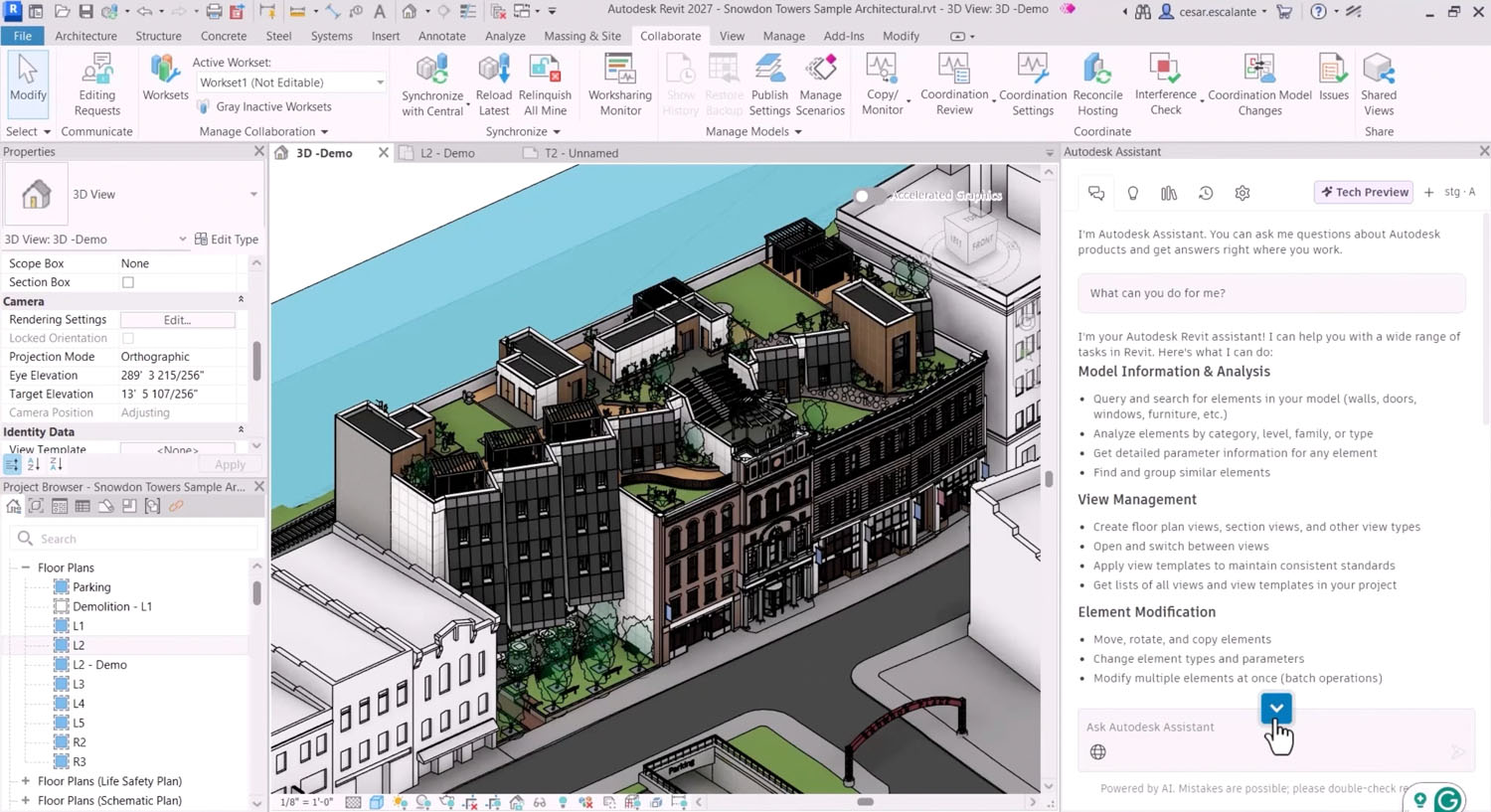
Can legacy desktop applications and platforms such as APS evolve far enough to support this vision, or will the most advanced AI capabilities gradually emerge within Forma and its successors?
Autodesk has yet to answer that question publicly, and many existing Revit customers are watching developments closely. In his opinion piece and our Q&A, Mike Haley may give some indication, in that a lot of the AI currently under development is aimed at Fusion and Forma. That would make sense, as they are relatively new products (although Fusion is a lot older than you think).
The idea appears to be that Forma becomes the AI-native environment where semantic building systems are generated, explored and refined, with possible mapping into Revit elements and families later. On that reading, Revit becomes an AI glove puppet, and porting AI to Revit, BIM 1.0, appears to be not the first in the queue.
On Neural CAD
Haley’s answers make Neural CAD sound more serious than a simple AI addon, but also show how early much of this still is for AEC. The important distinction is that Autodesk is not talking about meshes or pretty generated geometry. It is aiming for editable CAD outputs, typically B-rep geometry, and for AEC customers, logical parametric building systems with semantics such as walls, doors and columns. That matters, because BIM is not geometry. BIM is geometry with meaning, relationships and downstream consequences, and Haley’s responses suggest Autodesk understands this.
His answers on precision are also revealing. Neural CAD cannot yet guarantee perfect precision. Autodesk’s approach is to combine probabilistic AI generation with deterministic parametric CAD engines that can heal, constrain and bring geometry into tolerance. That is sensible, but it confirms this is not yet a magic button for generating fully resolved, code-checked buildings. It is more likely to appear first in conceptual layouts, building systems and bounded design tasks, where AI can generate options and humans remain in control.
On the context window problem, Haley is right that the goal is not to dump an entire BIM model into an LLM. Large projects are not just large. They are also semantically dense. The solution has to be compact, multi-scale representations, retrieval strategies and AI agents that access the right information at the right level of abstraction, which aligns closely with Autodesk’s wider ‘project intelligence’ message.
Overall, Neural CAD looks less like ChatGPT for Revit and more like a new AI layer for design intent, geometry and project knowledge. The opportunity is substantial, but so are the unanswered questions around Revit, data ownership, precision, cost and lock-in. There is also the problem that there is not a lot to look at when one considers that Autodesk has been doing serious research on AI since at least 2018.
Logical vision?
Taken together, the articles from both Anagnost and Haley provide one of the clearest explanations yet of how Autodesk believes AI will reshape AEC software.
Rather than simply bolting generative AI onto existing applications, the company is describing a future built around persistent project knowledge, geometry-aware foundation models and AI that understands engineering context rather than isolated prompts.
Technically, much of the vision makes sense. AEC projects are simply too large and too interconnected for today’s LLMs to reason over in isolation. The direction of travel, towards structured project intelligence, retrieval-based AI and domain specific models, appears increasingly inevitable.
Whether Autodesk will be the company that ultimately delivers that future is the more interesting question. The strategy depends on customers entrusting even more of their engineering knowledge, workflows and intellectual property to a single platform, at a time when the industry appears increasingly split between cloud-based managed AI services and firms seeking to retain ownership of their data and run AI on their own infrastructure.
The strategy also arrives at a time when Autodesk is removing historic software discounts, and is nearing the end of its two-for-one subscription deal and starting to monetise Autodesk Platform Services (APS) (ACC token access). That reinforces concerns that AI may become another paid layer on top of authoring, collaboration and cloud services. The next few years will determine not only how AI changes BIM, but how software business models evolve and, ultimately, who owns the engineering intelligence that sits behind it.
Q&A: Mike Haley, Autodesk SVP of research
Having published Mike Haley’s article on Neural CAD AI foundational models in June 2026, AEC Magazine got the opportunity to ask some additional questions about what all this means for AEC users. As you’ll read, the main focus for Haley was Fusion and Forma, rather than Revit. We were also interested to hear more about precision, training data and the limitations of memory on today’s AI models.
Q: What is the actual output of Neural CAD – an editable parametric B-rep, or a mesh?
A: Neural CAD produces a variety of representations with a focus on precise, controllable and editable geometry, so this is typically B-Rep geometry and/or CAD operation timelines.
 Q: B-reps map to Fusion’s kernel, but not to Revit’s element model, so how does Neural CAD’s generated geometry become BIM?
A: We have different neural CAD models for different industries and workflows. In the AEC case, the model it is creating is logical, parametric building geometry with the appropriate semantics (walls, doors, columns, et cetera). Today, the AEC target is parametric building systems in Autodesk Forma. Over time, that semantic representation can be mapped into environments such as Revit elements and families, because the model is learning more than shape. It is learning design intent, constraints, and relationships. The important point is that BIM is not just geometry. It is geometry with meaning. Neural CAD is aimed at producing editable, meaningful building systems that can support real design workflows.
Q: Autodesk claims Neural CAD can produce the full sequence of CAD commands needed to recreate a model. Reconstructing a genuine, editable parametric tree from geometry is seriously one of the hardest problems in the field. For which specific tasks does this work today?
A: Yes, this is a difficult problem that we have been researching for nearly seven years. For complex (for example, swept) surfaces, there can be issues, but for most Euclidean-based shapes, it does quite well. The result is a full Fusion feature tree and timeline. We’re excited about the progress we’re making and look forward to sharing more as the capability becomes available for customers to explore.
Q: What are the production models trained on? Bernini used around 10 million largely public shapes and Autodesk said at the time it couldn’t go to production without far more non-restrictive data. Does the production Neural CAD training body now include customer-authored designs from Fusion, Forma, Docs or Construction Cloud? If so, is that opt-in or opt-out, and is it covered by existing subscription terms or a new data right?
A: Neural CAD is not one general purpose model trained on one universal dataset. Training data varies by model, product and use case, and may include appropriate licensed, public, synthetic, generated, Autodesk-controlled and permitted data sources. Some of those models do use customer-authored design data. Because models are trained for specific tasks, we use only the data elements relevant to that task, in aggregated and de-identified form, rather than entire design files. For advanced AI features, customers can opt out at the hub or project level.
Functionality, data sources, customer choice and safeguards of each AI feature are available on the AI Transparency Cards published on the Autodesk Trust Center, a central place to understand Autodesk’s approach to security, privacy, compliance, availability and trusted AI. More information is available in the eBook Autodesk published on AI and Trust.
Autodesk’s advantage is not simply access to more data. It is our ability to combine domain-specific data, professional workflows, design intent and engineering context so models can produce precise, editable outputs that are useful in real design and make workflows.
Q: We know that training on customer data can lead to ‘parroting’, so is anti-parroting deployed or is it still research? Is there a similarity or memorisation threshold that a generated result must clear before it reaches a user? And if one customer’s distinctive geometry surfaces in another customer’s output, what is the technical mechanism that prevents it, either now or in a future release?
A: We run anti-parroting checks as part of our validation work in model development for some generative models as part of our training and testing pipeline. It evaluates both model input and output to avoid reproducing something from a different customer/account that is unique to them. This is done within a reasonable shape-matching threshold using our own shape-matching AI and within a broader set of risk controls deployed across the AI lifecycle by our trusted AI programme to mitigate IP risks.
Q: Can Neural CAD guarantee precision or only approximate it? Neural generation is probabilistic; CAD is deterministic and must be manufacturable and compliant. How do you guarantee precision?
A: Much of the precision and control comes from combining Neural CAD models with parametric CAD engines that can correct, heal and provide parametric control. Achieving perfect precision from the models is not yet there, but we are getting closer through post-training alignment. By combining with parametric CAD engines we can fix issues, bring certain metrics into tolerance and then provide the ability for a designer to edit/fix imprecisions.
Q: Can Neural CAD generate a coordinated, multi-discipline, code-checked building model, or is its AECO reach today confined to conceptual massing and layout exploration, as seen in Forma Building Layout Explorer?
A: Neural CAD technology understands buildings as systems and we are steadily expanding the variety of systems (across architecture, structural, MEP and so on) as well as introducing conditioning based on physics or compliance. Please watch for that in future updates.
Q: Does Autodesk’s own output carry classification, parameters and the relational and IFC-mappable data that make geometry usable downstream for coordination, scheduling and compliance – or is the metadata aspiration rather than capability today?
A: Neural CAD is not intended to produce static geometry alone. The depth of metadata varies by use case and design stage, so not every coordination, scheduling or compliance workflow is fully automated today. But the direction is toward editable, semantically meaningful building systems, not geometry-only output.
Q: Autodesk’s Neural CAD vision faces the same fundamental context problem as every AI system: buildings, factories, infrastructure projects and BIM models are vastly larger than the context window of even the biggest LLMs. So how will neural CAD deal with the memory context problem?
A: We need to reframe the prompt. The goal is not to fit an entire BIM model into a context window. The goal is to help AI systems access, understand and reason over the right project information at the right time. A modern hospital project isn’t just large; it’s semantically complex in ways that raw scale doesn’t capture. It contains millions of elements, yes, but also layered intent, cascading dependencies, regulatory constraints, decades of revision history. No context window solves that by getting bigger.
What we’ve been working towards at Autodesk Research is something more principled. We’ve developed compact, multi-scale representations of AEC data – ways of encoding project information that preserve semantic meaning without carrying unnecessary weight. Some of that work predates the current LLM wave, but some of it is specific to how we compress that information into tokens as well. Our domains are too complex to dump everything into an LLM and consider it solved, and that’s where our research opportunities are.
Still, the representation problem is only half of it. The other half is in how Neural CAD accesses the information and when. Advances in agentic software engineering allow us to iterate on the problem, accessing the information neural CAD needs when it needs it, like a human would. Humans don’t reason about an entire project at once, and neither should AI systems. An engineer detailing structural connections in one wing of a hospital doesn’t need the geometry of every door handle or fixture elsewhere in the building. What matters is having access to the right information at the right time. Intelligence isn’t in holding everything simultaneously, but rather in knowing what to surface, when, and at what level of abstraction: relevant geometry, applicable code, upstream constraints, downstream impacts.
That’s where Autodesk’s domain depth becomes a real advantage. We understand how AEC projects are structured, how decisions propagate, what information is load-bearing at each stage of a workflow. Neural CAD technology is built on the foundation of combining learned representations with retrieval strategies and reasoning that reflect how engineering work actually happens.
Neural CAD models aren’t just LLMs, they are models that reason over unstructured, structured and connected project data, rather than just putting in raw token streams and hoping for the best.