
Collaboration aims to ensure greater data interoperability across the entire lifecycle for the UK’s complex estates
nima (formerly the UK BIM Alliance) and the Digital Operations Working Group (DOWG) have announced a collaboration aimed at fixing the structural misalignment in how built environment data is captured, handed over, and managed.
The collaboration is said to mark a critical shift from traditional “project-biased” delivery toward an “operations-led” digital economy.
According to nima, the operations phase accounts for at least 70% of a building’s whole-life costs and it is in this phase that safety, carbon performance, and user experience are either realised or eroded.
The collaboration aims to shift the focus from “Construction Project” data to “Operations-led” data to help ensure the industry collects and manages only the data needed for the operational activity necessary to deliver real, measurable outcomes for asset owners.
Central to the collaboration is the deployment of “Right-to-Left” thinking, a methodology that mandates that successful digital operations and smart buildings must start with the asset owner’s desired outcomes and the operator’s requirements, rather than simply accepting the data the contractor has available at the end of the project.
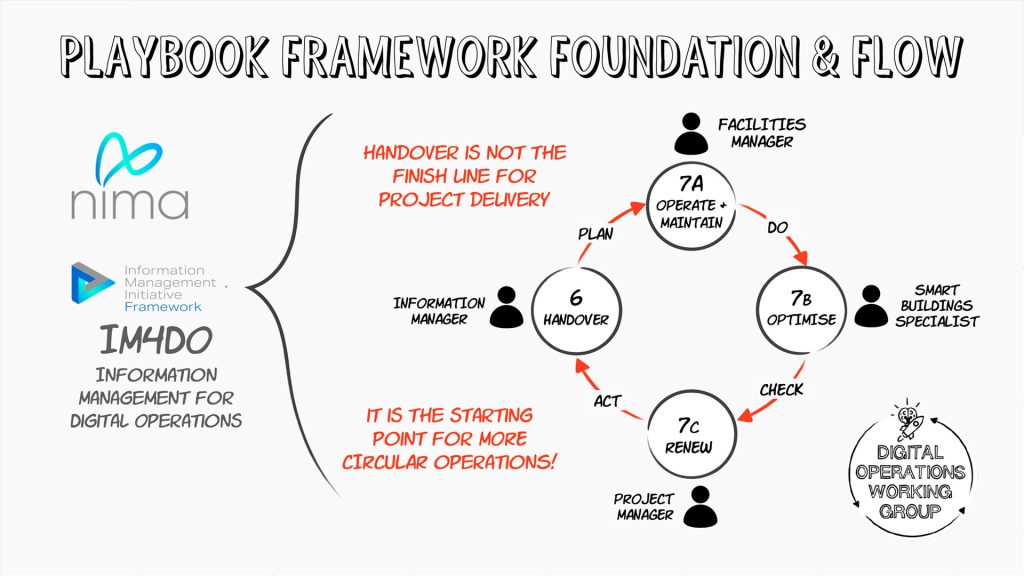
The upcoming Digital Operations Playbook addresses this by setting out a clear approach that aligns existing, fragmented industry standards—including ISO 19650, ISO 41001, NRM3, and SFG20—into a single, unified framework.
This approach is said to enable a true “Digital Handshake,” replacing massive dumps of available project data at handover with the effective, targeted sharing of the precise data required for operations.
“Digital transformation cannot stop at project completion,” said Gordon Mitchell FIWFM, Co-Lead of the DOWG and nima’s head of digital operations. “The real value of information is realised during operations, where data becomes intelligence that supports safety, performance and whole-life outcomes.
“This collaboration is about creating a practical ‘Digital Handshake’ that not only joins the dots between project delivery and operational reality, but helps unify the system around the information actually needed to operate, maintain and improve our built environment.”