

Epic Games is reshaping its architect-friendly viz tool, aligning it more closely with Unreal Engine while enhancing it with major advances in geometry, lighting, materials, and interactivity, writes Greg Corke
When Epic Games acquired Twinmotion in 2019, its stated ambitions for the AEC sector suddenly became clear. The company had been making considerable noise about taking AEC seriously, but it was hard to see how that could be achieved with only a specialist tool like Unreal Engine.
Twinmotion changed that, becoming the foundation for an expansive push towards millions of users, software partnerships, and a fast-moving roadmap of ambitious features.
Now, with technologies such as Nanite, deeper integration with Unreal Engine, and a carefully scoped approach to AI, Twinmotion is entering a new phase.
Epic’s early focus was on adoption at scale, with a dual mission to democratise architectural visualisation and build market share. Its first step was deliberately disruptive: give the software away for free.
Discover what’s new in technology for architecture, engineering and construction — read the latest edition of AEC Magazine
👉 Subscribe FREE here
A series of high-profile partnerships followed — most notably with Autodesk and Graphisoft — culminating in Twinmotion being bundled free with Archicad and Revit, the latter under an agreement that remains in place today. This is no cut down version. Revit customers get the exact same functionality, apart from access to Twinmotion Cloud, which allows users to share interactive real-time experiences online.
The Autodesk agreement has since evolved into more than a licensing deal. Autodesk has now taken on the development of the Datasmith Exporter for Revit, the core technology that brings Revit BIM models into Twinmotion.
“Our dev teams meet with each other on a weekly basis,” says Colin Smith, senior product manager, Twinmotion. “It’s a great situation, because they are closest to the Revit code, so are able to build things into the Datasmith translator, like improving the reading of materials or the recent thing we did around asset swapping, where you can automatically swap assets from the Revit asset to a Twinmotion asset on import. We continually work with the team to understand how we can make things better.”

The technology stack
One of the most significant (if less visible) evolutions in Twinmotion is its technical underpinning. Until recently, it was a compiled standalone app — periodically rebuilt from Unreal Engine, but fundamentally a separate product. More recently, however, Twinmotion runs directly as a specialised instance inside Unreal Engine itself. This is done in ‘PIE’ or ‘Play In Editor’ mode.
Why does this matter? For users, it means that Twinmotion is now much more closely aligned with Unreal Engine, enabling smoother deployment of major technology advancements and improving interoperability between the two tools.
“The reason that we made that change is because now it gives us the ability to really get into the technology stack and start to pull things up through the engine and show it in Twinmotion in a much more usable way,” says Smith.
Lumen, the real-time global illumination (GI) and dynamic lighting system, was the first major step in that direction. “When we brought Lumen in, we got real GI, comparable to what Unreal Engine was supplying,” says Smith. “That really improved the GI that we had in Twinmotion at the time.”
Solving the big model problem
More recently, another major technology to move from Unreal Engine to Twinmotion is Nanite — a virtualised geometry engine designed to handle gigantic, detail-heavy models without performance meltdowns. In short, it only streams visible data on demand.
In Twinmotion 2024, large-scale real-time visualisation demanded either more powerful GPU hardware or careful manual optimisation of the scene. This sometimes meant deciding which assets should be left out, as Smith explains, “Are you going to be able to have people walking on paths, cars driving on streets – all those kind of things that eat GPU power.”
This all changed recently when Nanite support was added to Twinmotion 2025.2. Smith is unequivocal about the magnitude of this shift: “Nanite meshes inside of Twinmotion give you the ability to jam in as many polygons as you want. We want to give architects the power to tell their stories as they want.”
For context, Smith gives an example of a Mars Rover project that’s featured in the Twinmotion 2025 showreel. “It’s a huge, huge scene that would have choked Twinmotion 2024. You wouldn’t even try it,” he says.
Nanite certainly promises to transform how architects approach large scale visualisation projects in Twinmotion. However, users still need to be educated as to the benefits.
“You have to purposely convert your assets to a Nanite mesh,” explains Smith,” “You can do it on import, or you can do it after the fact.”
Nanite meshes inside Twinmotion give you the ability to jam in as many polygons as you want. We want to give architects the power to tell their stories as they want Colin Smith, senior product manager
While most of the scene can be converted to Nanite meshes, some elements — such as certain aspects of foliage — either cannot be converted or the user may choose not to convert them.
“There are some edge cases that we don’t want to mess people up on,” explains Stephen Philips, solution architect, Epic Games. “If you have a lot of really thin geometry, like a bunch of wires, that can sometimes get overly compressed by Nanite. But for any other compatible mesh, it’s almost always a win.”
Support for Nanite also opens the door to bringing other Nanite-based functionality from Unreal Engine into Twinmotion in the future.
One of these technologies is MegaLights, a real-time lighting system designed to complement Nanite in Unreal Engine, specifically for large-scale environments. “It allows you to flood your scene with lights, and it doesn’t affect [the performance] of your scene,” explains Smith.
Epic Games is also looking to bring Substrate materials — enabling more flexible, realistic texturing — into Twinmotion in the future.
These changes will also pave the way for a more optimised “non-destructive” pipeline between Twinmotion and Unreal Engine. This would allow Twinmotion content to be seamlessly imported into Unreal, to produce more complex real time experiences or digital twins.
“We already have some customers where their designers are applying materials and entourage in Twinmotion effortlessly, and then the specialists in Unreal don’t have to do that – they can focus on what they’re actually good at with Unreal,” says Philips.
The interactivity boost
For many users, the Configuration feature, introduced with Twinmotion 2025, signals a shift from passive to interactive presentations — giving designers and clients the ability to explore alternatives, make decisions, and even “play” within the 3D scene.
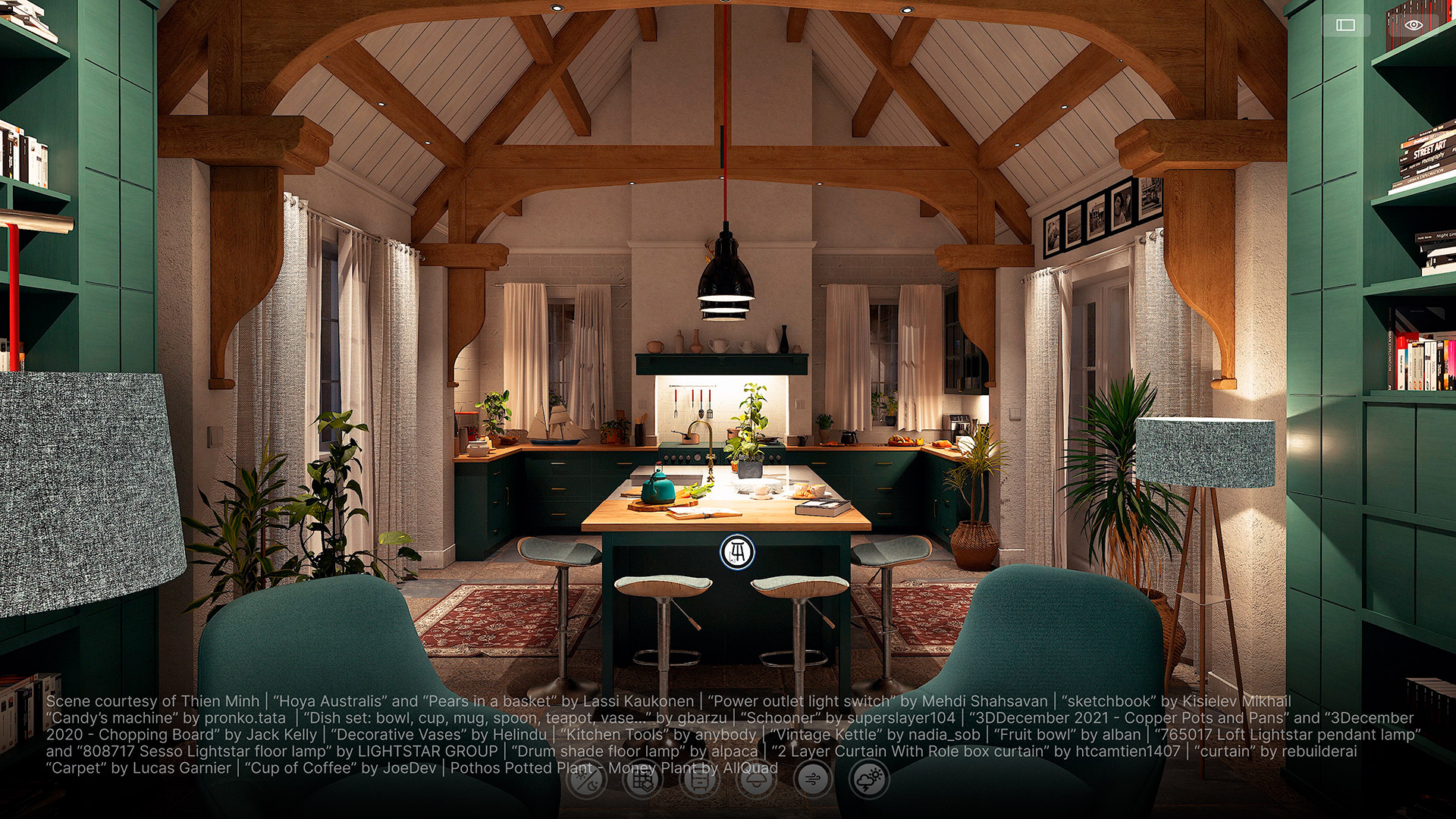
As Philips puts it, “Our configurations feature adds this whole new level of interactivity where you’re not just creating your scene and then letting someone walk around it. You can toggle visibility and settings on any type of property and any type of visibility for any kind of object.”
Philips gives an example of a kitchen project where users can change materials or click on objects to trigger events, “You bring up a menu, and you can see all the different [floor] tiles, you can select them, and it changes them all,” he says.
“You also have interactive switches, so you can walk in the scene and turn on the lights, change the time of day, open a drawer, trigger animations – there’s all kinds of things you can do with it.”
The value for client presentations and stakeholder engagement is significant, especially when paired with Twinmotion Cloud, which makes high-impact presentations accessible to anyone, anywhere, through a browser. Using pixel streaming, all the heavy GPU processing is handled in the cloud.
“[With Twinmotion Cloud] you can send people a QR code, you can embed it in a website, you can send them a link, you can put password protection on it, and it basically allows someone to open it up in a browser, on the PC, on a phone, on a tablet, and walk around in the scene just like you would if you were running Twinmotion locally,” says Smith.
The Configurator also streamlines the production of presentation assets: “We now have the ability to automatically spit out all of the variations, so that you can have every single version of the configuration come out as an image,” says Smith.
Measured steps towards AI
While competitors such as D5 Render have moved swiftly to roll out powerful AI features, Epic Games and the Twinmotion team have taken a more measured approach. They are rightly mindful of intellectual property, ethical sourcing, and the importance of preserving designer intent.
Smith is candid about the company’s position: “Epic has been very careful in the way that they’ve been approaching AI, I think purposefully. There have been a lot of questions about where the models are getting their information from, where they’re scraping things from, IP issues. As much as AI brings to the table, there’s a lot of questions around it.”
But this caution does not mean inaction. “It’s not that we’re not embracing it, it’s just that we don’t want to go too far, too fast,” says Smith.
He reveals that the next major Twinmotion release will include a suite of AI tools, “We are going to be incorporating AI functionality in the 2026 time frame. We have a number of AI tools that are coming, mostly around stylisation, so being able to take a finished render and make it super photorealistic.”
Here Smith gives the example of Twinmotion’s pre-rendered humans, “They look great from a distance, but when you get closer, they get kind of zombie looking, so being able to use AI to change those to looking like a photographic representation of people is really something that you want to do.”
“We’re also experimenting with things like changing backgrounds,” he says. “You could have things that look like hand drawings or oil paintings.”
However, Smith emphasises that AI will always be employed responsibly, with safeguards for IP protection and creative control.
“AI can do a lot of things to enhance your scene, but if you’re not careful, it can do [negative] things to your hero model,” says Smith.
“No designer worth their salt is going to allow AI to throw in an extra window somewhere or decide it needs to have a door somewhere where it doesn’t exist.
“If we are going to add these things to a scene, we have to make sure that the intention of the designer is not getting messed up as part of this ‘easy way’ to get visualisation. It’s a balancing act.”
The path ahead
As the architectural visualisation market continues to grow and mature, Epic Games faces both opportunities and challenges. Smith acknowledges that the industry remains highly competitive: “AEC is a pretty crowded room between Lumion, Enscape, D5 [Render], and us, and still the traditional offline rendering options, and now AI. There’s a lot of choices in there.”
Yet despite this crowded landscape, Twinmotion continues to grow, delivering “a 25% growth rate… year on year,” says Smith. “We have some of the biggest architectural firms in the world using our software, and they’re buying more seats than they were last year or the year before.”
While around 85% of Twinmotion’s customer base is in AEC, Epic Games is also seeing increasing adoption in sectors such as automotive, consumer products, and fashion. Even so, Smith stresses the company’s focus: “We’re not taking our eye off the ball, from where we started from,” going on to explain that the development roadmap is mostly designed to add features that benefit users across all industries.
At its core, Smith says, the mission remains universal: “At the end of the day, it’s all about storytelling… and so whether it’s a hospital or the latest BMW, they all have the same requirements as far as being able to tell a story, put a lot of context in their scene, [and] be able to share that experience with other people.”