
At Arcol, CEO Paul O’Carroll’s view of the agentic future is shaped as much by his proximity to the general contractor market as it is by arguments over authoring tools, writes Martyn Day
At Arcol, CEO Paul O’Carroll’s reading of where the AEC software market is heading comes from a different place and mindset to that of most of his BIM 2.0 peers.
While the company’s software is mostly aimed at building developers, O’Connell says it also offers a “reasonable” fit for the general contractor (GC) market. In line with that thinking, it’s no coincidence that Arcol’s advisors include Procore founder Tooey Courtemanche, a man widely respected in the GC space.
The origins of Arcol’s current strategy, meanwhile, predate the AI boom. “The pre-seed pitch for Arcol was a browser-based, real-time authoring tool that had intelligence at its core,” says O’Connell.
Discover what’s new in technology for architecture, engineering and construction — read the latest edition of AEC Magazine
👉 Subscribe FREE here
“The whole idea, years ago, was that your design tool should fundamentally understand the concept of a building. [It should] also understand that the timeline of construction means it’s actually better for you to put the crane here on site, [instead of] somewhere else.”
At the time, this was a story, rather than a technical roadmap, he admits. “Now there’s this entire infrastructure of LLMs and agents being built [and] that means we could just go build the thing.”
Agents, in other words, are the technology enabler that finally make the original Arcol pitch deliverable.


RIP Revit?
Revit is finished, says O’Carroll – but it won’t die because of the browser, he clarifies, but because of agentic workflows. “It’ll die because of constructability.”
The problem with Autodesk, he continues, is not primarily the file format or the age of the authoring surface. It is that the design, take-off and estimate business units have been so structurally siloed that they are no longer able to exchange data seamlessly.
The technical thesis that underpins Arcol’s product is that the next step forward cannot be a set of AI features bolted onto a single-player BIM tool.
“If you want to have an authoring environment where agents can collaborate and do work simultaneously, you have to have a collaborative authoring environment. You will always have a single-player agent in Revit,” he says.
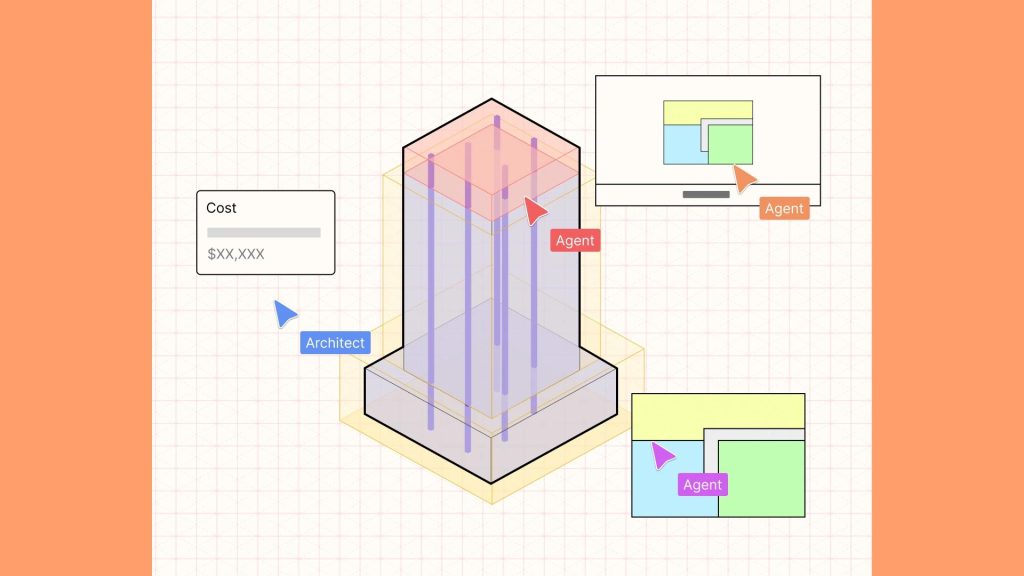
The real-time collaboration story that Arcol has led with publicly – the Figma comparison – is just the visible half of the overall bet that it is making. The other half involves non-human assistance. In other words, once a runtime is capable of supporting simultaneous edits by humans, it is also capable of supporting simultaneous edits by AI agents.
“Real-time collaboration is one of those things that’s very easy to say in a marketing deck,” he says. A more interesting claim is that once multiple agents can edit the same data stream without fighting each other, the industry gets a runtime it has never had before.
For now, Arcol is building out that runtime at the concept and feasibility stage, while extending authoring depth downstream into schematic design. “We feel like we’ve done that for the concept feasibility stage. So now our job is to layer on agents at that stage, while we also take a [Visual Studio code approach] into schematic design.”
The commercial proposition attached to this is where O’Carroll’s framing most clearly departs from his market peers. Arcol’s internal name for it is “the Consigliere model”. Instead of Arcol building a generic costing agent, a designer would invoke, for example, a Turner Construction costing agent. This would join the project file carrying Turner’s accumulated project history and sign off on a number the firm is willing to stand behind.
“From Turner’s perspective, they just got a project in the door, potentially,” says O’Carroll. That’s a net new revenue line for them, in that they can charge outcomes based on the work of agents.”
The result for Turner, by his account, is that it does not need to hire another five hundred estimators. “It can just scale this estimating agent, because it’s going to work 24/7. Agents don’t care about HR laws.”
The route to getting there seems Palantir-flavoured rather than SaaSflavoured. Arcol will embed engineers inside firms to build the first generation of these agents jointly, prove the economics, and then open the layer. What Arcol intends to be is the marketplace, not the expert.
Once a runtime is capable of supporting simultaneous edits by humans, it is also capable of supporting simultaneous edits by AI agents
O’Carroll does not expect other software vendors to populate this layer, and is explicit about that: “Customers are going to build their own, because they’re going to be able to sell it.”
Expert systems like Augmenta and Branch 3D are a different proposition entirely, he says. He views them as integrations rather than competitors.
“I just don’t want the future to look like you make some stuff in Arcol, then you want to go to an expert system, so you log out of Arcol, you go to Augmenta and you sync your model. It cannot be this disparate, siloed user experience,” he says.
These systems, in his vision, become first-class primitives inside Arcol, rather than separate products into which a user has to context-switch.
He acknowledges the political challenges involved in this proposition. “It is a more complicated business-to-business conversation, because there are a lot of egos involved. The private-equity communities of the world want to own the users. We have to communicate that, ‘Okay, you can do that, but you’re going to die if that’s what you want!’”
Beyond individual agents, O’Carroll frames the medium-term prize as orchestration. “The future of our industry is that a designer starts a project and says, ‘I want one agent to do this. I want another agent to do that. Tackle this problem and tell me when those two things are done.”
That layer, he argues, is effectively a mini Enterprise Resource Planning (ERP) system for agents, and it is where Arcol’s long-term product differentiation should sit. What is being orchestrated here is expertise – the expertise held by firms, priced by firms and running against firm-owned data.
That orientation explains his critique of Arcol’s closest BIM 2.0 competitor. “The mistake Snaptrude has made is it’s too single-minded on ‘building a thing for architects’,” he says. “I don’t think there’s been much thought about how the owner plays into this, and what the value is to the owner. Revit isn’t going to die because there’s some faster architecture tool.”
The GC space, according to his reading, is an untapped market for design tools. “You kind of have Qonic at late stages, but there’s nothing really early-stage that’s purpose-built for that process.”
The opportunity, as he sees it, is biggest for a tool that lets a GC bring past project data upstream into feasibility. In this way, for example, a choice between steel, CLT and concrete can be priced in terms of floor plan impact, unit count and HVAC efficiency, even while the architect is still massing.
“That’s the kind of stuff the architect traditionally doesn’t care about at the early stage. We think there’s an opportunity to build something really exciting for that market.”
A GC transformation
Asked what he is most excited about for Arcol, O’Carroll puts aside the Revit replacement narrative and gives two answers. “I do think [agents] dramatically change how the industry works. And the other [reason] is all of the stuff we’re doing in constructability and construction. I just don’t think anybody really fully gets it.”
Arcol’s challenge now is to change that mindset so that it’s ready to swoop if O’Carroll’s prediction that the combination of a collaborative runtime, firm-built agents and a GC-first go-to-market strategy will prove compelling to prospective customers.
Of the many BIM 2.0 visions laid out so far, Arcol’s is the one that most directly rewires the commercial topology of the industry.
Hypar widens who can participate in the design process. Motif preserves firm knowledge as a competitive moat. Snaptrude and Qonic rebuild the authoring and validation surfaces.
Arcol alone is arguing that the expertise sitting inside the largest GCs and engineering consultancies should become tradeable, agent-delivered products, with Arcol acting as marketplace rather than expert. That’s an idea that turns the conventional thinking completely upside down.
If it lands well, the potential here is for a real change in what firms sell, not just what tools they buy.
But the operational questions it raises are far from trivial. Questions remain over who is liable for an AI-signed cost number or a warranty on a branded consultancy agent, for example, or who carries the professional indemnity when advice given turns out to be wrong.
We expect the larger GCs to force the pace on those questions long before the authoring-tool vendors do. And it’s the firms that build their consigliere agents first will likely take the first pass at setting the terms and conditions.