
But, two weeks to check and sign the drawings
The largest productivity prize in architecture is the industrial production of drawings that are ready to issue: generated from the model, checked, compared against the last release and fit to be signed. That is where the fee sits, where the delays happen, and where the signatures are. But automating the drawing is the beginning of that prize, not the whole of it, writes Richard Harpham
Judging by the exhibition floors, product launches and conference programs of the past two years, architectural AI has a favourite subject: the beginning of a project. Text-to-image concept exploration. Generative massing across a hundred site permutations. Agentic assistants that will interrogate a planning code, sketch a façade, or turn out a morning’s worth of alternatives where a studio used to manage three. Much of it is impressive, and some of it will change how buildings are conceived.
Now count the demos about drawing production. The 400-sheet consultant-coordinated set. The dimension strings. The tag that overlaps a door swing on sheet A-204. The thing that gets built from.
Not everyone has missed it. At NXT BLD this year, Robert Gräbert of Graebert, Adi Shavit of Swapp and Bill Allen of Chaos shared a panel on drawing automation. Three companies from quite different starting points, arriving at the same unglamorous corner of the workflow. A visualisation business, an AI startup and a CAD developer do not converge by accident. It is worth asking what they can see that the main stage cannot. What they can see is where the money is.
Discover what’s new in technology for architecture, engineering and construction — read the latest edition of AEC Magazine
👉 Subscribe FREE here
Follow the fee
The AIA’s familiar phase-based rule of thumb allocates roughly 15 per cent of the design fee to schematic design, 20 per cent to design development, 40 per cent to construction documents, 5 per cent to bidding and 20 per cent to construction administration. Proportions vary by project and firm, but the shape does not: construction documents are consistently the largest single phase. The AIA’s own billings research points the same way, finding schematic design and design development together account for only just over a third of billings, while construction documents alone account for around 40 per cent.
So, the phase attracting the industry’s AI attention represents a relatively small share of the design fee. The phase attracting comparatively little represents the largest single share and produces the documents on which an enormous volume of downstream construction activity depends. To be precise rather than sweeping: this is an argument about where the fee sits, not a claim about hours, and where the fee sits is not the same as what it is paid for. Construction-document fees compensate coordination, judgement, revision cycles and the liability an architect carries at signature, not drawing production on its own. Automating the production line does not automate those other components, and there is no reason to expect the fee to shrink in proportion to the drafting hours it removes. Remarkably few practices publish reliable time-by-phase data at all, which is itself part of the problem.
What the documents cost when they are wrong
The downstream evidence is stronger than the upstream evidence, and unusually well documented.
Navigant Construction Forum’s 2013 study, still the most-cited benchmark in the industry, examined 1,362 projects worldwide containing more than a million RFIs. It found an average of 9.9 RFIs for every $1 million of construction value, or roughly 796 per project. Design professionals estimated each RFI took about eight hours to receive, log, review and respond to, at roughly $1,080 in 2013 dollars, nearly $860,000 of professional time per project. The median time from question to answer was 9.7 days, and more than one in five RFIs was never formally answered at all.
Smaller projects fare far worse: those between $5 million and $50 million averaged 17.2 RFIs per $1 million, against 1.1 for the largest jobs in the sample. The figures are a decade old and in 2013 dollars, the documented scale of the problem rather than today’s price.
How much of that traffic is a documentation failure rather than a genuine design question? Less settled, and worth separating at the outset: plenty of RFIs originate outside the drawings altogether, design uncertainty the model has not yet resolved, contractor preference, coordination changes made after issue, or the commercial tactic of generating a paper trail. Better drawings do not touch that portion of the number. One study of building projects attributed 77 per cent of RFIs to inconsistencies, errors or omissions in documentation, though the sample was small and the equivalent figure for the civil projects examined was 34 per cent. Document quality is clearly a major driver of RFI volume within that subset, but the profession lacks the industrywide dataset it ought to have to say how large the addressable share really is.
The counter-intuitive case for automating the boring work Generative systems are least reliable where judgement is the deliverable. A massing study that is subtly wrong is not a defect, it is a suggestion, and you discard it. The design intelligence remains yours because the machine’s output was never authoritative.
Production work is different, and the difference is worth stating carefully. The stakes are unambiguously higher: a missing dimension reaches site in a way a rejected massing option never does. But many production outputs are far more objectively testable. A dimension can be checked against geometry. A missing tag can be detected. An annotation collision can be measured. A changed element can be compared against the last issue. Higher consequences mean verification matters more, but verification is possible, which is not true of most concept-stage output.
Automation will expose the quality of the standards it: a firm with inconsistent naming, annotation and QA rules does not become consistent because it bought AI, it may simply produce inconsistency faster
That reframes what “AI in production” will really look like. Much of the most valuable AI here will not look much like AI at all. It will be hybrid: language models interpreting intent, deterministic engines executing rules, geometry and vision systems spotting conflicts, conventional software verifying the result. The view, sheet, tag and dimension automation of Chaos Glyph is largely rules-and-workflow engineering, with its AI Assistant supplying the natural-language interface; parts of Graebert ARES Neo are deterministic automation rather than anything generative. The point is not to put a language model in charge of the drawing set. It is to use AI where ambiguity helps and automation where certainty matters.
Three bets on where automation belongs
The three companies on that NXT BLD panel disagree fundamentally about where drawing automation should live.
Chaos Glyph, originally EvolveLAB’s product, now part of Chaos alongside Enscape and V-Ray, puts automation in the seat. It is a Revit plugin that creates views, sheets, dimensions and tags, with tasks combined into reusable bundles that run in a click; a recently added AI assistant accepts plain-language instructions such as dimensioning all interior walls. Commercially it behaves like a plugin, and Chaos publishes the price: a named licence is currently $600 a year. This is automation as personal productivity, bought the way architects have always bought tools, by the desk, adopted bottom-up by whoever is in pain.
Swapp puts it in the firm’s institutional memory. The pitch is an intelligence layer rather than a plugin: a two-week onboarding encodes a practice’s graphic standards, annotation rules and QA logic, after which the system applies them and absorbs the team’s corrections. Swapp says it works inside both Revit and Archicad, that it can automate up to 80 per cent of construction-documentation tasks, and that it has delivered more than 35 million square feet of production-grade CD sets. Those are company figures rather than independent findings, but a customer list including Stantec, HGA, Page and Woolpert suggests meaningful enterprise traction. Most striking is how Swapp frames what firms are buying: succession insurance, capturing how senior staff draft and check so that judgement stays in-house when they leave. That is a sharper articulation of the value than most practices have managed themselves. It does not publish prices, selling instead as an enterprise engagement, which follows logically from a product that begins with a fortnight of onboarding.
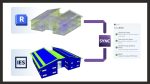
Graebert ARES Neo, declared interest below, puts it in the pipeline. Graebert describes Neo as a cloud-based automation service that lets Revit users import or create drawings, automatically add dimensions and tags, detect and fix annotation issues, and sync back to Revit and Autodesk Forma; for IFC and Rhino models it generates floor plans, sections and elevations as DWG or PDF. Two things follow from putting the work on a server rather than a desktop. Processing is designed to run in batch across a whole set, or a portfolio of projects, rather than one user’s session at a time. And Graebert intends the automation to run independently of Revit itself, planned rather than shipped, but if delivered it means generating and updating drawings need not consume additional authoring seats, which for a practice paying per licence is a cost question as much as a technical one. Graebert has not published prices but has indicated it will charge by volume of drawings rather than by user.
These are three theories of the practice, not three versions of a product. Is documentation a personal skill to be accelerated, an institutional standard to be encoded, or an industrial process to be piped? The pricing models give the game away: per seat, per engagement, per volume. How a firm answers says more about the firm than about the software.
Not all saved hours are worth the same
Here is the sharper version of my argument. Architects aren’t only pointing AI at the wrong end of the project. Much of the industry is solving half the problem and calling it finished. The measure being used is how much can be generated.
The measure that matters is how much is ready to issue, and those are not the same number.
Consider what happens when automatic drawing generation succeeds completely. A system produces 400 sheets in an afternoon, and your team still checks all 400 against the previous issue, by eye, at deadline. The drawings exist; they are not yet issuable. Industrialise only the first half and you lengthen the queue at the second.
And consider who does that checking. Drawing production is largely junior and mid-weight labour. Verification and sign-off are not: they are done by project architects, associates and principals, because it is their signature and their professional indemnity on the line. Automation that saves drafting hours saves the cheapest hours in the practice, in theory. In practice that saving is not guaranteed: cut junior production and the freed time does not disappear from the fee, it relocates, to senior staff configuring the software, tuning rule sets and standards, and resolving the exceptions the system cannot. A practice that trades an associate’s afternoon of drafting for a principal’s afternoon of exception management has not found a cheaper hour; it has found a more expensive one wearing the same timesheet code. Automation that saves checking hours is a cleaner win: it saves the most expensive hours outright and does so at the exact point where a delay stops a tender package, a trade buyout or a fabrication release. An hour returned to a principal at 11pm before an issue is simply not the same asset as an hour returned to a Part 2 at the start of a work stage, and it is only a genuine saving, rather than a relocation, when the tooling and its exceptions are not quietly consuming it first.
This is where change tracking becomes the interesting capability rather than a footnote. Graebert has been developing checking and version-comparison features for Neo, intended to report what has changed between drawing issues, filtered by discipline. If that works as described, it attacks precisely the expensive part of the cycle: it converts a fullset re-check into a delta review, where the reviewer verifies what the system has flagged rather than hunting across sheets for the five per cent that moved. The architect still signs, but signs against an audit trail rather than against their own tired eyes.
I would go further: that capability is what I would evaluate these tools on, and it is a reason to buy automation rather than an argument against it. Generation is maturing fast, three credible vendors already do it well, and a practice still placing dimensions by hand is simply paying more than it needs to. The harder, more valuable step is proving what changed, to a standard a signing principal will accept.
Which brings me to a metric the profession should start keeping. There is surprisingly little published benchmarking on how long practices spend checking major drawing issues. In conversations with large firms, I have repeatedly heard periods approaching two weeks from model freeze to signed release, repeated a dozen or more times across a project. That is anecdotal, not industry data, but it points at a number every practice ought to know and almost none measures.
Call it freeze-to-issue time. How long does it take your firm to get from model freeze to issued set, and how many times will you do it on this project? If you cannot answer, you cannot evaluate any of these tools honestly, because you don’t know what your bottleneck costs.
Two cautions. Automation will expose the quality of the standards beneath it: a firm with inconsistent naming, annotation and QA rules does not become consistent because it bought AI, it may simply produce inconsistency faster. And be realistic about where saved time goes. As was observed from the NXT BLD stage this year, when AI made concept imagery easier to produce, client expectations expanded to match. The same inflation is coming for documentation, which makes automating the price of staying in the game rather than a guaranteed route to margin.
A last thought to consider Developing human IP in your firm in an age of automation. For generations, junior architects have learned how buildings go together partly by drawing and detailing them. The profession’s traditional apprenticeship was built around progressively deeper involvement in drawing, detailing and coordination, automation risks removing some of that repetitive labour, and some of the learning embedded inside it.
That is not a reason to refuse the tools. It is a reason to adopt them deliberately, and to treat the design of the apprenticeship as seriously as the design of the workflow, because the replacement will not appear by itself.
The demos will keep being about concept design, because concept design photographs well. The returns are in the drawing set.
Disclosure: the author provides commercial advisory services to Graebert on ARES Neo. He has no commercial relationship with Chaos or Swapp.
Sources
• AIA phase fee allocation and billings distribution: AIA, Defining the architect’s basic services; AIA Architecture Billings Index white paper, Designing the Construction Future.
• RFI benchmarks: Navigant Construction Forum, Impact & Control of RFIs on Construction Projects (2013), 1,362 projects, 1.1m RFIs, 796 per project, 9.9 per $1m, ~8 hours and ~$1,080 per RFI, 9.7-day median reply, 21.9% unanswered; 17.2 RFIs per $1m on $5m–$50m projects.
• RFIs attributable to documentation issues: Morales et al., Potential Application of BIM in RFI in Building Projects, Buildings 12(2), 2022, small sample; use with caution.
• Chaos Glyph features and pricing: (accessed August 2026).
• Swapp claims, integrations and customer list: (accessed August 2026), vendor-reported figures.
• ARES Neo shipping capabilities: (accessed August 2026). Change-tracking/version comparison, server-side batch processing at set and portfolio scale, Revit-independent operation, and volume-based rather than per-seat pricing are all described by Graebert as planned or in development, confirm status and permission to publish before press.
• NXT BLD 2026 drawing automation panel: Robert Gräbert (Graebert), Adi Shavit (SWAPP), Bill Allen (Chaos).