
The next big battle in AEC software may not be over who builds the best BIM modeller, but who builds the best manufacturing platform for construction. That was the key message at Dassault Systèmes’ AEC Summit, where discussions covered digital twins, AI, robotics and industrialised construction
As software executives focus their attention on developing the next generation of design tools, we see not only a bunch of start-ups jockeying to replace BIM 1.0 tools at the design end, but also increasing interest among established mechanical CAD (MCAD) vendors in technology specifically built with construction and fabrication in mind.
At NXT BLD 2026 in May, presentations given by executives from Siemens and Dassault Systèmes focused on recent enhancements to their respective toolsets and made it clear that the race is on when it comes to fabricable digital twins for construction (see presentations here).
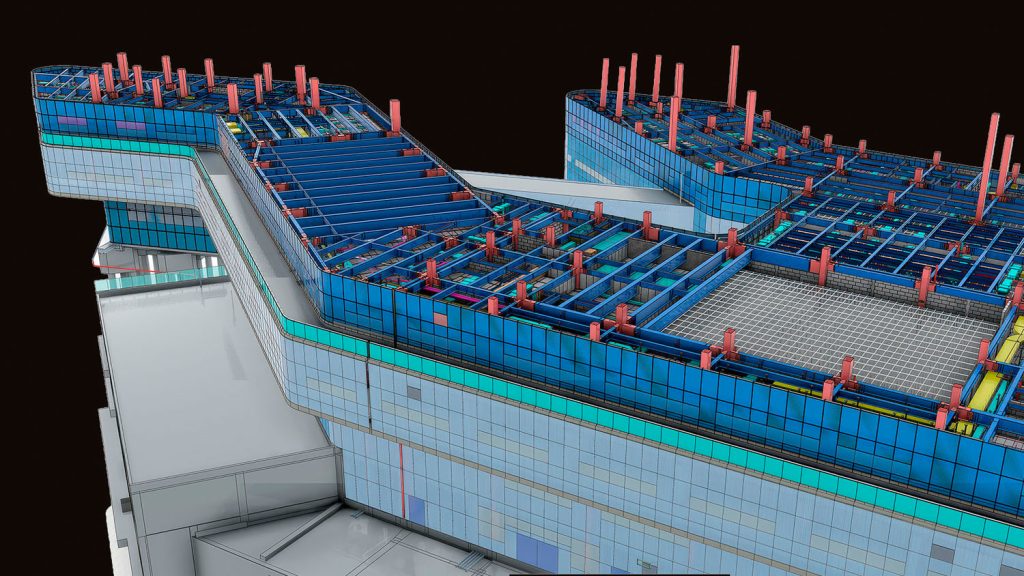
More recently, Dassault Systèmes (DS) invited customers and journalists to its Paris-based headquarters for a week-long AEC Summit. At this event, executives framed the work they have been doing to make the company’s core modelling tool, Catia, more construction-specific.
Discover what’s new in technology for architecture, engineering and construction — read the latest edition of AEC Magazine
👉 Subscribe FREE here
Remy Dornier, who leads AEC at the company, set out the thesis for attendees. There are, he said, three forces converging on the AEC industry simultaneously: virtual twins, industrialised construction and AI. He sees AI’s role as being to source knowledge, store and structure it, and recombine it on request.
If one looks back to the development of the printing press, Dornier said, it’s clear that Gutenberg didn’t invent knowledge. Instead, he spread it and that diffusion produced the Renaissance. AI, according to this reading, is an equally democratising force when applied to industrial know-how.
So how does DS propose to help customers harness this force? According to Catia CEO Olivier Sappi, the company sees a shift to a ‘generative economy’, in which a company’s value lies not in the physical assets it creates, but in the intellectual property and knowhow that go into building a hospital, an airport or an AI factory (a data centre).
Dassault Systèmes has spent 45 years building ‘virtual universes’ in which objects can be designed, simulated and tested long before they exist in a physical sense. These ‘universes’ are collections of virtual twins, grounded in models, solvers and physics. (In effect, it’s the same message as the company’s pitch to manufacturing customers, but tweaked for a construction audience.)
AI agents, meanwhile, are referred to as ‘virtual companions’ at Dassault Systèmes . The company is creating three variants of these companions for performing different tasks within the design process. They are Aura, which provides AI assistance for project management, logistics and planning; Leo, for structural design and mechanical; and Marie, for scientific research.
Aura, Leo and Marie are not large language models (LLMs), Sappi explained. Instead, they’re ‘world models’, designed to team up with engineers and designers, rather than replace them.
In this vision, the aim is to provide ‘IP lifecycle management’ or, in other words, a layer for traceability, lineage and sovereignty, which is followed by virtual twin technology to deliver an ‘industry world model’.
You cannot build a complete building from an LLM trained on the open internet, Sappi insisted, because knowledge of how to construct a building lives inside a firm. So Dassault’s goal is to capture that knowledge and ground it in its science and solvers.
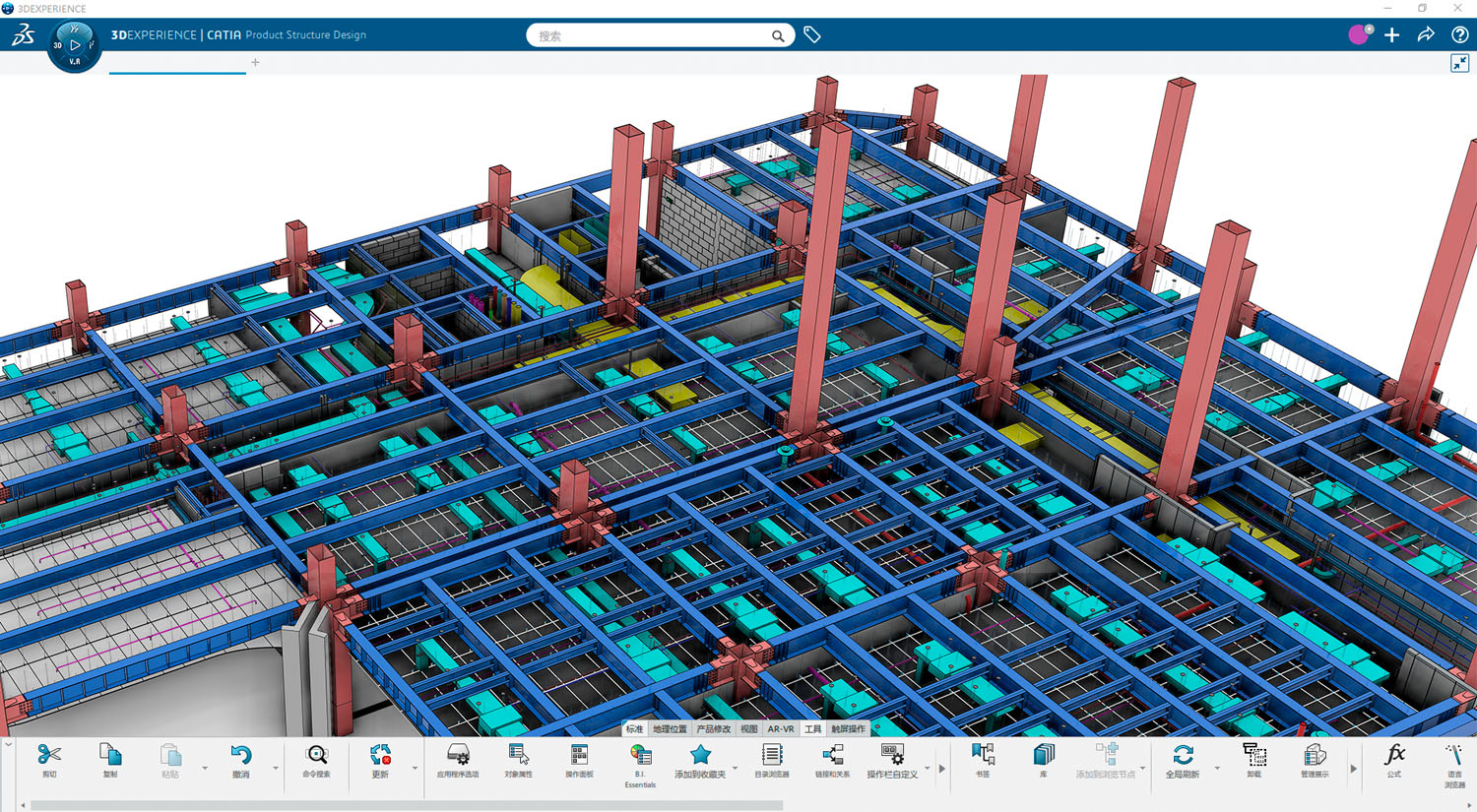
As a result, the company is extending its kernel and its platform downstream into a market which it does not yet own at the authoring layer, but where it is working very closely with leading firms such as Vinci and Bouygues in order to deeply embed construction know-how within Catia.
The AI factory era
Sean Young from Nvidia gave a presentation about the data centres that the company is designing and fabricating. Young explained that a data centre is not just a shed full of racks, but “a factory whose single product is inference, an asset that converts power into tokens and tokens into revenue at a rate the rest of the building industry rarely contemplates.”
Young offered some persuasive figures: roughly $50 billion of capital infrastructure creates $100 million in revenue per day, he said. That’s a ratio that reframes every engineering decision as a margin decision. A badly engineered MEP system becomes, in Young’s words, the weakest link in the chain, bleeding 30% to 40% of incoming power into cooling that ideally would have gone to compute.
Nvidia is partnering with manufacturers who build critical components, among them Vertiv, Siemens, Trane, Eaton, Rolls-Royce and Caterpillar, with the aim of producing hardware optimised for specific compute generations. The current cluster is branded ‘Vera Rubin’, a combination of CPU, GPU, DPU and Ethernet capabilities working together under a framework that Nvidia calls DSX.
The key, benchmarkable performance indicator here is tokens-to-Watts. If a firm can demonstrably improve that ratio by a single percentage point against $100 million per day, it has a basis to charge for value created rather than hours billed. Young set a direct challenge for his audience, telling engineers that by selling time and materials against assets of this scale, they were leaving the most monetisable aspect of any deal on the table.
(As a side note, while today’s AI compute has issues with addressable memory, an Nvidia Vera Rubin cluster could potentially work on an entire federated BIM project – with its point clouds, GIS layers, schedules, specifications, regulations and simulation results – all at once, while coordinating multiple specialist agents).
The platform doesn’t remove context-window limits entirely, but it enables far larger models and much faster retrieval and reasoning over external data than previous hardware.
According to Young, professionals in the AEC industry often spend a great deal of time mastering 3D software only to flatten everything back into paper and PDFs. The result, he argued, is an industry with no single, reliable source of truth, no data lineage and no way to trace a component from one trade to the next.
While this might involve tolerable inefficiency on an ordinary construction project, it might impose a disqualifying burden on the most complex building type ever attempted. Young believes that an approach based on model-based systems engineering, or MBSE, is the right one, because it drags every nut and bolt into a database structure where each element traces back to a requirement and can be simulated in isolation or as part of the whole (or ‘sim-ready’, as it’s known).
Nvidia doesn’t build data centres on a commercial basis, only for itself – but in doing so, it creates a building and compute architecture template that others can use to create their own data centres. This is achieved by sharing sim-ready assets via OpenUSD that carry all their physics under the hood and an open-source data centre blueprint published on GitHub.
The demand inversion
Justin Schwaiger, prefabrication technology leader at DPR Construction supplied the session’s hardest evidence of a fundamental shift in construction. As he told attendees, DPR’s prefabrication business has grown from $200 million in 2024 to $800 million this year and is projected to pass the billion-dollar milestone next.
He was candid that the market dynamic has flipped. It used to be the case that prefab firms had to push components on a lukewarm, sceptical market. Today, DPR is asked how many it can supply and is being pulled into projects, rather than having to sell its way into them. And that’s happening as the ‘building-as-a-product’ idea sees engineering-to-order replaced by configure-to-order.
This was illustrated using the Nike shoe configurator: a client feels they are getting something bespoke and unique to them, while the manufacturer has merely pre-engineered a range of options.
The supporting argument is that physical infrastructure, not algorithms, is now the binding constraint on AI, with grids, supply chains and labour all unable to scale on the timescale that capital requires. The labour point is the one that should concentrate minds, with around 40% of the construction workforce heading for retirement inside five years and the largest data centres being built precisely where skilled labour is thinnest.
Prefabrication answers that by relocating the work to where a workforce can be trained in factory techniques, rather than site techniques – a structural case for offsite that survives independently of the AI narrative wrapped around it.
Data centres are the ideal candidate for industrialised construction, Schwaiger observed, precisely because they do not really have architects who care about aesthetics, removing at a stroke the variable that has defeated offsite construction in every sector where it actually lives.
Can this same configure-to-order logic, carried from windowless compute sheds, survive when applied to hospitality, residential and the rest of the traditional construction portfolio?
Dassault Systèmes wants Catia to become the engineering platform on which industrialised construction is designed, validated, manufactured and ultimately operated
Configure-to-order works flawlessly where the client does not care what the building looks like. But whether it survives contact with buildings that people are meant to inhabit, rather than buildings that house machines, is the question the data centre boom cannot answer. The huge amount of money being thrown at solving time-to-market may deliver benefits for other parts of the industry. For example, could hospitals be viewed as factories, in some way?
For AEC firms, the genuinely actionable takeaway is not the prefab catalogue or the digital twin, but the idea that value has moved off the production line and into the judgement that configures it. Firms that capture that value are the ones that treat configuration logic, data lineage and optimisation as assets they own and compound, rather than what they rent from a vendor that also sells them the kernel.
DS customer: Yellow River
Yellow River Engineering Consultancy (YREC), based in Zhengzhou, China, is regarded as one of the county’s most technically advanced water engineering consultancies.
YREC’s Lu Wang argued that water infrastructure design suffers from several structural issues. Among them are inconsistent design quality, projects taking too long and unpredictable design costs. These are compounded by engineering knowledge being lost as people retire or move jobs, very long project lifecycles that make innovation difficult and poor reuse of engineering data. Wang concluded that traditional approaches towards design cannot solve these problems.
YREC has spent over twenty years building towards a new design process. The company started to research digital design in 2004, resulting in a partnership with Dassault Systèmes in 2009.
From 2020 onwards, YREC has invested in big data and an AI-led ‘Digital Design Factory’ concept. This has reinvented the company’s approach to design by aggregating multiple types of data capture (2D drawings, 3D models, documents, engineering data and so on) to build modules and libraries in Catia for design teams to reuse.
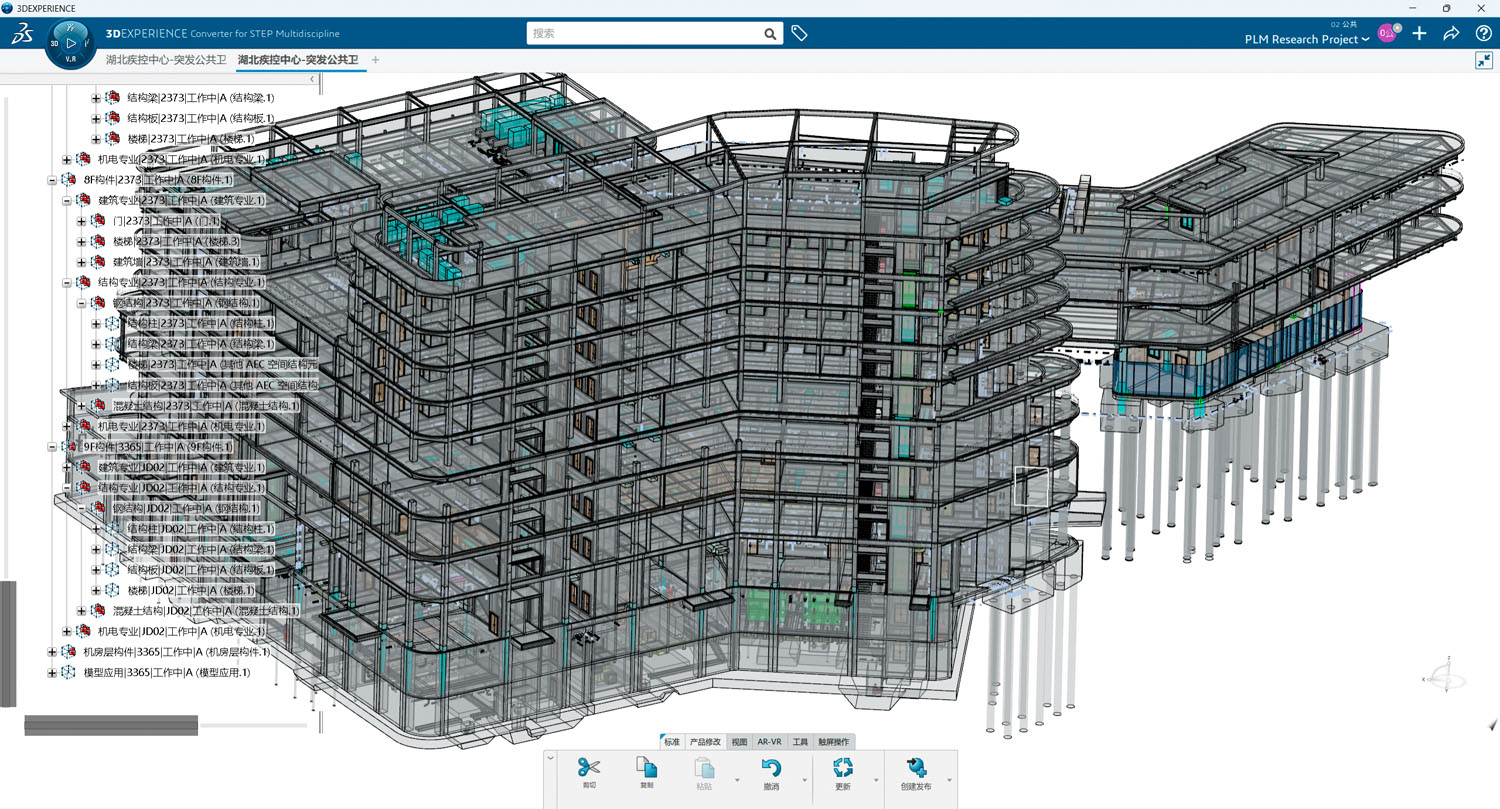
Wang explained that one of the most interesting application areas has been in the workflow for designing gravity dams. Instead of designing each dam from scratch, the company uses big data algorithms to optimise dam cross-sections. Engineers drag and drop major components into place (from custom software built on Dassault’s platform), automating much of the design through parameterdriven models that generate all the engineering geometry. This construction platform can simultaneously generate 3D construction models and 2D drawings, as well as cloud-hosted engineering models. YREC also has embedded simulation capabilities along with compliance/regulation checking into its design system.
This firm has collected data from hundreds of steel gate projects across China and applied machine learning and optimisation algorithms using generative adversarial networks (GANs) to optimise designs and compare them against engineering codes.
Wang described engineering as an industrial production process: capture data once, reuse knowledge, automate design, validate with AI, and generate models and drawings with minimal manual intervention.
It is a concrete example of how a large engineering consultancy is restructuring design around AI and reusable engineering knowledge, rather than simply adding a chatbot to existing workflows. Wang thinks design will split into two groups: firms that embrace AI, automation and technical innovation and will survive; and those that do not adapt and risk disappearing.
DS customer: Laing O’Rourke
At Laing O’Rourke, Bruce Bell is head of product in the contractor’s Technology and Innovation team. He explained how the company is extending its longstanding Design for Manufacture and Assembly (DfMA) strategy by applying product engineering, digital design and advanced manufacturing to some of construction’s most labour-intensive challenges.
Unlike traditional contractors, Laing O’Rourke owns much of its delivery capability, including pre-cast concrete, MEP manufacturing, facades and logistics, allowing it to industrialise construction across the entire supply chain, rather than relying solely on subcontractors.
Bell argued that it’s clear that BIM alone is insufficient for the task. To manufacture building components, models must become engineering-grade assets that contain the information needed for automated production. His team is developing new design tools to generate data that is absent from BIM models, while linking these directly to robotics, CNC machinery and other digital manufacturing processes.
Much of the work focuses on solving practical site problems, from automating internal wall systems to eliminating manual handling of heavy reinforcement cages on major infrastructure projects, such as the Hinkley Point and Sizewell nuclear power stations. Bell also highlighted a parametric bridge design platform that has reduced design times from months to days, demonstrating how productisation and automation can accelerate delivery while creating repeatable, manufacturable construction systems.
Data centres are the ideal candidate for industrialised construction, DPR Construction’s Justin Schwaiger observed, precisely because they do not really have architects who care about aesthetics, removing at a stroke the variable that has defeated offsite construction in every sector where it actually lives
Bell’s presentation reinforced a theme that surfaced repeatedly throughout the event; namely, that the biggest gains from AI and digital engineering will come from rethinking construction processes rather than simply digitising existing ones.
Laing O’Rourke is using BIM as a manufacturing dataset, not just a coordination model, with the explicit aim of driving robotics, automation and repeatable production.
It also highlights a broader shift in construction, where competitive advantage increasingly comes from owning digital workflows, manufacturing capability and engineering knowledge. In that sense, the contractor is behaving less like a builder and more like an advanced manufacturing company that just happens to construct buildings.
DS customer: Bouygues Bryck
Bertrand de Peufeilhoux is head of the Bryck industrialisation project at Bouygues Construction France. At the DS AEC Summit, he outlined how the contractor is rethinking BIM as the foundation for industrialised construction, rather than simply creating a digital representation of a building.
Working with Dassault Systèmes, Bouygues has developed a series of digital ‘brycks’, reusable software modules that embed construction expertise directly into a virtual twin. These automate repetitive engineering tasks, generate production-ready deliverables and connect design with site operations. This is a systems-level engineering approach to design.
Examples included automated workflows for concrete walls, floor slabs and buried services, where BIM models are enriched with construction intelligence to produce assembly instructions, positioning data, layout drawings, quantity takeoffs and procurement information. Site teams can update the model through lightweight web tools, ensuring the virtual twin remains accurate throughout construction, while automatically regenerating downstream documentation.
Beyond construction, Bouygues is embedding engineering knowledge into its generative design tools, including a parking configurator that evaluates multiple design options and uses AI assistants to make sophisticated optimisation tools accessible through natural language.
The company is also developing automated BIM compliance checking, using around 200 programmed business rules to validate designs against its own construction standards and best practice. The goal is to transform BIM into an active production platform that links design, manufacturing and construction through a continuously updated digital twin.
Perhaps the most interesting aspect of Bouygues’ approach is that it shifts the conversation beyond BIM authoring and coordination into execution. The model is no longer the end product, it becomes the operational backbone for procurement, planning, quality assurance and site delivery.
By embedding construction knowledge into reusable software modules, Bouygues is effectively creating a library of digital manufacturing processes that can be applied across projects. Coupled with AI-driven optimisation and automated compliance checking, it points to a future where much of the routine engineering and construction planning is generated, rather than manually produced. It is another example of BIM evolving from documentation into a platform for industrialised construction.
Catia roadmap
The AEC Summit also focused on recent developments delivered by Catia’s construction development team, together with details of the roadmap they are following.
I have to say that, from a presentation that provided 1.5 hours of relentless feature updates, it’s clear that DS has a sizeable team working to make Catia a construction-specific modelling engine, with deep capabilities. This has clearly come from years of engagement with the likes of Bouygues, for whom DS has developed a highly capable, design-to-fabrication system.
A major focus of development has been on web-based workflows, enabling a wider range of users to interact with models without requiring specialist CAD software. New capabilities include improved object filtering, parameter editing and redesigned measurement tools, as well as a lightweight review CDE (common data environment) application that allows project teams to inspect, update and commit changes directly to the platform.
For authoring, the team has expanded support for architectural modelling with new wall types, richer door and window libraries, complex-level geometry and improved opening management. Construction-specific workflows have also been strengthened through one-click generation of construction models from engineering data. There are some handy tools to compare imported IFC models against construction models and links to daily planning that connect BIM directly with site execution.
Structural and reinforcement modelling are also receiving significant attention. New capabilities include standard reinforcement mesh libraries, improved rebar grouping, more robust drawing generation and enhancements for producing fabrication-ready schedules. Civil infrastructure has likewise progressed, with support for junctions and ramps, improved road and rail alignments, geological modelling, automated earthworks calculations and IFC 4.3 support for infrastructure workflows.
The team also highlighted continued investment in content libraries, adding reusable objects, templates and equipment that can accelerate design, with the next catalogue focusing on data centres and construction site assets.
DS’s AEC roadmap centres on four strategic themes: industrialised construction, richer semantic BIM data, reality capture and civil infrastructure. And here, much of the development effort is being directed towards AI-enabled workflows, with the Leo engineering assistant able to query BIM models using natural language, to generate quantity take-offs through knowledge graphs, as well as automate reinforcement layouts.
Perhaps the most significant long-term development, however, is Dassault Systèmes’ ambition to make its desktop Catia AEC applications available through the web. Rather than recreating functionality in lightweight browser tools, the company is developing a new architecture that mirrors the full desktop experience inside a browser, allowing users to access the same modelling and engineering capabilities without local installation.
If successful, it would remove one of the traditional barriers to deploying high end engineering software across large project teams, while making sophisticated authoring tools available on a much wider range of devices.
Conclusion
What emerged over the course of the AEC Summit was that Dassault Systèmes is not trying to build another BIM authoring tool. Its ambition is much broader.
The company wants Catia to become the engineering platform on which industrialised construction is designed, validated, manufactured and ultimately operated.
That puts it on a different trajectory to many of today’s BIM vendors. Much of the industry is still focused on creating and coordinating models, while Dassault is concentrating on what happens after the model exists. The emphasis is on embedding engineering knowledge, capturing manufacturing processes, validating designs against rules, connecting directly to fabrication and increasingly allowing AI to work on structured engineering data rather than disconnected files.
The customer presentations reinforced that this is no longer a theoretical vision. Whether it’s YREC automating dam design, Bouygues embedding construction expertise into reusable software modules, Laing O’Rourke driving robotics from engineering grade BIM, or DPR Construction treating buildings as configurable products, the common theme was remarkably consistent. Every organisation is moving engineering knowledge out of individual experts’ heads and into reusable digital systems.
Whether Dassault can establish itself as a serious authoring platform in AEC remains an open question. The installed base of Autodesk Revit is enormous, while a new generation of cloud-native BIM tools are attempting to redefine design workflows from the opposite direction.
But if construction genuinely shifts towards productisation, design-for-manufacture and AI-assisted engineering, the centre of gravity may also shift and firms may opt to swap dumb BIM representational systems for knowledge-based ones.
In that world, the winner may not be the company with the best modelling tools, but the one with the deepest understanding of how buildings are actually engineered, manufactured and assembled.