
From its structural engineering roots to AI-enabled construction workflows, Allplan is charting a measured path in which openness, data sovereignty, and controlled automation underpin its design-to-build strategy
As AI moves from experimentation to operational reality, engineering software vendors are under increasing scrutiny. Questions around data sovereignty, model liability, cloud architecture, and long-term platform strategy have become board-level concerns for infrastructure owners and engineering firms alike.
Under the leadership of Sunil Pandita, CEO of Allplan and chief division officer planning & design, Nemetschek Group, Allplan is continuing its journey towards becoming a design-to-build platform shaped by openness and controlled AI adoption.
In this interview, Sunil outlines how he sees the next phase of BIM unfolding, and where Allplan and the wider AECO industry are heading.
AEC Magazine: Allplan has traditionally been strongest in structural engineering, detailing, and German-speaking markets. How do you characterise Allplan’s historical “centre of gravity”, and what parts of that legacy are still core strengths versus constraints you’ve had to consciously move away from?
Sunil Pandita: I’d say our historical centre of gravity was – and still is – structural engineering, precision detailing, and bringing BIM to the field. That engineering-first DNA gave us deep domain expertise, and therefore the credibility to be used on complex, mission-critical projects. We were trusted not just to model geometry, but to deliver data that could be built.
Where we’ve consciously evolved is expanding from a single-discipline authoring tool towards connected workflows across design, engineering, detailing, and fabrication. That hasn’t meant abandoning our structural heritage. Instead, we’ve used it as the foundation to connect engineering intent with fabrication reality and construction delivery in a much more integrated way. This has enabled us to scale what we were already good at across the full lifecycle of a project.


Discover what’s new in technology for architecture, engineering and construction — read the latest edition of AEC Magazine
👉 Subscribe FREE here
AEC Magazine: Over the past decade, Allplan has shifted from a pure authoring tool to a broader “design-to-build” platform. Looking back, what were the two or three inflection points, technological or commercial, which most changed how you thought about the company’s direction?
Sunil Pandita: Looking back, there were three decisive inflection points. The first was our early commitment to openBIM. It forced us to think beyond proprietary workflows and to position interoperability as a strategic principle rather than a feature. That decision continues to influence how we architect our products today.
The second shift came through structural integration – specifically with Scia and Frilo. By bringing analysis and design closer together, we began to break down the traditional boundary between modelling and verification. That fundamentally changed how we saw our role: now, we were part of a continuous engineering loop.

The third inflection point was moving downstream into detailing, fabrication, and construction workflows with Allplan Precast, SDS2 and Manufacton. That step made it clear that geometry alone is not enough. The real value emerges when design intent flows all the way to manufacturing and site execution without losing fidelity.
Together, these shifted Allplan from a design tool to a design-to-build platform.
AEC Magazine: Nemetschek has long promoted openBIM as a philosophical and commercial differentiator. From your perspective, where has openBIM genuinely worked well for Allplan users – and where has it fallen short of what customers actually need in real projects?
Sunil Pandita: openBIM has worked particularly well in multidisciplinary coordination and public-sector environments, where transparency and neutrality are essential. It has enabled teams using different tools to collaborate without being forced into a single vendor ecosystem. That remains a real strength for our users and a principle we continue to stand behind.
Where expectations have risen is in round-trip workflows and semantic richness. Exchanging BIM models is no longer enough. Engineers and contractors increasingly expect parametric intelligence, design intent, and performance data to move between systems without degradation. In practice, that level of fidelity is still challenging across heterogeneous toolchains.
So, the next phase of openBIM is not simply about file exchange; it’s about making it operational under real delivery pressure. That is where we continue to invest: in deeper interoperability, automation, and APIs that allow connected workflows without sacrificing intent.
AEC Magazine: “Design-to-build” is now a central Allplan message. What are the three measurable outcomes you want customers to be able to point to over the next 18–24 months – time saved, errors reduced, CO2 cut, fewer RFIs, better margins? And which workflows are you prioritising first to achieve them?
Sunil Pandita: We know that “Design-tobuild” only has meaning if it translates into measurable performance. So, three tangible outcomes customers will see over the next 18–24 months includes the following.
First, they should see a reduction in detailing and documentation time through targeted automation, particularly in reinforcement modelling and steel detailing workflows. Second, expect higher model reliability for construction, which should mean fewer downstream clashes, fewer RFIs, and less rework between engineering, fabrication, and site execution. Third, expect tighter integration across the project lifecycle, so analysis results, detailing decisions, and construction data remain connected rather than being recreated in parallel systems.
To achieve that, we are prioritising reinforcement automation, structural analysis-to-detailing handover with Scia and Frilo, steel detailing through to fabrication, and collaborative cloud workflows that support coordination under real delivery pressure.

AEC Magazine: You’ve pushed harder on cloud collaboration with offerings like Allplan Cloud and shared project spaces. Where do you currently draw the boundary between “cloud as viewer/collaboration” and “cloud as authoring/compute”, and what do you think will not move fully into the cloud for your users?
Sunil Pandita: Cloud has already proven its value in collaboration, coordination, and shared data environments. That remains our primary focus: enabling distributed teams to review, validate, and exchange information in real time without compromising data ownership.
Authoring and heavy compute will increasingly become hybridised, especially for simulation and AI-driven automation. Of course, some mission-critical authoring will remain desktop-based for performance, sovereignty, or regulatory reasons, and we respect that reality rather than forcing a one-size-fits-all model. For many engineering firms, data sovereignty and predictable performance are operational realities.
We see the future not as fully cloud or fully desktop, but as intelligently distributed – using cloud where it adds scalability and collaboration, while preserving local control where it matters most. What’s most important is that the architecture reflects how engineers actually work.
AEC Magazine: What is the long-term technical goal of aligning Allplan more tightly with Scia and Frilo on the engineering side: a unified data model, shared services, or simply better interchange? And how do you avoid forcing users into a single-vendor stack?
Sunil Pandita: Our goal here is to break down silos between disciplines, whilst also delivering the best solution on the market. To do that, we need to reduce the friction between modelling, analysis, detailing, and verification so that the engineering intent is preserved across systems. For us, that means delivering streamlined, AI-driven engineering-to-detailing workflows, not simply file exchange. So, we are investing in shared services, structured data exchange, and tighter analytical links – particularly between Allplan, Scia, and Frilo – so that structural behaviour and detailing logic remain connected rather than being recreated manually.
That said, we are very conscious of avoiding lock-in. openBIM is part of our DNA, therefore using open APIs remains one of our core principles. Users must be able to integrate Allplan within other tools in their ecosystem. The added value of combining Nemetschek solutions should come from efficiency and continuity, not from restriction.
AEC Magazine: Offsite and DfMA are becoming operational realities, not just talking points. With moves like acquiring Manufacton, are you aiming to become the system of record for prefabrication planning, or to remain the geometry/detail authority feeding other factory and ERP systems? How are you seeing pre-fabrication uptake in Europe?
Sunil Pandita: You’re absolutely right that offsite and DfMA are becoming operational necessities, driven by labour shortages, sustainability targets, and schedule pressure. Across Europe, we are seeing prefabrication uptake particularly in infrastructure, industrial construction, and larger public projects where manufacturing accuracy, repeatability and programme certainty are critical.
From a design-to-build perspective, our role is to connect the design intent to manufacturing reality. Acquiring Manufacton helped us strengthen the downstream part of the workflow – such as production planning, tracking, and handover – rather than replacing ERP or factory systems. That way, we could help ensure that what is designed can move efficiently into controlled production environments without reinterpretation.
AEC Magazine: How are you handling data to train your AI? Customer data, synthetic data? What are the core details that need to be trained on?
Sunil Pandita: In a world with AI, trust has become a decisive factor for partnerships and business relationships. We operate within the strict legal framework of the EU, which places clear boundaries around the ethical use of AI with the AI Act. Our AI strategy prioritises the protection of personal data, equally importantly, the protection of our customers’ intellectual property. We do not monetise our customers’ expertise via AI. At the same time, we’re building partnership-based business models with customers who are interested in joining us in becoming part of a new data economy.
AEC Magazine: Most current AI in CAD/BIM is about visualisation and content generation. Where do you see AI making the biggest dent in risk and liability – model correctness, constructability, compliance – and how will you handle trust, traceability, and “why the model changed” for audit-heavy firms?
Sunil Pandita: We see the greatest impact not in visualisation, but in model validation, revision comparison, and compliance support – areas where structured rules and repeatable checks can strengthen quality control. For example, with the acquisition of Firmus.ai, we are advancing automated revision comparison for construction plans, helping teams detect changes that might otherwise go unnoticed under time pressure. At the same time, AI must operate within the same accountability framework as any human team member. Decisions must be traceable, and changes must be transparent so that AI-generated or AI-evaluated outputs can from part of an auditable workflow. Our approach ensures that expert users retain full control and can intervene at every stage of the process. In practice, this means engineers can see what changed, why it changed, and retain responsibility for the final decision. This is the only way AECO professionals can work holistically with AI.
AEC Magazine: AEC firms are increasingly wary of platform lock-in, cloud upsells, and unpredictable pricing. What concrete steps are you taking to prove long-term predictability – licensing clarity, data portability, open APIs, export guarantees – especially for large asset owners and public-sector clients?
Sunil Pandita: The concerns around data sovereignty, pricing transparency, and long-term control are entirely justified, particularly for infrastructure owners and public-sector clients who are managing assets over decades.
Our goal has been – and continues to be – to be an international pioneer in ethical data standards, as demonstrated by our support and promotion of openBIM. We believe that data portability should not depend on a vendor relationship. So, we support not only a wide range of manufacturer-neutral data formats like IFC, BCF, IDS, SAF, GLB, etc., but also manufacturer-independent APIs and manufacturer-specific formats from partners and competitors.
Clients need confidence that their project information can be retained, exchanged, and reused independently of licensing changes. Therefore, we embed openness structurally into our platform architecture. We develop our cloud products with an API-first approach and provide open access to those APIs, allowing customers and partners to integrate Allplan into broader digital ecosystems without restriction.
AEC Magazine: AEC is slowly shifting from file-based BIM toward more granular, API-driven data models and “digital twin” backbones. Do you see Allplan evolving into a data platform that exposes structured model data as a service? Or will files remain the primary contract boundary for the foreseeable future?
Sunil Pandita: We see two parallel trends shaping the future of BIM data. The first is the evolution toward intelligent digital twins. For nearly a decade, we have supported the migration of both open and native BIM files into structured cloud databases, where data can be accessed and managed at a granular level through open APIs. This enables teams to move beyond static file exchange and work with structured model data as an information backbone.
The second is that Allplan is shifting from a provider of solutions for fragmented planning processes to a provider of an AI platform that coordinates architectural design and infrastructure concepts and translates it into autonomous construction execution information. AI will be there providing an inherent understanding of the economic constraints, local regulations and performative requirements, as well as constructability with robotic fabrication and logistic systems.
However, files remain a practical and contractual reality for the moment. IFC and other export formats will continue to play an essential role, particularly where legal boundaries and delivery milestones are defined through file-based exchanges. The shift will not happen overnight.
AEC Magazine: With tightening EU data regulations, growing scrutiny of US tech platforms, and increasing cyber risk in infrastructure projects, how much does “European digital sovereignty” actually influence your cloud and AI architecture choices, and is that becoming a competitive differentiator for Allplan outside Europe?
Sunil Pandita: From a global perspective, Europe has taken a unique approach to AI regulation and data governance. Rather than allowing technology to scale first and regulate later, the EU has chosen to define ethical and legal boundaries at an early stage through frameworks such as the AI Act.
You’re absolutely correct that this has directly influenced our cloud and AI architecture. We prioritise compliance with European regulatory standards, transparent data handling, and clear separation between customer data and commercial AI models.
For infrastructure and public-sector clients, for example, this is incredibly important. These projects often involve sensitive building data, critical infrastructure information, and long asset lifecycles. Therefore, for them – and others – digital sovereignty is an operational concern.
For those who want to use AI today in a way that protects their personal rights and intellectual property, we offer an alternative to software providers who turn customer and project data into business models. So, yes, this creates a competitive advantage as the construction industry understands how important the protection of building data and company knowledge is for its competitiveness.
AEC Magazine: Over the next 5–10 years, do you expect the AEC software stack to consolidate into a handful of vertically integrated platforms – or fragment into ecosystems of specialised tools glued together by data lakes and APIs? Strategically, which side of that divide is Allplan really betting on?
Sunil Pandita: Over the next five to ten years, we expect a gradual dissolution of rigid data silos across the construction industry. This is because AI development will increasingly expose the inefficiencies created by isolated systems and protectionist data models.
That does not necessarily mean total consolidation into a single vertically integrated stack. The AEC industry is too specialised and too diverse for that. Instead, we anticipate the emergence of more open project platforms – environments that enable collaboration between teams of experts, autonomous machinery, and AI, while at the same time allowing professional manual control over every decision during the planning process.
Strategically, we are betting on openness within integration. We believe in connected ecosystems rather than closed monoliths. The objective is not to control every layer of the stack, but to ensure that engineering intelligence, model semantics, and lifecycle data can move across tools without loss of meaning.
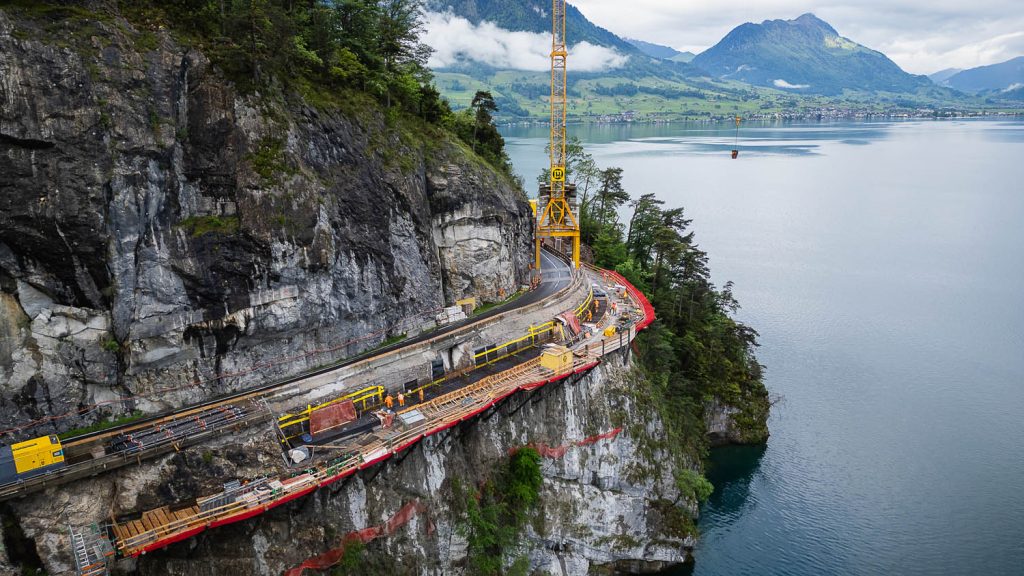
Main image: Alpine infrastructure on Lake Lucerne in Switzerland, designed with Allplan Civil Copyright: Baenzinger Partner AG