
As AI sweeps into AEC software development, the ‘how, why and what’ of implementation and future capabilities are the subject of much debate. Martyn Day spoke with Ian Keough, the developer of Hypar, an AI-powered cloud platform for generating buildings, to get his take on the subject
The AEC software debate around AI and BIM, vendor positions are solidifying.
At Motif, Amar Hanspal wants to rebrand the ‘I’ in BIM, transforming it from ‘information’ to ‘intelligence’, to build a platform that enables firms to encode decades of hard-won judgement as a queryable institutional asset.
At Qonic, Erik de Keyser is building self-evaluating models, where classification, compliance and coordination become autonomous, rather than periodic.
Discover what’s new in technology for architecture, engineering and construction — read the latest edition of AEC Magazine
👉 Subscribe FREE here
At Snaptrude, Altaf Ganihar is pushing Universal Graph Representation and modular AI ‘delegates’ for the highest-friction tasks.
At heart, each of these efforts is a schema-building exercise, a bet that the path to intelligent BIM lies in richer, more structured descriptions of the built world.
At Hypar, by contrast, Ian Keough (the original creator of Autodesk Dynamo) is betting the other way. He suggests that agentic AI is anything but new.


“It’s like one of those time-lapse videos of a glacier melting or flowing,” he says. “You don’t realise that the glacier is moving, but [it is]. It’s just moving on a different timescale. That’s like all of architecture.”
Architects, by his reading of the situation, have always orchestrated agents. It’s just that they’re typically called consultants. As I put it to him, the RIBA and AIA stage-gates have codified that glacial pace into the economics of fees and deliverables. He agrees, saying that the real novelty in 2026 is not the agentic structure itself, but the possibility of running it at conversational speed.
The consequences stack up quickly, by his reckoning. If the agents were always there, most of the artefact generation that follows a design change is pure toil.
“Having some structural engineer who got a Masters in structural engineering from UC Berkeley sit down and build a Revit model is a complete waste of time,” he says. The insight, the system selection, the judgement involved – these, he argues, are what you hired the engineer for. The Revit model is just a by-product, and in a properly agentic workflow, a generated by-product.
Back in the day
None of this works if you try to build it on top of Revit, Keough insists. “Even when we were building Dynamo back in the day, we always knew that it’s unfortunate that we have to build this on top of Revit, because Revit was never made to interact in this way. We’re always just going to be riding on top of this thing that’s fighting us.”
His view of Autodesk’s Model Context Protocol (MCP) play is that it is plumbing, not foundation. “This can’t be an MCP layer that reaches down into Excel and fills in fields,” he says.
That chimes with my own analysis. When you price the Autodesk Platform Services (APS) tokens, the business model of running a live clash detection agent across Collaboration for Revit collapses before that agent has delivered any value.
This is where Keough diverges from his peers, and from my own position. I have argued in these pages that the industry needs BIM as a substrate for agents to collaborate across tools.
Motif’s Hanspal wants a platform that encodes a firm’s proprietary intelligence.
Snaptrude’s Ganihar wants a rich universal graph. Qonic’s De Keyser wants embedded validation. All three are, in different reg-isters, schema work, formalising what buildings are, so that software can reason about them.
Keough’s substrate, to my eye, is thinner and stranger. Take a picket fence, for example. He argues that the language model al-ready knows what a picket fence is. “We are both now connected to everything that’s ever been said about picket fences, to every rule and guideline and piece of code that’s ever been connected to the concept of a picket fence.”
In that move, the representation problem and the knowledge problem separate. The ontology-first approach that underpins the IFC format, he suggests, quietly becomes redundant.
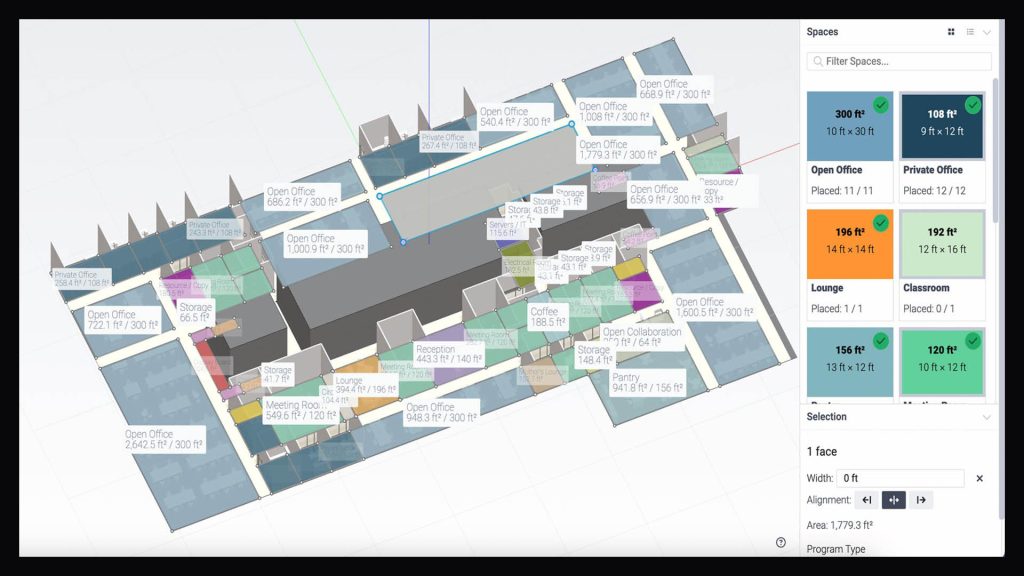
Hypar now ships a flexible component that is literally a sized box or a cylinder, and when rendering is needed, image-to-model inference handles the detail at generation time.
That is a very different wager to make. Keough is betting on inference to collapse the lot. Where Motif’s Hanspal treats institu-tional knowledge as a competitive moat to be captured and owned by the firm, Keough sees the useful knowledge as already public and lexically connected through the model. Where Snaptrude’s Ganihar builds a relational graph to give the AI structured ground to stand on, Hypar lets naming and inference do most of that work. Where Qonic’s de Keyser embeds validation as error-checking on finished models, Keough puts it upstream, in the generation loop, as agentic course-correction. If Keough is right, decades of schema work in AEC – from IFC to proprietary element libraries – become unnecessary scaffolding.
Generative vs deterministic
Keough’s wager is not one I’m fully ready to make yet. The SDK and standardisation work carried out by Antonio Gonzalez at That Open Company matters, to my mind, precisely because vibe-coded tools will otherwise spread through firms as undocumented, unmaintained dependencies. A purely semantic substrate does not address that issue.
One of Keough’s own venture capital investors once told him that the first slide of his pitch deck should include the word archi-tects, with a red line slashed through it. He was entirely right to refuse. Disintermediating the profession is firing at the wrong tar-get. His counter-move is to widen participation instead, to the ring of clients, estates teams and junior consultants who never learned Revit, but could make valuable contributions if the tooling allowed them to do so.
That is the right instinct commercially, but it does not answer the question of who is on the hook when a junior consultant drops an MRI machine into a healthcare scheme, the clearance zone is wrong and the error only shows up once the equipment arrives on site. BIM schema may be slow and heavy, but they are what makes tool behaviour predictable enough to get sign-off, not to mention predictable enough to insure.
To date, the legal frame has not caught up with the semantic one. On the subject of Autodesk, Keough is more generous than most, holding up Microsoft’s acquisition of GitHub as evidence that incumbents can indeed pivot under clear leadership. Whether that model applies in San Francisco is, as ever, an open question.
Either way, Keough is one of the AEC software community’s most eloquent speakers and deeper thinkers. His presentation at NXT BLD 2025 was one of the best.
His talk at NXT BLD 2026 (London, 13-14 May) promises to be just as thought-provoking, as well as giving attendees fresh insight into what as-yet undisclosed developments are coming next from Hypar.