
HVAKR pulls together HVAC load calculations and duct layouts in a single cloud platform with an AI agent sitting on top. As Martyn Day reports, this provides further evidence that discipline-specific AI is landing in engineering software faster than it is in the main BIM platforms
Engineering software is where AI is starting to show real, verifiable productivity gains in AEC. While the BIM 2.0 debate over what will replace Revit rumbles on, discipline-specific tools for structural, MEP and electrical engineering are already shipping AI agents into live workflows. HVAKR, aimed at mechanical design, is one of these tools.
A classic shed-to-Techstars story, HVAKR’s web-based HVAC design platform was built 2021-2023 by the company’s co-founders Andres Krippner (CEO) and Davis Muxlow (COO), with development assistance from Dayton Muxlow. The California-based company was a member of the Techstars 2024 cohort and has since matured from a bootstrapped start-up to a young company actively onboarding MEP consultancies and launching its AI-based tooling.
The company’s mission is straightforward: to replace the mess of scattered Excel files and desktop applications that continue to underpin most mechanical design work with a single cloud-based and AI-powered platform. This covers the full workflow from load calculation through to duct layout in a single environment.
Discover what’s new in technology for architecture, engineering and construction — read the latest edition of AEC Magazine
👉 Subscribe FREE here
Task-splitting risks
Mechanical consultancies have traditionally split these tasks across multiple disconnected tools, typically Trane Trace or Carrier HAP for loads and a separate CAD layer for physical distribution.
Any late-stage architectural change has meant re-entering data by hand on both sides, a process that comes with the risk of the load model and the duct layout drifting apart.
HVAKR, by contrast, brings the two sides together into one project — so a change to glazing or occupancy propagates in a single pass through loads, airflows, coil sizing and duct annotations.


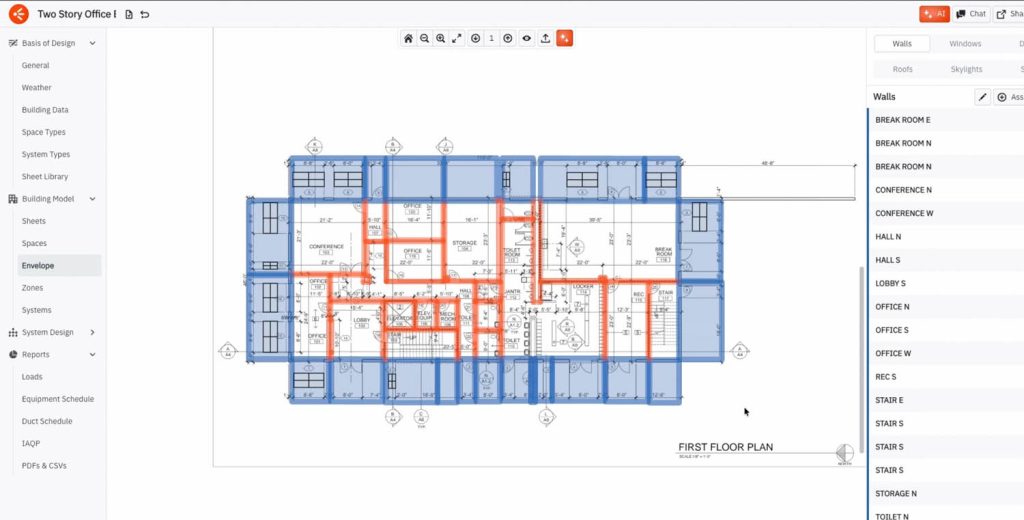
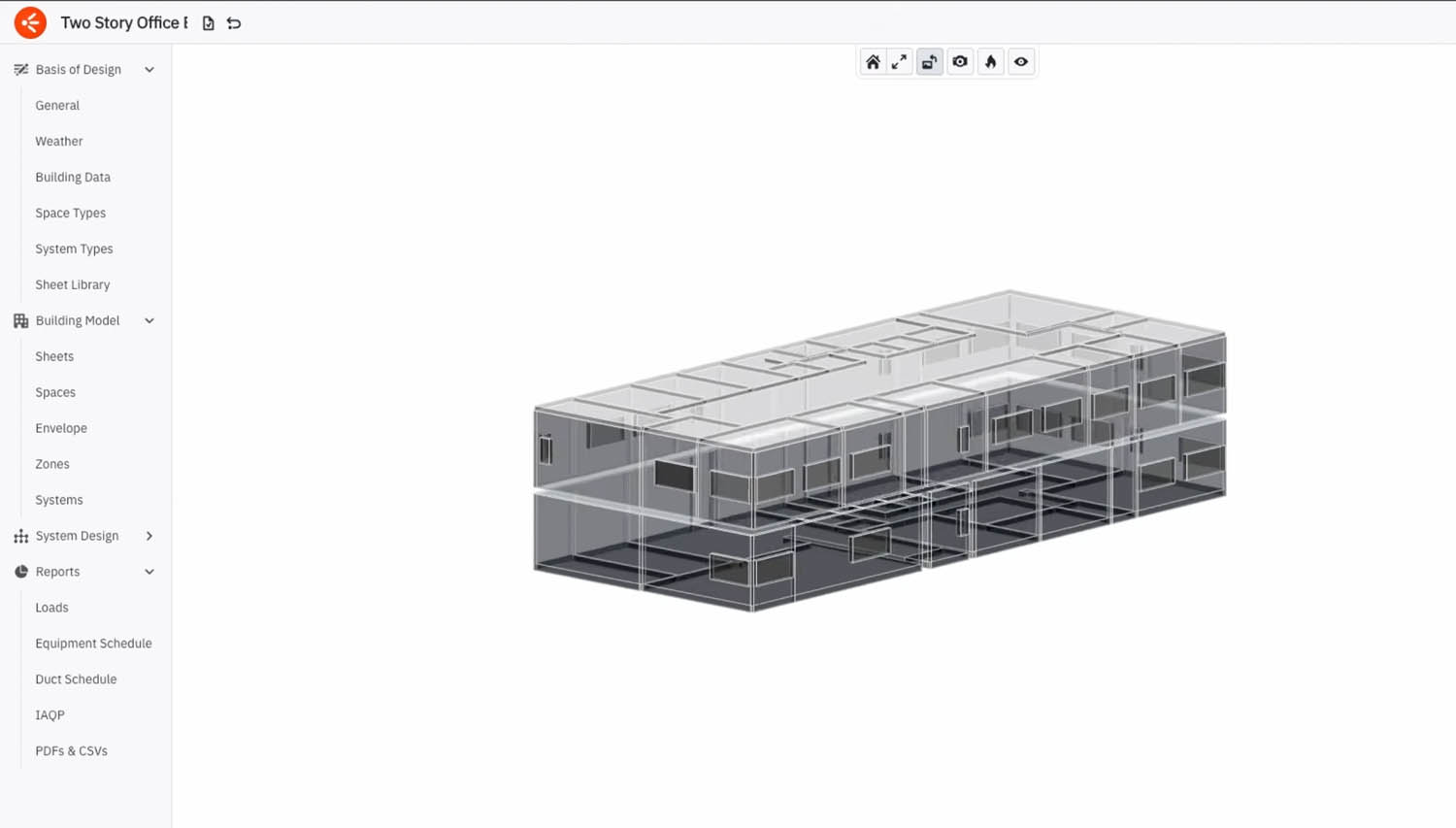
The design process itself follows a familiar sequence: basis-of-design set-up; visual take-off from imported floor plans; zoning and system assignment; load summaries with psychrometric detail; and dry-side duct layout with automated CFM assignment and annotated 2D output.
It’s especially valuable at kick-off and bid meetings, where engineers need to have order-of-magnitude load figures long before detailed plans exist. Satellite imagery and generic template envelopes let a rough block load be produced in minutes rather than hours.
HVAKR and AI
HVAKR’s AI layer is the aspect most likely to interest readers who are tracking the broader agentic story. The company markets its AI as a mechanical design agent and positions it as the digital equivalent of an engineer in training.
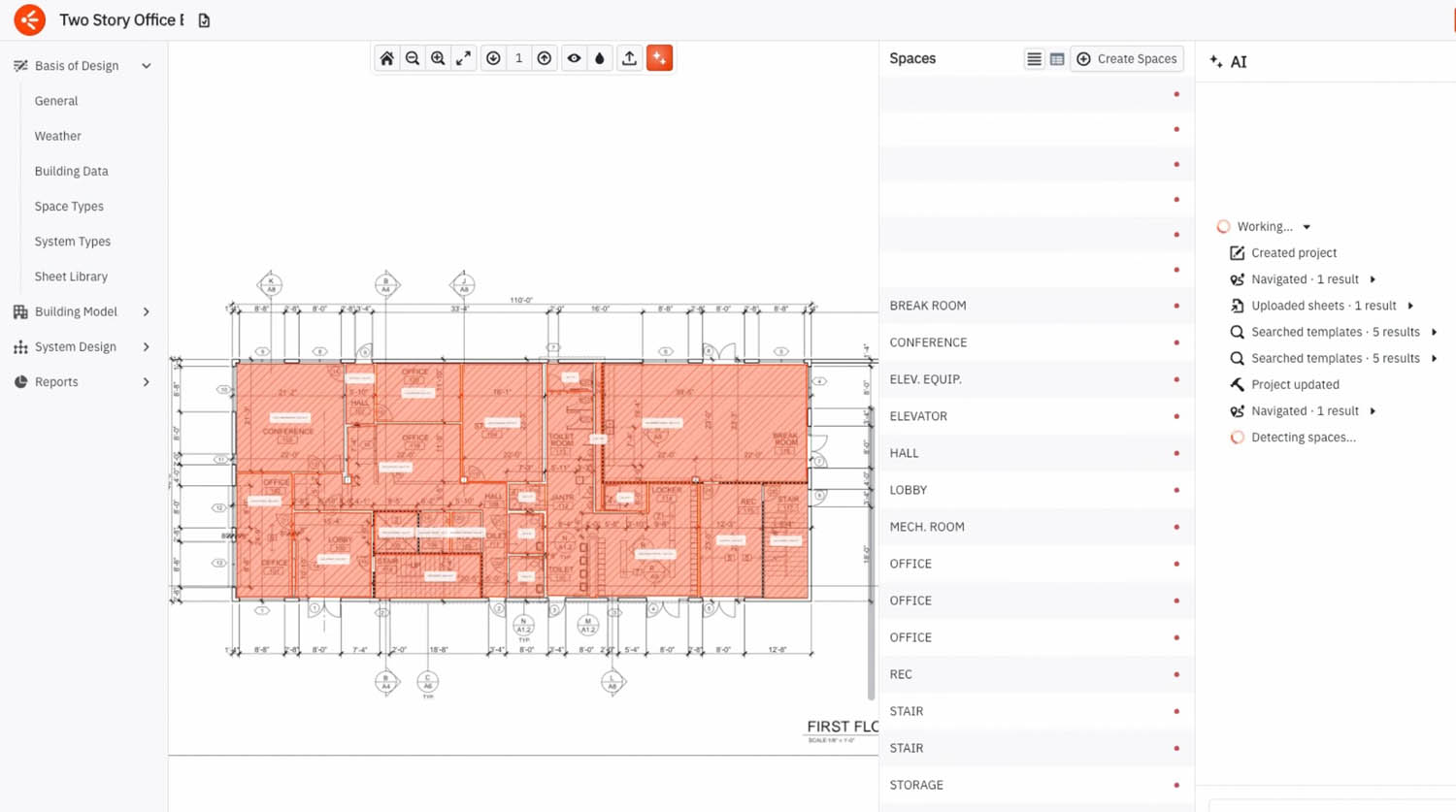
Given an architectural drawing and a natural language prompt, it will carry out initial project set-up. It will model spaces, assign zoning and define envelope properties. It will accept bulk edits in plain English, such as changing window heights across an entire model or assigning ASHRAE 62.1 space types to every space with a given name. It will run analytical queries; for example, flagging the spaces with the highest cooling load per square foot and pointing at the driver, which gives the senior engineer a quick way to sanity-check where a design is pulling energy.
Future work announced by the company includes automated diffuser placement, generative duct routing and A-versus-B system comparisons.
One of the reasons HVAKR attracts customers is that its interface is built around PDFs. It’s super-easy to use. Engineers upload architectural PDFs directly, which is how floor plans already arrive at most MEP consultancies, either from a Revit export or from the architect’s drawing set. There is no requirement to work from a BIM model, and no separate file format to learn. That keeps the onboarding overhead low and it means the AI can be pointed at project inputs the consultancy already has.
AI across MEP
HVAKR is one of a small but growing group of discipline-specific AI tools. This group also includes Augmenta, which is applying a similar approach to electrical design, automating power distribution and containment routing. Endra focuses on structural engineering. Norwegian start-up Consigli, meanwhile, is positioned as an ‘autonomous engineer’ across space planning, MEP loading and modelling. The company was acquired by AECOM in November 2025 for approximately $390 million, providing a clear signal that the market is beginning to value this category.
On their own these products do not prove a trend but the pattern across them is consistent. Discipline-specific AI is shipping, consultancies are using it and the productivity claims made for them are specific enough to be tested against billing timesheets, rather than accepted on faith. For MEP consultancies still running loads in Trace and layouts in AutoCAD, HVAKR is worth a closer look.
Attendees at NXT BLD 2026 (London 13 / 14 May) will have the chance to meet HVAKR’s founders and see first-hand how they apply AI to dumb PDFs for rapid analysis.