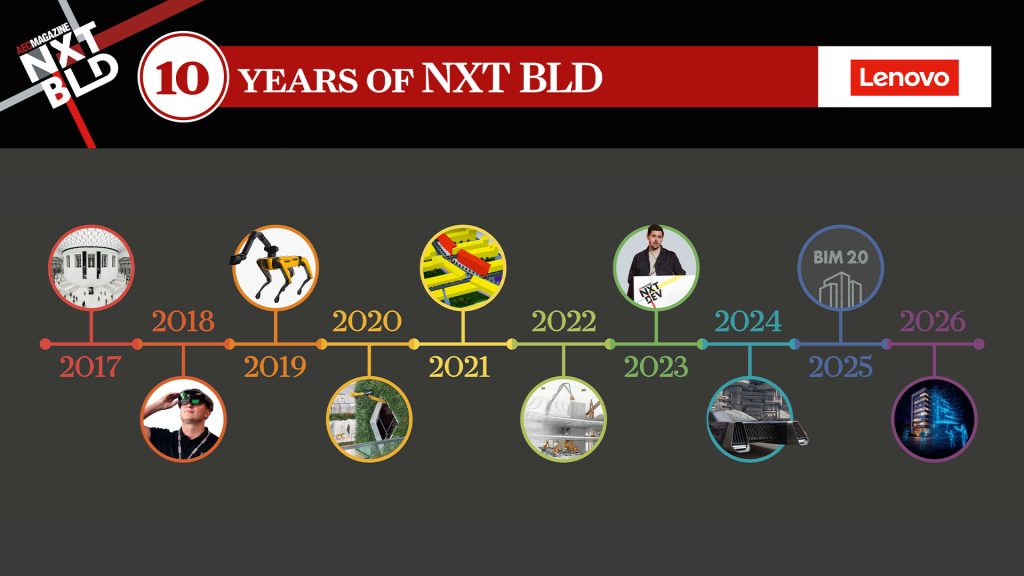

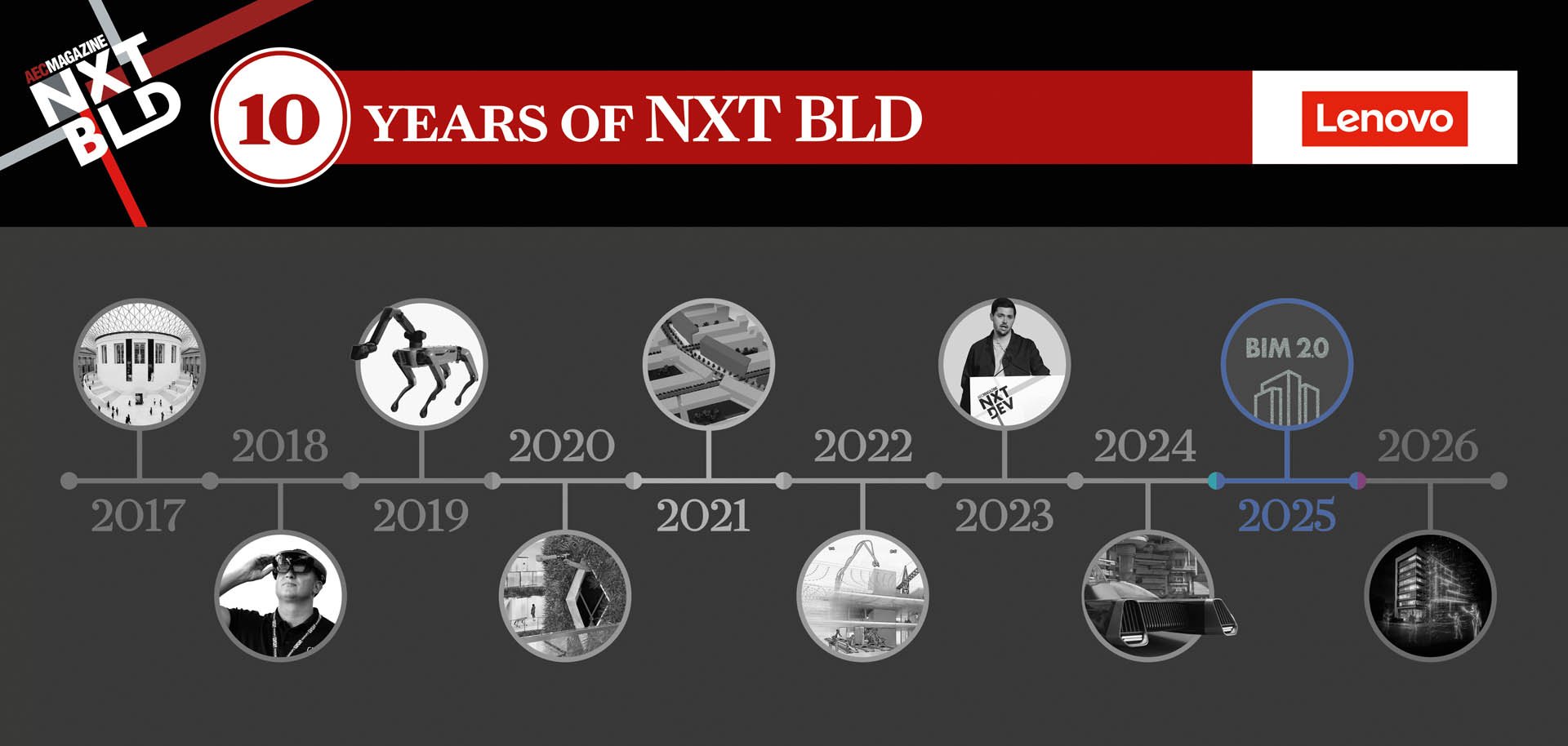
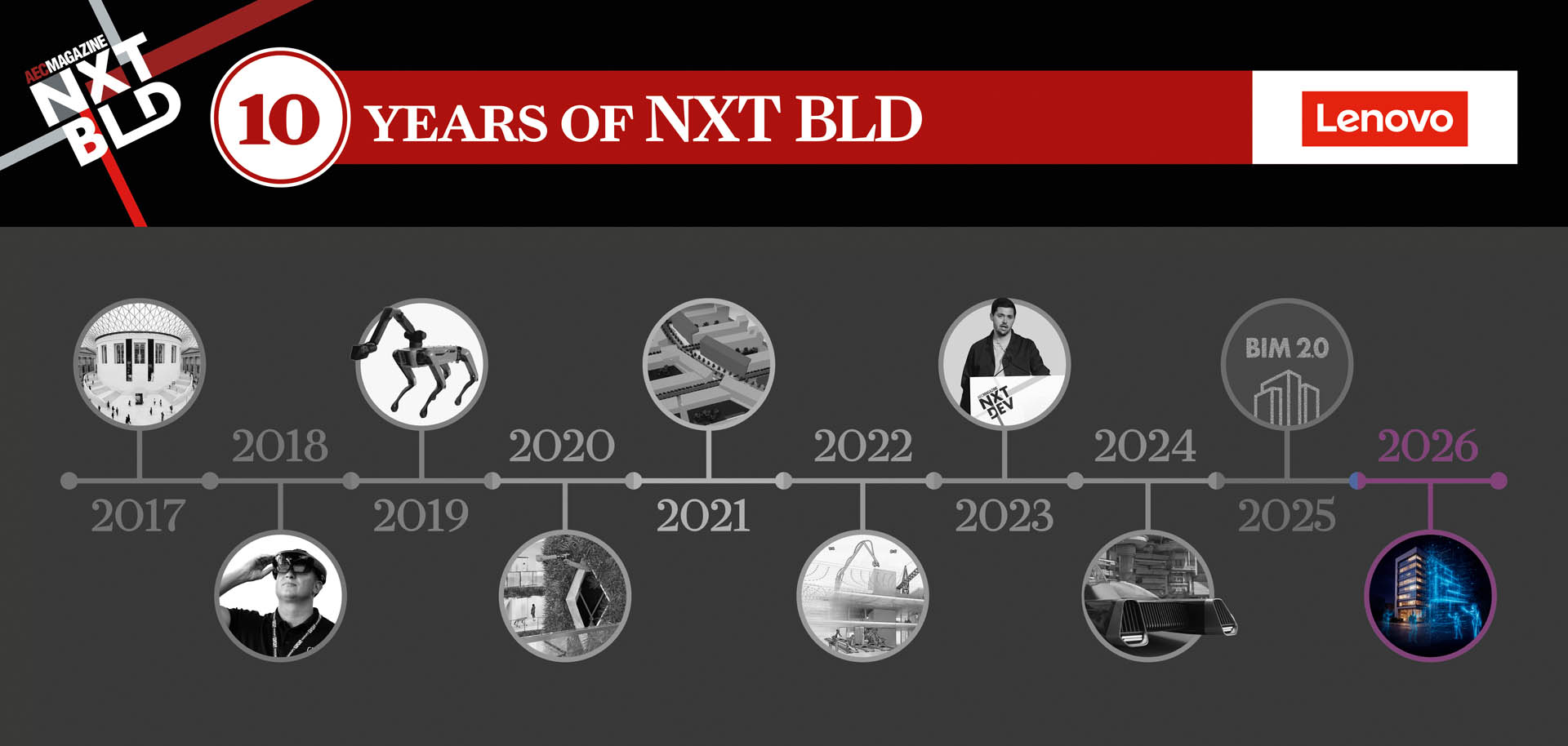
As we approach the 10th anniversary of NXT BLD (London 13-14 May 2026), we look back at the highlights, and industry shifts that have shaped our future gazing event
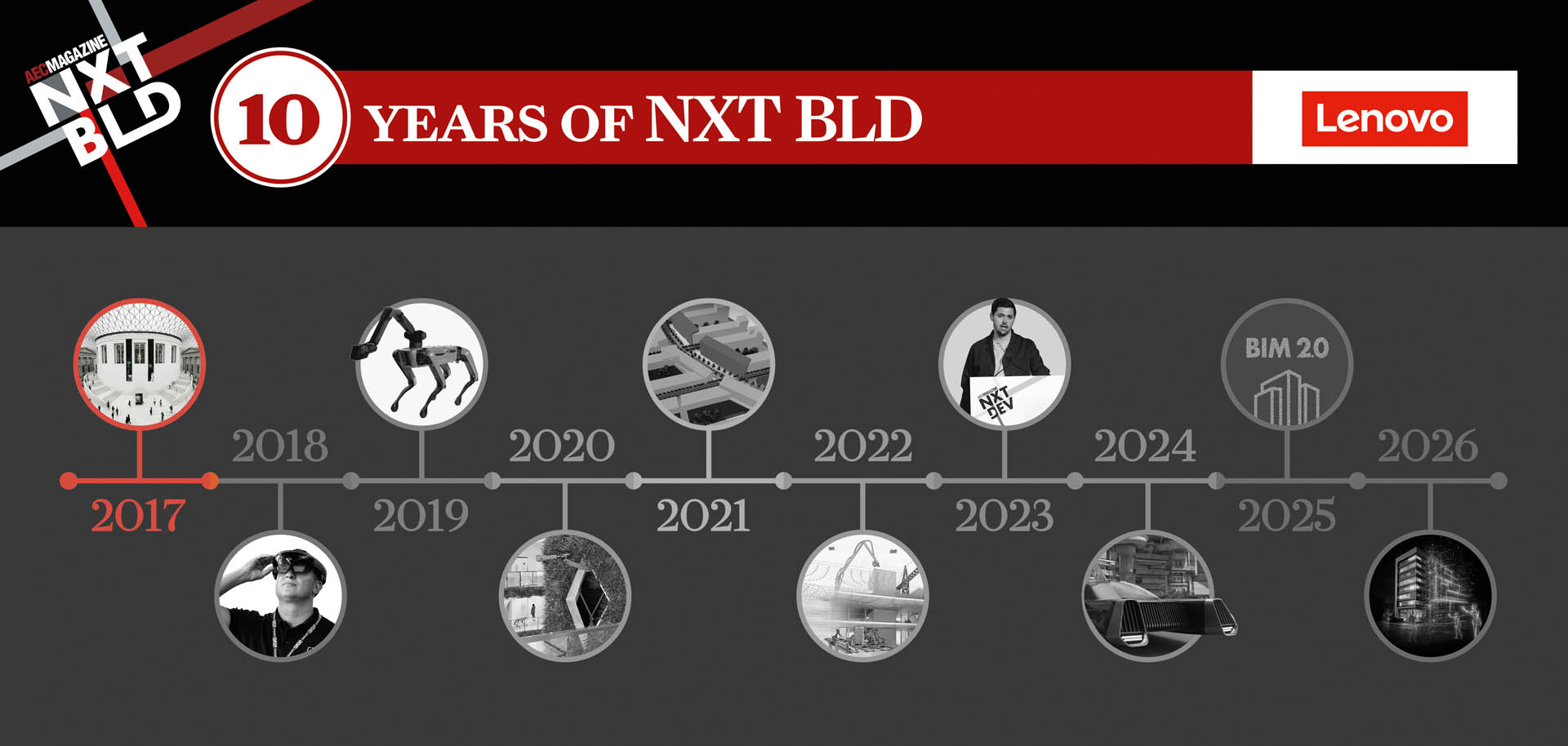
NXT BLD 2017
There was arguably no better place to host our inaugural event than the Foster-designed British Museum, bringing together 250 of the UK’s most forward-thinking AEC practitioners and technologists. With BIM now embedded and mandated, NXT BLD shifted the conversation decisively beyond it—towards VR, AR, real-time rendering, scanning and drones, alongside early signals from AI, robotics and model-to-fabrication. It marked a threshold moment, where digital design began looking outward to construction, automation and new ways of making buildings real.
NXT BLD 2018
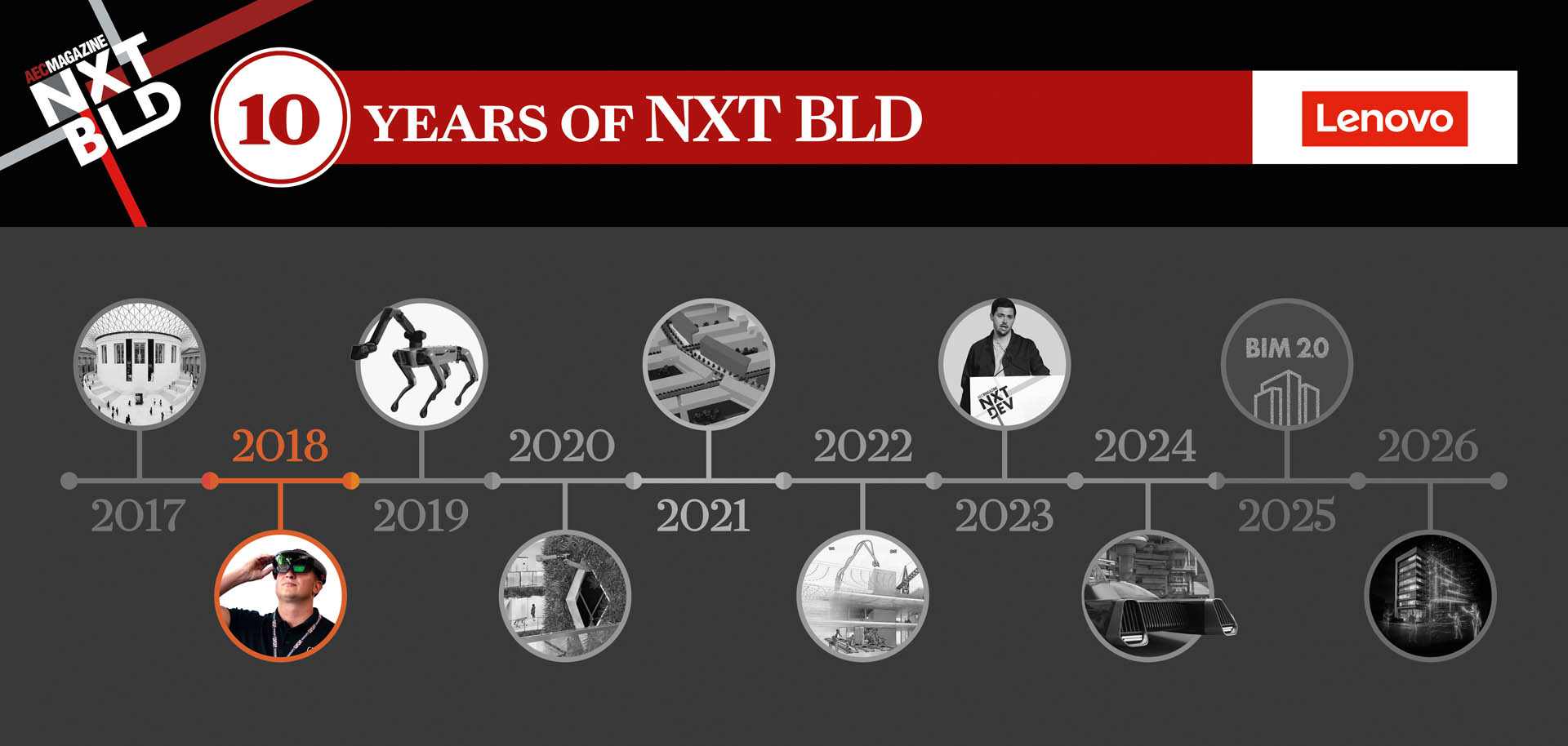
In 2018 the focus shifted to digital fabrication, as the AEC sector moved closer to an “art to part” future.
Bruce Bell of Facit Homes showed how bespoke houses can be designed in Revit and manufactured on-site with a CNC machine in a shipping container. Stefana Parascho from ETH Zurich, demonstrated multi-robotic assembly systems, while Andrei Jipa pushed 3D-printed concrete into ultra-thin structural forms.
Marc Petit of Epic Games highlighted real-time design with Unreal Engine, while Dr Marianna Kopsida of Trimble introduced HoloLens for construction, merging BIM data with as built reality for QA and schedule planning.
NXT BLD 2019
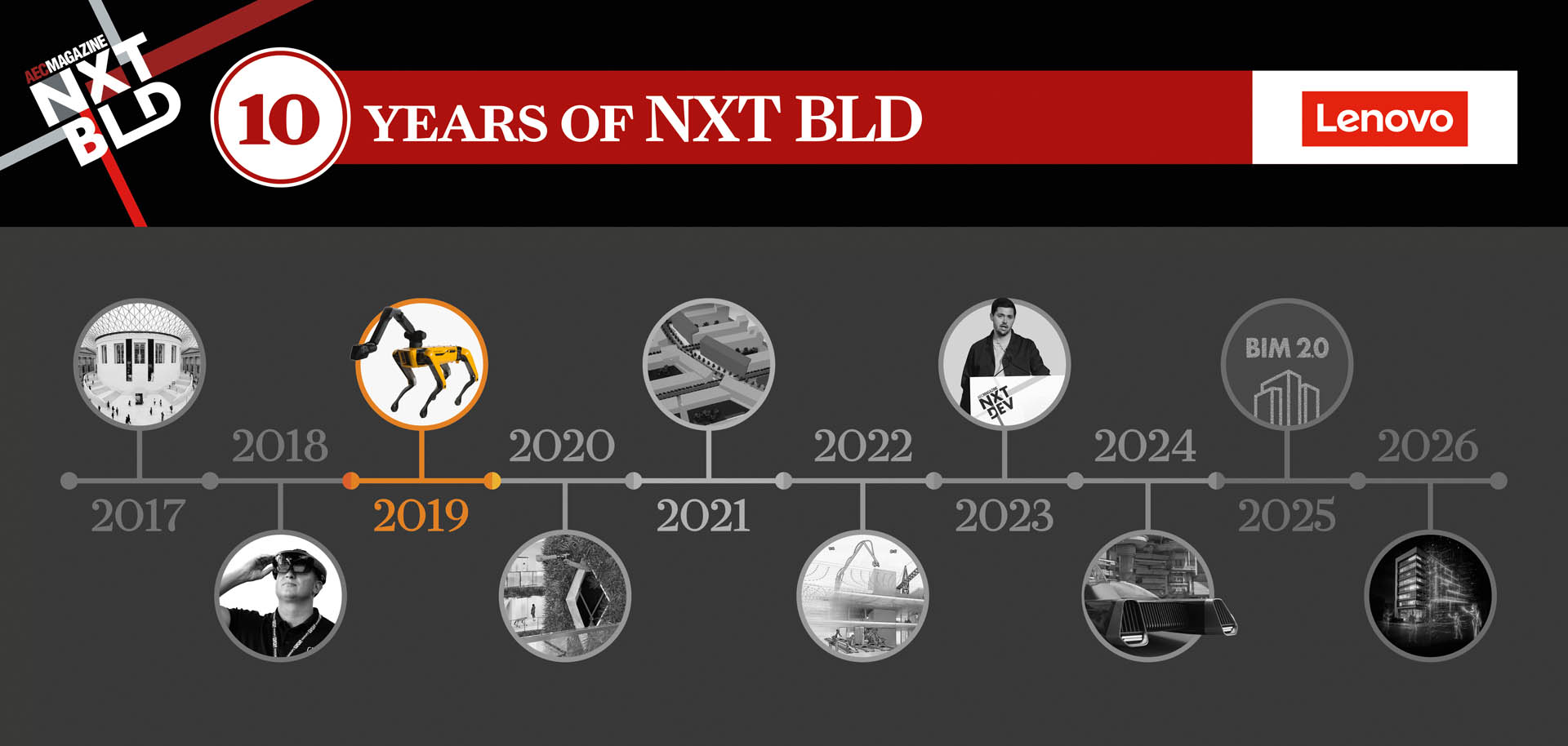
2019 was dominated by one undeniable star — Spot Mini. Boston Dynamics’ quadruped robot made its first UK appearance, walking straight onto stage and instantly stealing the show. Behind the scenes, Spot nearly didn’t make it at all after it got stuck in customs — adding to the sense that robotics had truly arrived, but not quite on our terms yet.
Faro and Topcon took full advantage of Spot’s visit, mounting laser scanners on its back to test automated reality capture for the first time. Meanwhile, real-time ray tracing truly came of age, with Nvidia RTX reshaping how architects visualise and communicate.
NXT BLD 2020
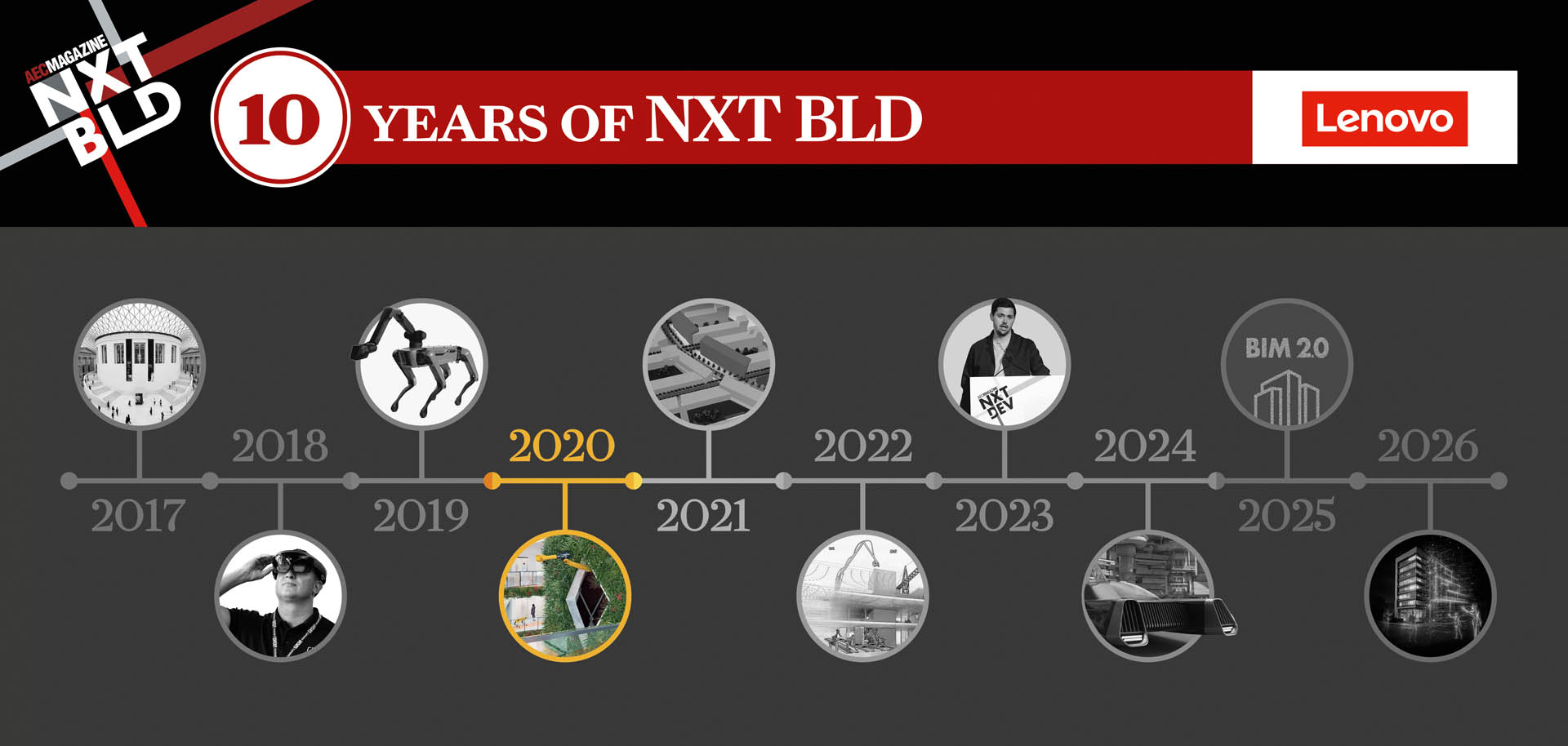
With the unwavering support of our partner Lenovo, with us since the very beginning, we hosted a virtual NXT BLD at the height of Covid, welcoming a global audience — from New York to New Zealand, Cape Town to Colombia.
The programme reflected a world in rapid change. The Open Letter to Autodesk group debated future AEC workflows, Royal BAM explored on and offsite construction, and Foster + Partners examined human–robot coexistence. Nvidia introduced Omniverse for collaborative design, while Lenovo showed how Covid had reshaped work and how its AMD Threadripper Pro workstation can transform AEC workflows.
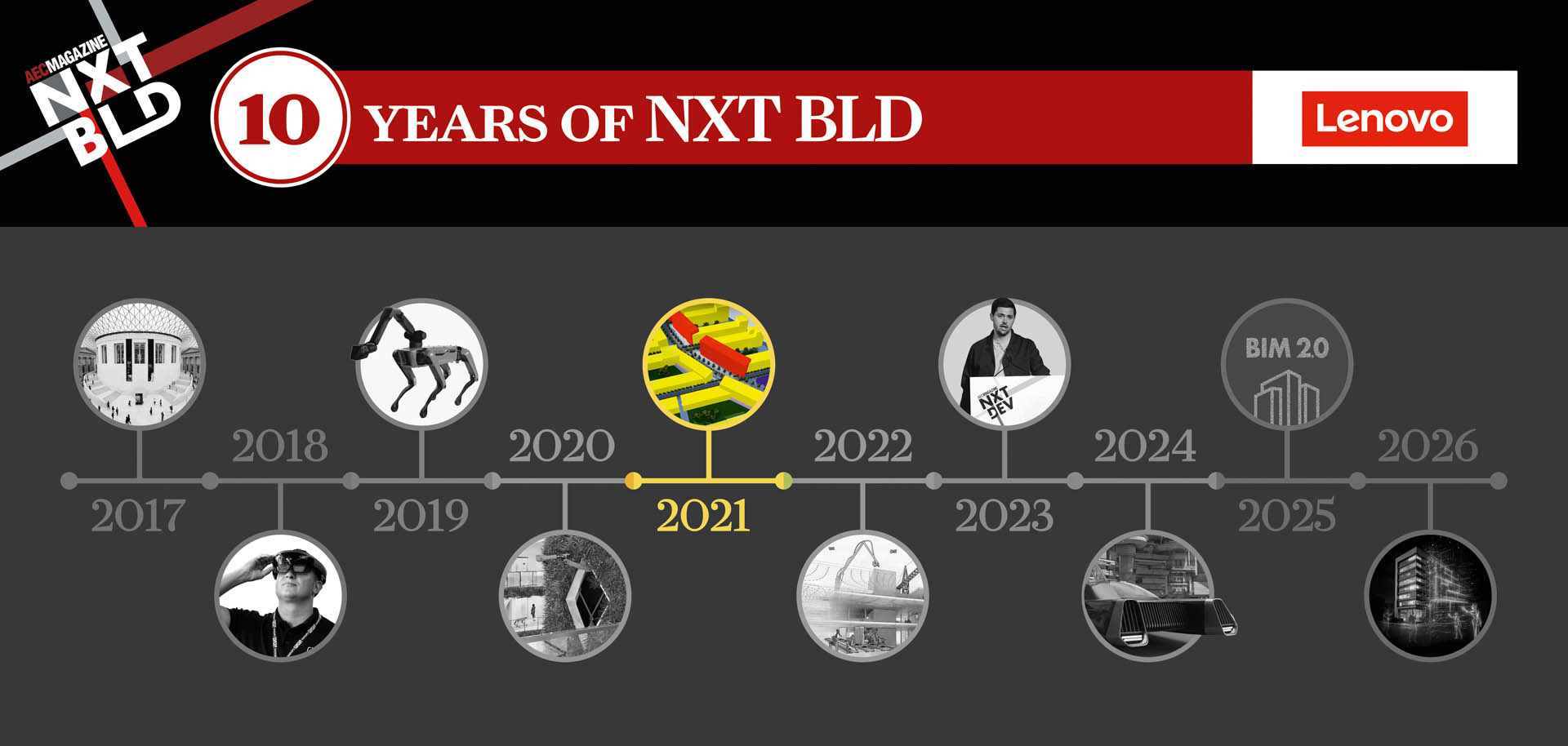
NXT BLD 2021
2021 welcomed the renowned Foster + Partners Applied Research and Development group for the first time, showing how computational design, optimisation, fabrication, AR/ VR, AI and simulation directly support projects.
Meanwhile, HOK’s Greg Schleusner challenged BIM’s document-centric limits, calling for open data flows and better connected tools. This call for action has since evolved into an industry collective, and a powerful open tech stack that is set to be unveiled at NXT BLD this May.
NXT BLD 2022
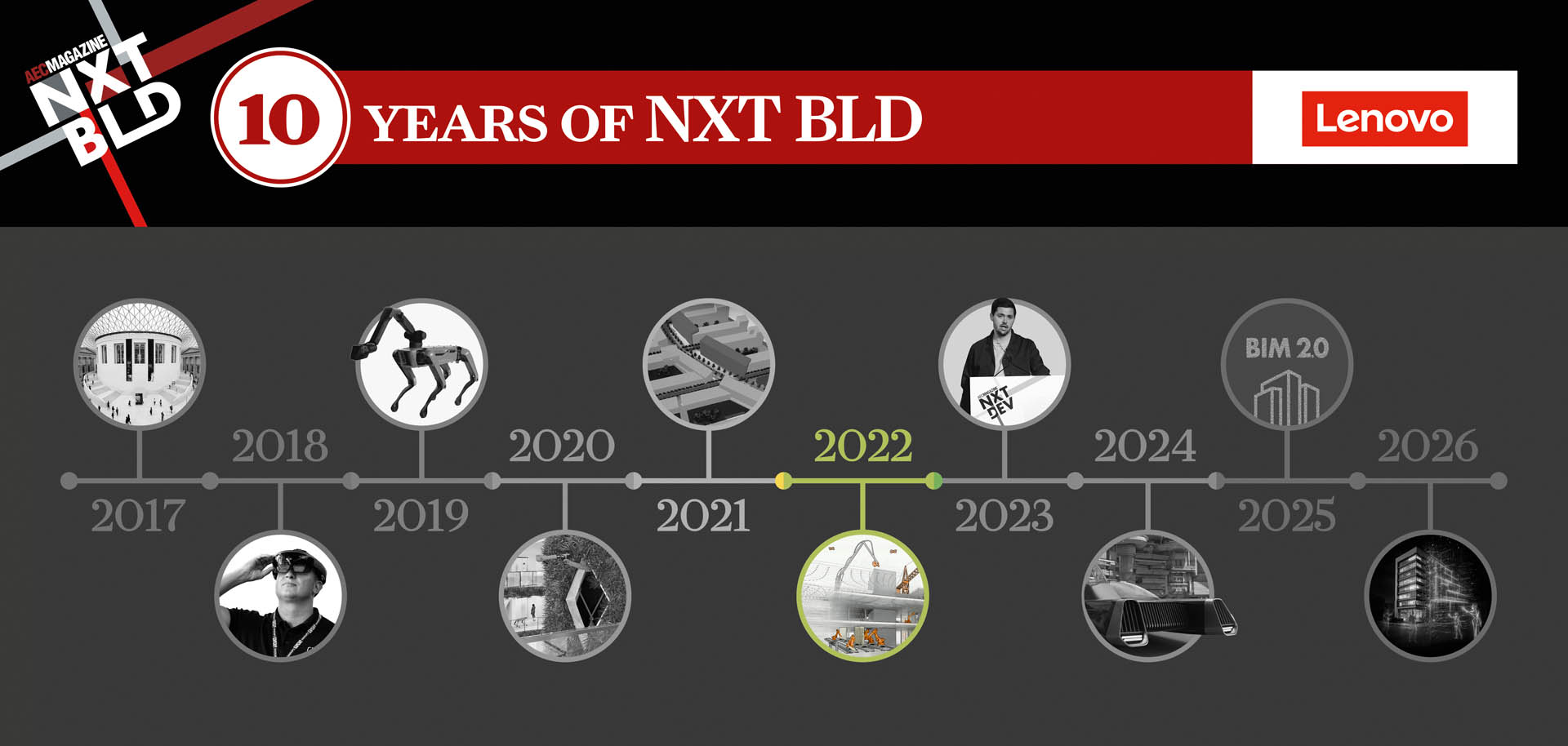
2022 was headlined by Michael Marks, co-founder of offsite construction unicorn Katerra and the first VC to speak at the event. His presence underscored the scale of disruption in construction, opportunities for startups, and planted the seed for NXT DEV in 2023.
Industrialised construction remained a key theme, alongside growing interest in AI and a rare glimpse into semiconductor fab prefabrication from Intel. Elsewhere, Conor Black of Arup explored the shift beyond parametric design towards cloud-based, knowledge-driven tools.
NXT BLD 2023
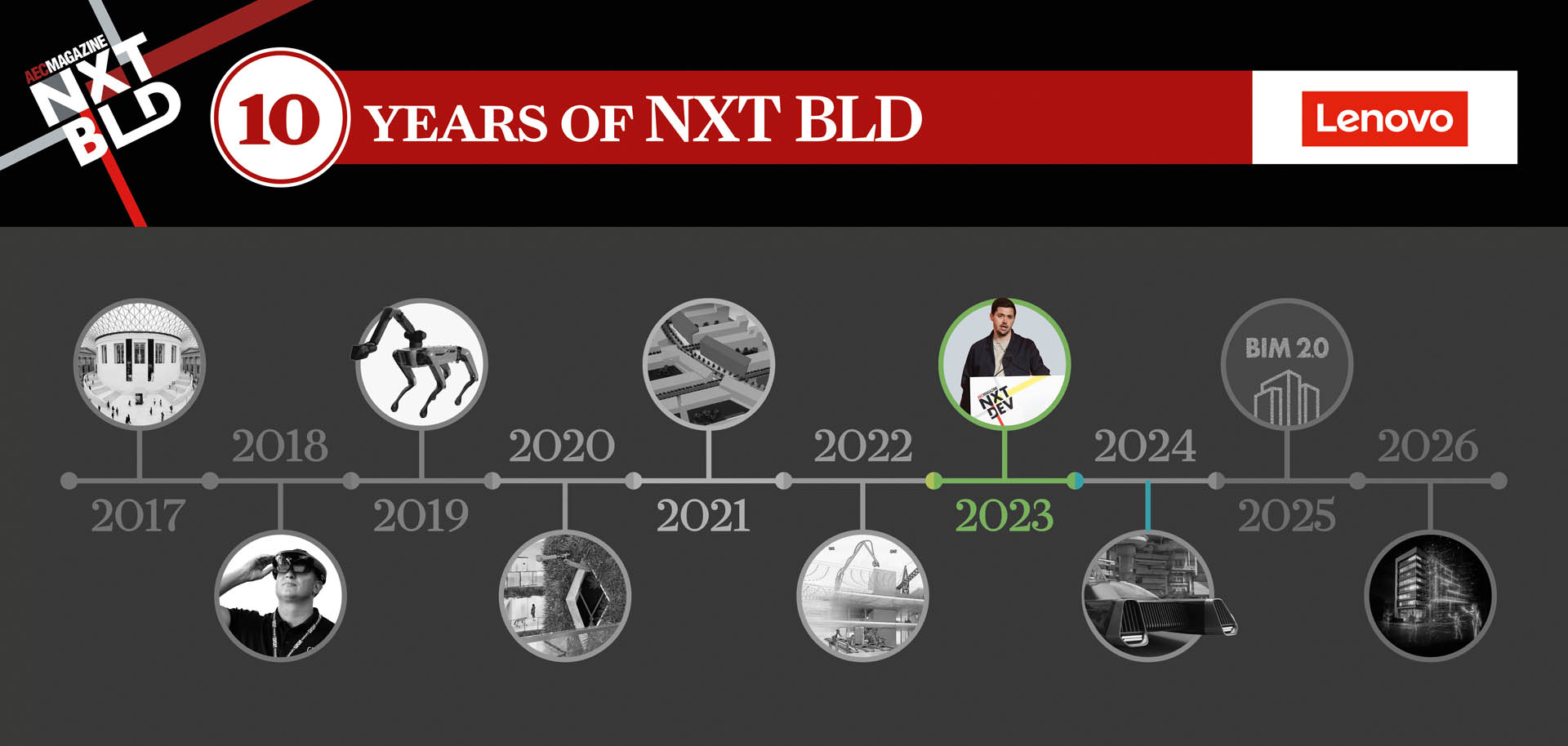
2023 expanded into a second day with the launch of NXT DEV, bringing together IT directors, software developers and financiers to shape the future of AEC software.
A standout moment came from Aaron Perry of AHMM, representing a collective of major AEC firms, unveiling the “Future Design Software Specification”—a vision for future tools and platforms. The talk remains essential viewing and is available here. Meanwhile, Foster + Partners highlighted how data underpins everything – optimisation, simulation, digital twins, AI and robotics.
NXT BLD 2024
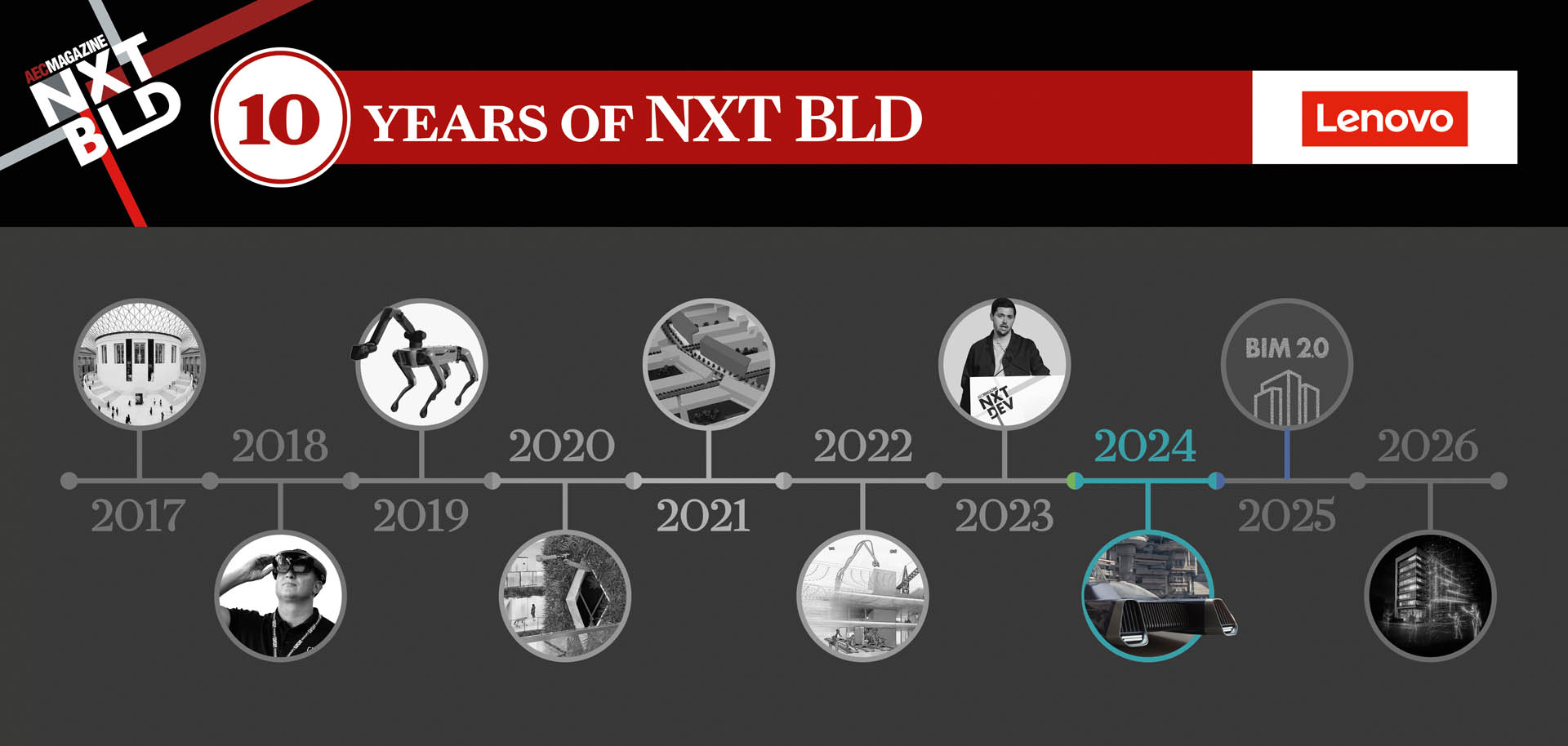
2024 centred on big debates spanning design automation, autodrawings, openness, AI, digital fabrication and BIM 2.0, alongside a very lively panel on licensing and business models.
Data remained a dominant thread, with Autodesk advancing BIM granularity, HOK’s Greg Schleusner pushing open data schemas, and Bentley Systems reinforcing the shift towards open ecosystems. Dale Sinclair introduced WSP’s “Kit of Parts” approach to streamline industrial construction.
And who can forget ILM, who opened the event with Hollywood-scale storytelling giving a behind-the-scenes look at Star Wars VFX?
NXT BLD 2025
2025 was the year that BIM 2.0 became real. For the first time, Arcol, Qonic, Hypar, Autodesk, Snaptrude and Motif took the same stage in rapidfire demos of next-gen design tools. Industry leaders including Heatherwick Studio, Foster + Partners, HOK, Bouygues, Perkins&Will and AECOM revealed cutting-edge workflows and R&D, while Buro Happold launched BoHM as an open, multidisciplinary data schema.
AI was everywhere: it was clear that firms are already starting to build in-house LLMs, coding with AI, and pairing data lakes with agents to create powerful internal tech stacks.
NXT BLD 2026
2026 will be defined by AI, open source, autonomous design, agentic BIM. Leading firms including Laing O’Rourke, Foster + Partners, Perkins&Will, HOK, and Buro Happold bring real-world insight, while MEP and structural software pioneers show how AI can automate design and challenge traditional RIBA-style phases.
With sessions on data, advanced construction, robotics, BIM 2.0, GeoBIM, apps-on-demand, data, reality modelling, autonomous drawings and more — plus the launch of several new software tools / platforms, including an open source agentic BIM data lake tech stack, NXT BLD is the place where the future of AEC software and practice collides.
Discover what’s new in technology for architecture, engineering and construction — read the latest edition of AEC Magazine
👉 Subscribe FREE here