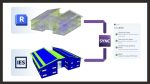

You probably know Palantir from its unusual CEO, or its ties to the military and the NHS. Now, it is targeting AEC, and positioning itself to integrate project, financial, and operational data into a single enterprise decision layer, for faster project control. For AEC vendors and contractors, the question is whether control of geometry still defines market power, or whether influence is shifting to whoever owns the semantic layer above the model
For two decades the AEC software industry has operated on a simple assumption, that control of geometry equals control of the project. Vendors have competed on modelling environments, coordination workflows, and document production, confident that whoever owns the model anchors the stack. That assumption is now under pressure.
Palantir Technologies is set to test it, not as a new authoring tool or a better common data environment, but as something structurally different. It is positioning itself as an enterprise decision layer that sits above design tools, Enterprise Resource Planning (ERP), scheduling systems, supply chains, and site sensors. The question for AEC firms and software developers is straightforward, if the orchestration layer sits elsewhere, what becomes of BIM?
System of record vs system of decision
AEC vendors have long fought to be the system of record. Whoever owns the model or the Common Data Environment (CDE) owns the project’s source of truth. Autodesk Construction Cloud (ACC), now part of Autodesk Forma, is positioned as a single source of truth for every project. Procore promotes unification of budgets, contracts, and field operations in one platform. Bentley Systems iTwin and ProjectWise revolve around infrastructure digital twins and document control.
Discover what’s new in technology for architecture, engineering and construction — read the latest edition of AEC Magazine
👉 Subscribe FREE here
Palantir’s ambition sits at a different level. It aims to become the system that governs enterprise decisions. Here, if labour planning, procurement risk, supply chain resilience, and capital allocation are controlled through an external semantic layer, the authoring tool becomes an input mechanism rather than the strategic core. Geometry flows upward into a portfolio platform where risk is priced and resources are allocated. For developers this introduces structural tension.
Modern AEC platforms expose APIs and SDKs to encourage integration. An external orchestration layer can ingest structured data at scale, observe workflow patterns across organisations, and build optimisation logic above the tools themselves. Over time differentiation migrates from the modelling environment to the enterprise runtime.
What Palantir actually does
Most practices and contractors have spent years rationalising their digital estates. Authoring in Revit or Archicad, coordination through a CDE, finance in an ERP, planning in Primavera, spreadsheets bridging the gaps. Integration exists, yet the semantics remain fragmented. A model may describe geometry in forensic detail, but it rarely encodes how labour allocation decisions affect procurement exposure, or how change orders cascade into enterprise cash flow.
Palantir argues that this fragmentation is the true inefficiency. Its Foundry platform ingests data from across silos and maps it into what it calls an ‘Ontology’, a structured representation of how the organisation operates. Objects such as Project, Subcontractor, Change Order, and Procurement Package are mapped alongside relationships, constraints, and permissible actions. Its mature and proven AI Platform allows AI agents to reason over that model and trigger governed decisions within defined guardrails. In practical terms this is not about drawing buildings, it is about running portfolios. The target buyer is not the BIM manager; it is the CEO.
Why construction, why now
Construction is capital intensive, schedule exposed, and operationally complex. Large contractors manage thousands of interdependent variables across labour, materials, logistics, compliance, and finance. Margins are thin and delays are expensive. Data is abundant but poorly unified.
Palantir’s bootcamp model — short intensive workshops designed to enable firms to build working prototypes on live data within days — reinforces its positioning. In earnings calls the company has cited construction examples where a two-day session produced a disruption management tool that reportedly delivered significant savings. The specific number matters less than the message to boards: speed to value at enterprise scale.
Bootcamps compress the enterprise sales cycle. A contractor that might spend a year evaluating software can see a working decision layer in 48 hours. That speed is persuasive, but once workflows are encoded into a cumulative semantic model, speed also becomes dependency.
Asymmetric lock in
Palantir’s Ontology is persistent and cumulative. It does not forget context after each interaction or completed project. Workflows, rules, and relationships accumulate over time. As more operational logic is encoded, switching costs increase.
Replacing one BIM tool with another is disruptive but achievable. Extracting years of encoded procurement logic, labour planning heuristics, and level decision models from a proprietary semantic layer will be materially harder. The platform becomes intertwined with how the business understands itself. Board level questions follow. Who owns the operational model? Can it be exported in usable form? What leverage accrues to the platform provider once enterprise dependence is established? These are governance issues that reach far beyond software configuration.
Reputational risk
Palantir’s expansion has been accompanied by sustained controversy linked to defence and immigration enforcement contracts. The company formalised a strategic partnership with Israel’s Ministry of Defense following the Gaza conflict in 2023. A June 2025 report to the UN Human Rights Council concluded there were reasonable grounds to believe the platform had been used in military decision making in Gaza. Palantir has also secured substantial contracts with US Immigration and Customs Enforcement for its case management systems. Based on what I have seen and heard from the company’s eccentric CEO, Alexander Karp, I do not feel reassured that we share a common morality.
Institutional investors including Norway’s Storebrand have divested on humanitarian law grounds. Soros Fund Management exited its position. Universities and public bodies have faced scrutiny over their relationships with the company.
For AEC firms operating in the UK and EU this matters. Public sector procurement increasingly includes human rights and ethical due diligence criteria. Pension fund backed developers operate under explicit ESG mandates. Association with controversial technology providers can influence eligibility on publicly funded infrastructure frameworks. This is not a moral aside, it is a commercial consideration.
What this means
For large contractors and infrastructure owners the appeal of deploying Palantir is clear. A unified operational model promises improved schedule resilience, earlier risk detection, and portfolio visibility that traditional project centric systems struggle to provide. The trade off is structural. Firms must decide whether they are building internal digital capability or outsourcing their decision architecture. If the enterprise runtime is external, strategic leverage shifts accordingly.
Palantir is positioning itself not as a new authoring tool or a better Common Data Environment (CDE) but as an enterprise decision layer that sits above design tools, ERPs, scheduling systems, supply chains, and site sensors
Smaller practices may not engage directly, yet as owners adopt enterprise platforms requirements cascade down supply chains. Reporting standards, data structures, and integration demands begin to reflect the owner’s semantic model rather than the designer’s preference.
The vendor dilemma
Incumbent AEC vendors face a constrained set of choices. They can attempt to build their own enterprise intelligence layers. Autodesk is making a lot of noise of its AI efforts throughout its applications. Bentley is embedding AI across its portfolio, including Copilot capabilities and connected data services. Nemetschek has acquired specialist AI firms. None of the vendors possess the horizontal data integration breadth that Palantir brings from defence, healthcare, and heavy industry, and all remain comparatively slow in delivering vertical intelligence tools at enterprise scale.
They can partner with foundation model providers. This carries a different risk profile. Foundation models provide inference services, they do not build persistent operational ontologies or embed engineers to encode business logic. The language model remains interchangeable infrastructure. The enterprise semantics stay under vendor control.
They can attempt to collaborate on open operational standards. An industry defined ontology for construction operations would blunt the risk of a single proprietary model becoming dominant. History suggests coordination at this scale between competitors is difficult. They can also lean into ethical positioning, emphasising transparent governance and absence of controversial defence applications, a potentially meaningful differentiator in European public markets.
Oddly, or perhaps not oddly, in America it seems to be the other way round. Anthropic has run into problems with the Pentagon, when the now aptly named Ministry of War demanded that Anthropic allow their key product, Claude, to be used in military targeting automation, as well as for spying on the public.
What none of the BIM developers can assume is that control of geometry alone guarantees strategic relevance. The most defensible territory remains deep computational intellectual property, geometry kernels, discipline solvers, compliance engines, and fabrication toolchains. For now, deterministic engineering logic remains harder to commoditise than coordination workflows.
Where power settles
The AEC industry has spent years debating interoperability at the file level. The emerging contest operates above it. If Palantir, or a platform like it, becomes the default operational layer for major contractors and owners, the consequences extend beyond software selection.
Pricing power migrates toward whoever governs portfolio outcomes, and innovation cycles orient around the platform that holds operational logic rather than the one that produces drawings. Ecosystems reorganise accordingly, vendors that once set the terms of engagement find themselves feeding data upward into a layer whose rules they did not write, and enterprise technology budgets increasingly flow toward the platform that integrates capital allocation with operational intelligence.
For large contractors and infrastructure owners the appeal of deploying Palantir is clear. A unified operational model promises improved schedule resilience, earlier risk detection, and portfolio visibility that traditional project centric systems struggle to provide
Once enterprise semantics consolidate in a single cumulative platform, third party developers optimise for that platform. Data pipelines standardise around it. Startups build extensions that assume its ontology as the reference architecture. The platform becomes the gravitational centre of the sector, and alternatives struggle to attract comparable ecosystem investment or strategic attention.
For contractors the calculation is whether the gains in speed and visibility justify long term dependence on an external platform that encodes how the business thinks and operates.
For vendors the question is whether coordination and document production, the functions most exposed to an orchestration layer, should remain central to their strategies or whether deeper computational territory offers a more durable position. For the industry as a whole, the issue is whether it defines its own operational data standards or allows that definition to settle inside a proprietary system one Palantir ‘bootcamp’ at a time.
In the age of AI, the decisive shift to deliver the long hoped for efficiencies of Lord Egan will certainly not be about better BIM models. It might well be about who builds the most popular and powerful AI decision layer above the traditional design workflows, and on whose terms they will be.