
Trimble Connect platform introduces AI agents and automation to improve project coordination, manage risk and streamline workflows
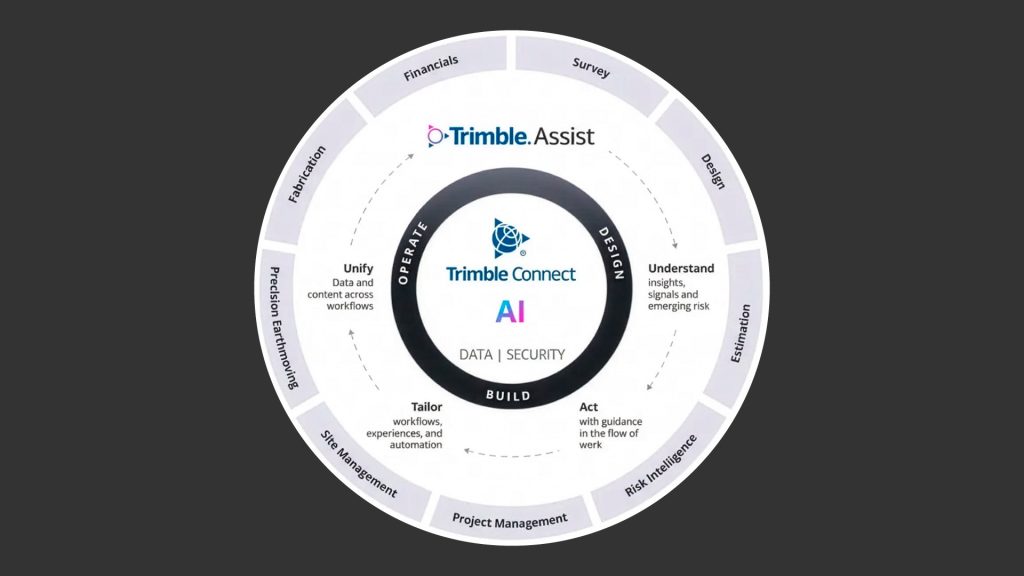
Trimble has embedded AI within Trimble Connect, expanding the platform beyond its traditional role as a common data environment (CDE) to connect site information with design, cost and operational workflows. The new capabilities are intended to help teams identify and mitigate risks across the project lifecycle, while keeping human judgement at the centre of decision-making.
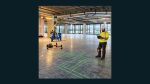
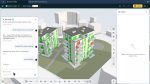
Unveiled at Trimble’s Dimensions User Conference, the AI capabilities span design, construction and project operations. In design, they include generating architectural options using live as-built point-cloud data, converting natural-language prompts into constructible structural models, and automatically classifying scanned point clouds into structural elements. For construction teams, applications include AI-powered diagnostics for machine-control systems, converting 360-degree site walk videos into 3D point clouds, and voice-driven site inspections that automatically transcribe observations and link them to project drawings.
Discover what’s new in technology for architecture, engineering and construction — read the latest edition of AEC Magazine
👉 Subscribe FREE here
For project operations, Trimble is introducing AI-powered procurement and invoice matching, contract risk analysis and change-order automation. An AI-powered scheduling capability also links project timelines with live site data, identifying potential delays, recommending mitigation measures and updating plans to help keep projects on schedule and within budget.
These capabilities are underpinned by two components of Trimble’s AI layer: Trimble Assist and Trimble Agent Studio. Trimble Assist provides a conversational AI interface through which teams can interact with AI agents and surface insights from across the Trimble ecosystem. Trimble Agent Studio enables customers to capture standard operating procedures and the institutional knowledge of experienced employees in customised AI agents and skills, helping to train and guide the next generation of workers.
Trimble says its AI layer grounds generative models in the physical realities of construction, combining leading AI models with project-specific data, field and machine telemetry, and the ability to act on insights within Trimble applications. The approach uses domain-specific knowledge from specialist workflows, rather than relying on general-purpose AI tools alone. It also allows teams and developers to build, configure, orchestrate, access and govern custom AI agents across project workflows.
“In construction, risk can enter a project at five major points: physical, informational, contractual, commercial and knowledge. Connection is how we help customers manage that risk,” said Rob Painter, president and CEO of Trimble. “The power of Trimble’s open platform lies in its ability to allow teams to identify real-world problems and enable rapid decision-making, all grounded in data from the work itself. By embedding industry intelligence within Trimble Connect, we are driving predictability and profitability across the built lifecycle.”