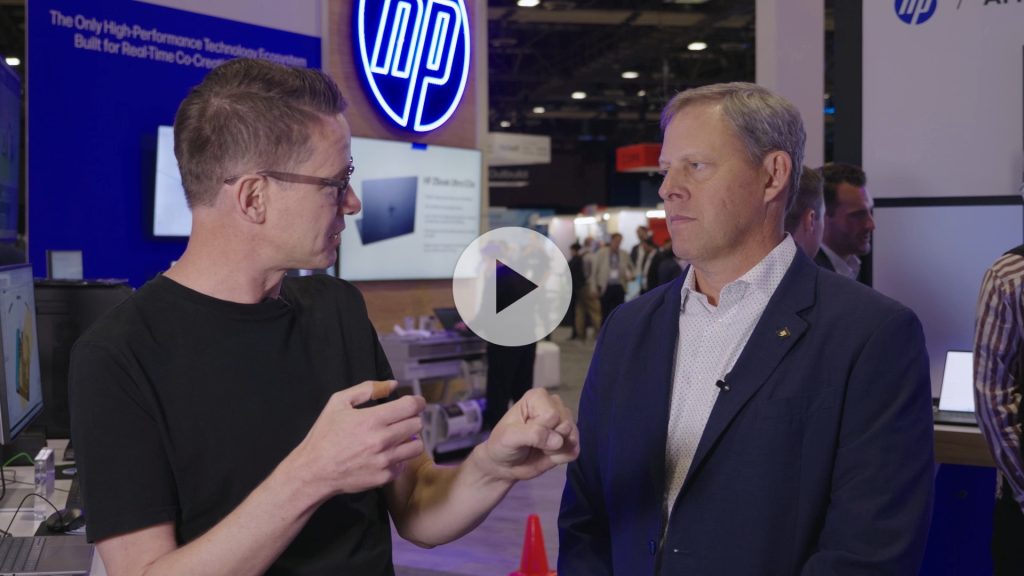

At Autodesk University 2026, AEC Magazine’s Greg Corke caught up with AMD’s David McAfee to talk about the Ryzen AI Max Pro, the processor behind HP’s new ZBook Ultra G3a, and what it could mean for firms that want to run serious AI models alongside Revit, viz tools and the rest of the AEC design stack.
For years, the AI conversation in AEC has been about cloud. The HP ZBook Ultra G3a, built around AMD’s Ryzen AI Max Pro, asks whether that has to be the case. With up to 192 GB of unified memory, of which a whopping 160 GB can be allocated to the GPU, it puts AI models once reserved for data centres onto a mobile workstation, and raises important questions about how design and engineering firms should buy, configure and plan their hardware.
The interview goes well beyond the launch of the HP’s new mobile workstation. Up for discussion:
- Bringing AI on-device: How a unified memory pool of up to 192 GB could let users run large models locally on a mobile workstation, rather than depending entirely on the cloud.
- Sharing the silicon: What happens to performance when a local AI model competes for resources with Revit and visualisation software running at the same time.
- Ending the BIOS hunt: How HP and AMD are working on simpler, more accessible controls for allocating memory, so users don’t have to dig into the BIOS.
- Buying for an uncertain future: The trade-off between the power efficiency of LPDDR memory and the fact that it can’t be upgraded later, at a time when AI requirements keep shifting.
- Drivers, CUDA and AI-assisted code: AMD’s work on professional drivers for Radeon GPUs, and whether AI-assisted coding could make it easier to port applications built for Nvidia’s CUDA to AMD’s ROCm platform.
- A tiered future for compute: AMD’s vision of a spectrum running from mobile workstations to the Threadripper Halo Station and the cloud, and where Radeon Pro fits as visualisation and AI workloads converge.
Meanwhile, read AEC Magazine’s first thoughts on the HP ZBook Ultra G3a, including how, with the help of Perplexity, desktop Revit workflows can be optimised using a fully local LLM and MCP Server.
Discover what’s new in technology for architecture, engineering and construction — read the latest edition of AEC Magazine
👉 Subscribe FREE here
Related articles:
Advertisement