
Designed to help customers understand what an AI feature does and its limitations, what kind of data it is trained on, and the protections in place
Autodesk has updated its AI Transparency Cards and made them available through Autodesk Assistant. Customers can question Assistant in natural language about an AI feature and receive an answer linked to the relevant card.
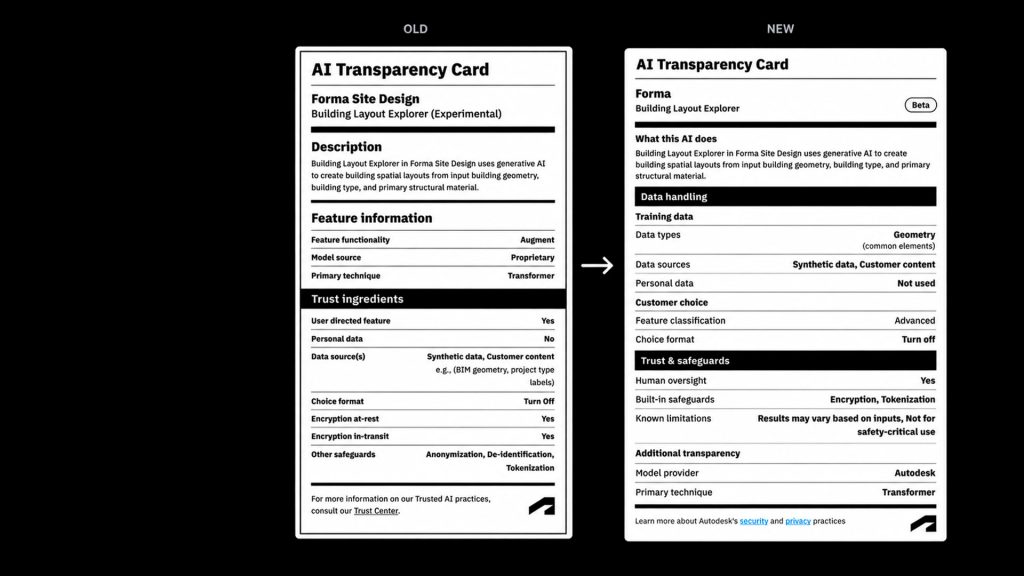
Introduced in 2024 and modelled on nutrition labels, the cards explain what each AI feature does, which models sit behind it, how it was trained, and what limitations apply. Customers previously accessed them through the Autodesk Trust Center.
The original cards had two sections covering feature information and “trust ingredients”. The updated cards provide more detail on data handling, customer choice, safeguards, and model providers.
Autodesk’s Sebastian Goodwin says customers had asked for more information about training and data protection. The company worked with Deloitte to test the cards using the Trust ID framework, which divides trust into humanity, transparency, capability, and reliability.
Customers answered questions about Autodesk and its AI features before and after reading a card. Autodesk reports that perceptions of transparency, reliability, and overall trust improved. Better understanding also raised expectations, leading Goodwin to conclude that transparency helps but cannot provide trust on its own.
Discover what’s new in technology for architecture, engineering and construction — read the latest edition of AEC Magazine
👉 Subscribe FREE here
Goodwin cites a customer who dealt with a client’s concern about using AI on a project by taking a printed card into a meeting. Putting the cards inside Assistant means the same information can be retrieved without leaving the application.


The feature is available now through the existing Autodesk Assistant. It is separate from the standalone, next-generation Assistant previewed at AU26, whose availability and licensing will not be announced until 2027.
What AEC Magazine thinks
This is a modest update, but one that practices can use immediately. Clients increasingly want documented answers about how AI will handle their project information, and the cards provide Autodesk’s response without requiring users to leave the application.
They remain vendor-authored descriptions rather than independent audits. The Deloitte research measured whether customers felt more trust after reading a card, not whether the feature became more secure, reliable, or accurate.
The addition of model provider information is useful, particularly if Autodesk uses different models for different tasks. Practices need to know which model handled a request, what information it received, where that information was processed, and whether it was retained or used for training.
There is a difference between documentation and evidence. A transparency card describes how a feature is supposed to operate, while an audit trail records what happened during a specific transaction. Cards will also need dates and version histories as Autodesk changes providers, models, and policies.
Assistant is effectively being asked to explain the AI used by Autodesk, which makes its link to the original card important. The next step is transaction-level provenance showing which model ran, what data it received, and what it returned. Without that record, customers can read Autodesk’s policy but cannot prove that a particular request followed it.