
Agent-first Assistant spans products, projects and teams to understand entire workflows
Autodesk is extending its agentic AI technology beyond individual tools to span products, projects and teams, while drawing on connected project data in platforms like Autodesk Forma to understand not just the question being asked, but the project behind it. At the same time, the company’s research division is testing something more radical: software with no fixed interface at all.
Speaking at the Autodesk University press briefing, Mike Haley, who leads AI and research at Autodesk, unveiled a new agent-first standalone Autodesk Assistant planned for 2027, and described a vision for the future where dynamic, AI-assembled experiences replace fixed interfaces, driven by speech and sketches.
Autodesk’s AI strategy is built around the idea that AI is only as good as the context it’s grounded in. According to the company, that means understanding the specialised constraints of real-world projects such as buildings, infrastructure, products, and manufacturing processes. “It’s not just a pile of text,” said Haley. “It’s geometry. It’s engineering intent. It’s the project history. It’s the relationships behind the work.
“You are not going to find context as rich as this in any other software product out there,” he claims.
Discover what’s new in technology for architecture, engineering and construction — read the latest edition of AEC Magazine
👉 Subscribe FREE here
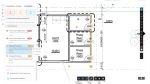
Autodesk gives an example of a structural change in a building. The next generation of Assistant can understand that change in the context of the project, identify its downstream impacts on fabrication, schedule, cost, construction sequencing, and operations, and bring forward the Autodesk capabilities needed to act. Professionals do not need to know which Autodesk product or AI capability to reach for.
A standalone, agent‑first Autodesk Assistant
Last year Autodesk introduced an AI-enabled version of Autodesk Assistant inside its core design tools, including Revit, AutoCAD and Fusion. The new standalone, agent‑first experience is designed for the many workflows that don’t live neatly inside one application.


Autodesk has observed that for every person that uses a core tool like Revit or Fusion, there are roughly ten more people around that project, such as project managers, who touch related workflows but never open the core design application.
With the standalone Assistant Haley explains that a much larger group of people can start finding value in the engines and the AI tools that Autodesk is building. He stresses that the “agent-first” Assistant is not a chat window bolted onto a CAD system, but an orchestration layer that surfaces issues before the user asks, pulls information from across a project, analyses how changes ripple through schedules and designs, and routes the right tool or agent to the right task.
“Our customers can spend less time figuring out where to go or which tool they need, and more time on their actual projects and moving them forward,” he said.
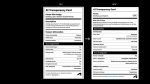
Customers can also bring their own tools and agents into the same agent environment. Under the hood, an AI orchestrator selects the best model for each task, based on “accuracy, speed, security, and cost.”
Haley stressed that the standalone Assistant does not replace the in‑product Assistants. Instead, they all run on the same platform.
Assistant Builder and predictable agentic workflows
One of the criticisms often levelled at AI systems in professional environments is their inconsistency. The same prompt can yield different behaviours from one day to the next. Autodesk’s answer is Assistant Builder, a way to create templated agentic workflows that combine the flexibility of AI with predictability.
Rather than manually wiring together tools, users describe what they want to achieve, and Assistant Builder then creates a multi‑step workflow, which can be templated and reused.
“You don’t want to have a different workflow every time you come and ask it because that day it just hallucinated a different thing,” Haley said. “You want to explain what you’re trying to achieve, have it create a workflow, and then template that for you, and now you can reuse it.”
At any point, users can return to that workflow, re‑prompt it to adjust behaviour, or refine its steps. The result, says Haley, is that “it becomes predictable” while still being powered by AI under the hood.
Geometry‑aware AI: Neural CAD and beyond
Autodesk is combining multiple strands of AI with traditional computation. Haley explained that Autodesk draws on its Neural CAD models that were first announced last year, which can “extract relevant geometric information out of drawings and 3D models”, plus decades‑old in‑house geometric engines, used heuristically for precise understanding of 3D models. “We don’t have to use AI if you want precision,” he said.
In some cases Autodesk will also use select third‑party models. “If there’s large amounts of language related stuff or dimensional things that some of the frontier models can read, we can use that information as well,” said Haley.
The standalone Assistant uses these tools to “bring all that geometric information and curate it into a special custom context for you.”
On the research side, Haley said Neural CAD for buildings has “significantly evolved” and can now generate and analyse site-layout options based on project constraints and goals.
R&D: towards speech‑driven, adaptive interfaces
If the standalone Assistant represents Autodesk’s near‑term product vision, its research organisation is already working several years beyond that.
Haley is clear about his team’s remit: “Our job inside Autodesk Research is to look five years ahead of the company, five years ahead of the industry.” That means exploring how AI might transform the interface itself, not just individual commands.
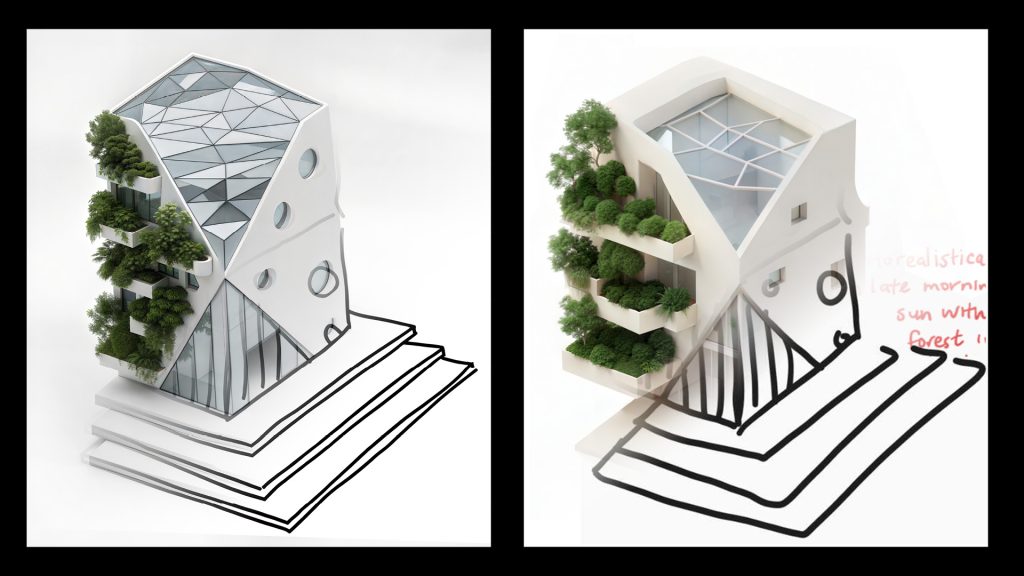
One of the most visible examples is Project Quill, an experimental system that asks what happens when designers interact with software through a blend of sketching, written annotations and spoken word.
Rather than clicking through static menus, designers communicate ideas “in a way that feels incredibly natural,” he said. Haley described this as “an entirely new interaction model for design,” where everything “just flows.”
“If you play AI forward there is no reason why we even need to type anymore,” he said. “We should just speak… If that could become the interface of software, then it does radically change how we would use software.
What AEC Magazine thinks
The important part of the Autodesk Assistant announcement is where it sits. The standalone version is intended to operate above individual applications, selecting the tools and agents required for a task. It becomes the front door to its portfolio rather than another chatbot inside Revit or Fusion.
The obvious comparison is Palantir. Its Ontology maps company data to real objects and relationships, then adds actions, functions, permissions, and governance. AI works against that structured representation rather than searching through disconnected files.
Autodesk appears to be aiming at a specialist version for “Design and Make”. Its industry clouds hold the data, Assistant receives the request, and AI Orchestrator evaluates the models and tools available for the task. Assistant Builder then brings customer and third-party agents into the same environment.
Autodesk has an advantage over Palantir because it owns many of the applications that create the original geometry and project records. It could connect design intent, approvals, changes, and actions at source. If it also controls the data, Assistant, agent marketplace, and orchestration layer, however, customers may find nearly every route through the project owned by Autodesk.
What Autodesk has not shown is anything that is as developed as Palantir’s Ontology. Connecting files and searching drawings does not create a live semantic model of a project. Nor has Autodesk described equivalent controls for agent actions, including permission checks, monitoring, action logs, and reversal when something goes wrong.
Those controls matter more than the chat interface. An agent working across design and construction software must know what it can change, record what it did, and provide a reliable way back when it gets something wrong.
AEC Magazine will explore Autodesk’s agentic AI strategy in more detail in our Autodesk University report.