
HighArc, the developer of a cloud-based BIM system specifically aimed at homebuilders, has just announced another significant injection of funding and is partnering with supply chain firms in order to build out its next-generation business model, writes Martyn Day
On 30 June 2026, BIM developer HighArc announced its $95 million Series C funding round led by Insight Partners, taking the company’s total funding since 2019 to around $175 million.
According to CEO Marc Minor, the latest cash injection came together quickly on the back of strong inbound demand, rather than necessity. It will support a workforce of some 215 people, around half of whom come from a background of homebuilding and architecture, rather than software development.
For the uninitiated, HighArc is not another BIM authoring platform in the mould of Revit. Instead, it is an expert BIM system built specifically for the American and Canadian timber frame housing market. This is a sector that still relied largely on AutoCAD and Excel when HighArc launched in 2018 and where projects often don’t involve an architect at all.
The HighArc platform is cloud-based and built on its own geometry kernel. Housebuilders work directly in plan, placing walls, doors and windows, while the system automatically dimensions, frames timber in real time, checks compliance against building codes and treats the house less as a drawing and more as a live ‘recipe’, where every design decision flows directly into a bill of materials.
Discover what’s new in technology for architecture, engineering and construction — read the latest edition of AEC Magazine
👉 Subscribe FREE here
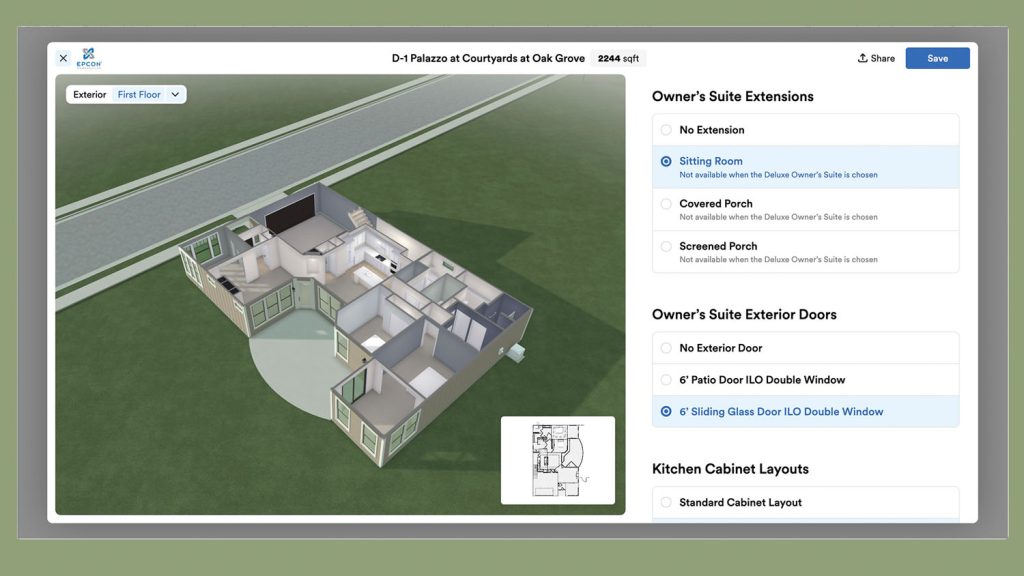
From the outset, HighArc was conceived as much more than a drawing package. It connects design to customer configuration, construction documentation, permit generation and back-end enterprise resource planning (ERP) systems. I’ve previously described it as being akin to ‘PLM for housing’.
But funding aside, there’s a lot more going on at HighArc right now that deserves attention: first, the introduction of AI-based estimating; and second, the move into materials distribution via a newly announced partnership with US LBM, the largest privately held distributor of lumber and building materials in the United States.


More than just money
In a market niche where BIM usage is an exception rather than the rule and where most projects still revolve around drawings, distributors typically receive plan sets from builders and must compete against multiple rivals for the same work. They must choose between producing quotations quickly enough to win projects or accurately enough to protect already razor-thin margins.
One common dodge is to quote rapidly, secure the work, and quietly re-estimate afterwards. In effect, these firms are value-engineering projects back to an acceptable margin once a contract has been signed. The alternative is still a largely manual process using drawing take-off software and human judgement.
HighArc’s answer is its AutoTranslate capture system, which was introduced about one year ago and is now connected directly to estimating. Entire PDF drawing sets can be ingested, sheet by sheet, and resolved into the walls, doors, windows, roof structures and wall assemblies that a distributor actually prices. In practice, it focuses on the structural shell rather than the interior.
Minor is witheringly unimpressed by the wave of AI estimating start-ups that are crowding in behind him. Many of them, he argues, have been funded to the tune of six or seven million dollars on little more than a promise to generate floor plans. If you point a foundation model straight at a set of drawings, his argument runs, it will hallucinate quantities that nobody will catch until the margin has already melted away. In a trade where profit can be measured in a few percentage points, that can’t be dismissed as a rounding error.
HighArc makes a different claim: an estimate that is computed, rather than inferred, using each builder’s own business rules, regional construction practices and preferred SKUs. These are all expressed through HighArc’s ontology and executed deterministically. The presence of one of the largest engineering firms specialising in housing on the company’s cap table suggests that the HighArc team believes that engineering knowledge, rather than AI, is where its defensible value lies.
That distinction is important, because it explains the company’s moat. HighArc does not create geometry first and then attach information afterwards. Instead, it represents buildings as structured text through a domain-specific language and ontology, sitting on top of a deterministic rules engine, with probabilistic AI layered above it.
HighArc’s wager is that strategic value has migrated. It no longer sits in drawing geometry, but in producing structured, queryable building data that every downstream participant can consume without redrawing
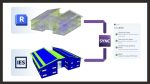
Minor’s favourite illustration compares a Signature Homes project occupying 6GB in Revit with an 11MB HighArc representation that captures every possible variation of the same design. In this model, planning regulations become another layer of constraints, while estimating becomes business logic operating directly on structured building data. A particular 2×6 resolves into the builder’s preferred products, suppliers and pricing rules.
AI sits on top of this foundation, rather than replacing it. AutoTranslate converts drawings into building data, while AutoLayout is a genuine tokenising language model that predicts layouts room by room, using synthetic data generated by HighArc itself. A roof design system and an agent layer allow users to interact with buildings using natural language, asking for a garage to be extended by five feet, for example, or checking whether a table that seats twelve people will fit on a rear patio. The agent then orchestrates the underlying tools to carry out those tasks across the model.
The same agent workflow is also tackling one of HighArc’s historic bottlenecks, onboarding builders by ingesting their catalogue of existing homes, even directly from their websites, and then reconstructing them and identifying opportunities to rationalise similar designs. One builder reportedly sketched a house over Christmas, refined it with the agent, generated visualisations for approval and had it under construction by February.
Beyond housebuilders
The partnership with US LBM broadens HighArc’s ambitions beyond housebuilders. The company began by helping production homebuilders to generate houses more efficiently. It now wants to produce building data of sufficient quality that every participant in the supply chain can use it without redrawing, re-entering or reconstructing information.
The latest funding will be invested in deeper structural automation, SKU-level intelligence and tighter alignment between building designs and regional material availability.
More complex structural engineering continues to flow out as DXF for engineers to complete before being incorporated back into the model.
Pricing pointedly avoids the metering that BIM incumbents have spent the past few years tightening – the per-seat licences, the per-token charges and the automation surcharges that turn a customer’s own efficiency into another line on the vendor’s invoice.
Instead, enterprise customers pay according to the complexity of their business, while smaller builders work on a per-project success fee and can use the platform for free until they actually start building, on the principle that HighArc should not get paid until its customer does.
The decision to raise more funding while already sitting on cash was, Minor says, about speed and nothing else. He intends to recruit aggressively and has no appetite for waiting politely while the rest of the field works out what he has been building since 2018.
HighArc’s shareholder list tells much the same story as its partnership with US LBM. Alongside traditional venture investors sit an unusually strong collection of strategic backers from across the construction value chain, including Ferguson Ventures, Simpson StrongTie, Suffolk Technologies, Starwood Capital, RXR Realty, MetaProp and Fifth Wall.
Most notable for AEC readers is the presence of former Autodesk chief executive officer Carl Bass among the individual investors, a quiet but powerful endorsement of a company challenging the geometry-first assumptions that have defined BIM for decades.
The broader question is whether HighArc’s reading of the market proves correct. If mainstream housing really can be generated down to the individual element inside a computational system, a great deal of today’s manual design labour simply evaporates. Larger practices already concede in private that their bread-and-butter work, the rectangles that pay the bills and win no awards, is easily the most automatable work they perform.
HighArc’s wager is that strategic value has migrated. It no longer sits in drawing geometry, but in producing structured, queryable building data that every downstream participant can consume without redrawing. Push that logic to its conclusion, and the company that owns the data layer ends up worth more than the company that owns the modeller, which is precisely the inversion that the geometry-first incumbents, with their files and their tolls, are not built to survive. On the evidence of this round, that proposition looks considerably less speculative than it did even one year ago.