
That Open Platform is a new cloud BIM OS with authentication, collaboration, versioning and deployment solved out of the box, as Martyn Day reports
Few firms in the AEC software development space have moved as quickly as That Open Company. When Antonio González Viegas first appeared on our radar, the firm was best known for IFC.js, a browser-based open source IFC toolkit. It was clever, it was free, but its attractions were niche, appealing predominantly to developers prepared to build BIM tools from components.
By contrast, the technology previewed by Viegas at NXT BLD in May, takes That Open Company several steps further, combining its open-source foundations with AI-driven development in a way that could reshape the economics of BIM software.
In a few short years, the company has matured from an IFC library to a full set of Software Development Kits (SDKs) used by more than 1,000 companies, including RIB, Bosch, and Ferrovial. A wider community of over 10,000 developers are building on its open-source work.
Discover what’s new in technology for architecture, engineering and construction — read the latest edition of AEC Magazine
👉 Subscribe FREE here
The obvious criticism was that an SDK is a box of parts, not a product. Firms wanting bespoke tools still had to solve identity, cloud infrastructure, collaboration and deployment before writing a single line of workflow logic. That is precisely what the company set out to address at NXT BLD (watch here).
The NXT BLD preview
Viegas opened his presentation with a familiar indictment of the industry’s operating model: decades-old applications that take ten minutes to open real world models; design decisions shaped by software limitations, rather than actual project needs; and teams spending additional thousands simply to collaborate, while still coordinating through emails, meetings, and snapshots.
All of it, he argued, rests on software scarcity, because making BIM software professionally has always required rare expertise, millions in capital and years of development. AI, he argued, has put an end to that scarcity. Every piece of software shown in his presentation was built with AI, much of it by people with no programming knowledge at all.

The vehicle is That Open Platform, which Viegas described as a BIM operating system rather than another BIM tool. It provides the hard parts as standard: a cloud-based common data environment (CDE), roles and permissions, versioning, application hosting, and deployment. It ships with pre-made applications and a model checker.
So what happens next? The significance of what That Open Company has achieved represents far more than a faster way to build software. Large Language Models (LLMs) have reduced the cost of writing application code by an order of magnitude, shifting the constraint on software development from engineering effort to domain knowledge.
For AEC firms, the scarce resource is no longer programmers, but sufficient understanding of their own processes to describe them accurately. AI does the coding; firms contribute the expertise.
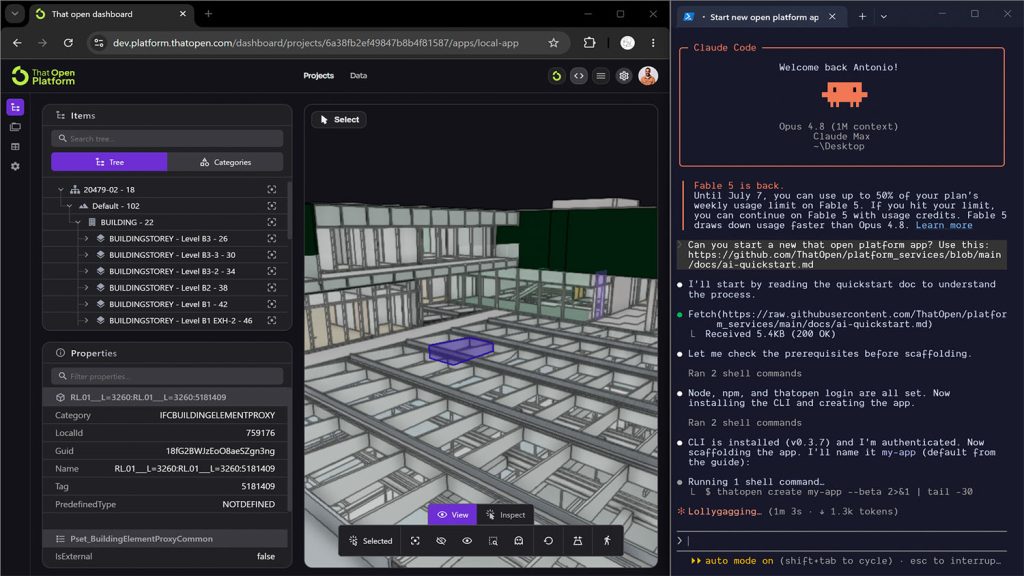
In his presentation, Viegas asked Claude Code to build an application to show off the platform. Roughly ten minutes later, he had a working model checker with GIS integration and property browsing, running locally on his own machine, owned outright rather than rented.
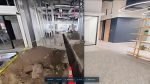
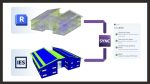
A further request published it to the platform, versioned, governed by project roles, and with immediate access to all project data. He then showed Revit and Rhino streaming changes into the platform with a Git-style history of who changed what and when, and with automation running incremental clash detection on only the elements that changed. Interoperability was not solved with yet another universal language, but with user-defined logic mapping elements between tools natively.
A commercial launch followed quickly, with founding membership opening on Monday 22 June and the enrolment window closing the following Friday. The offer included lifetime beta access, three months of unlimited use and direct influence over the roadmap.
Viegas was explicit that the company wants its first cohort to be people who understand the problem deeply. The platform is now live for its founding members.
Why this matters
The commercial launch itself is less important than what it represents. Traditional BIM vendors built successful businesses off the back of a scarcity of software development. If AI allows firms to generate bespoke applications in hours instead of years, value begins to shift away from generic software seats, towards workflow knowledge, operational expertise and firm-specific intellectual property.
Traditional BIM applications force firms to adapt their processes to software. Here, the relationship is reversed. Firms keep their workflows, while AI generates the application, and the platform supplies the infrastructure around it. In many cases, the cost of producing a bespoke internal application no longer involves months of software development, but a straightforward conversation with an AI coding assistant. The resulting software remains an asset owned by the firm, instead of another subscription with a provider.
The open question is whether That Open Company completes the final step and adds native RVT authoring. It already supports an open geometry engine, editing APIs and streaming technology, and executives at the company have repeatedly stated their ambition to enable anyone to build authoring tools.
If that happens, the platform would evolve from an application framework to a foundation offering a complete open BIM operating system. Whether That Open Company achieves that goal remains to be seen, but its direction of travel is increasingly clear.