
Meta’s new headset weighs about 100g and moves compute and battery into a separate puck worn on the body. It is launched primarily as a media device, but PC connectivity, full-colour passthrough and holographic calling give it potential in the office and on the construction site
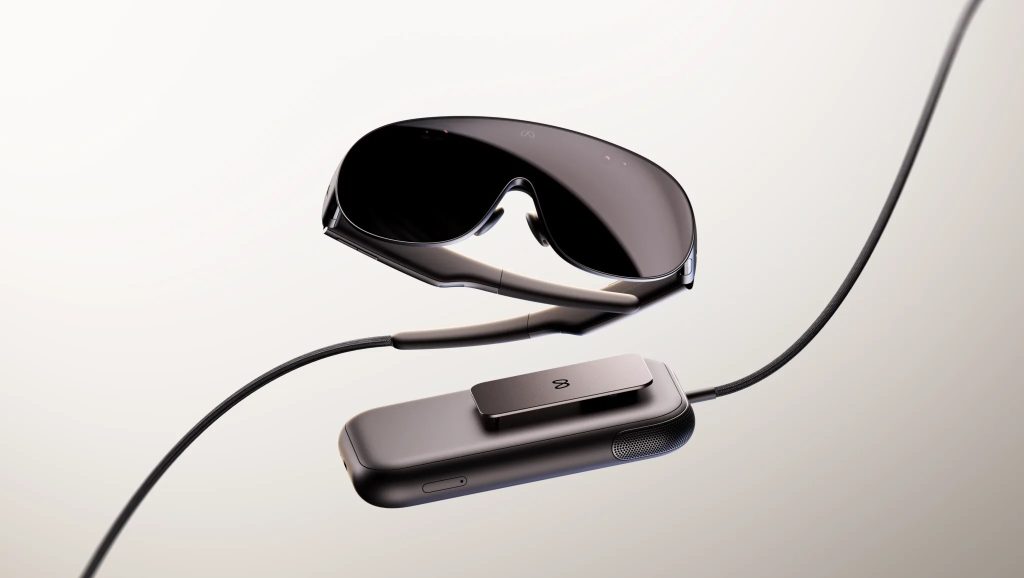
Meta has announced Meta VR Glasses, a glasses-style virtual reality device that goes on sale in spring 2027, priced at $1,299.99. At around 100 g, Meta says it is five times lighter than the Meta Quest 3. Most of that saving comes from splitting the hardware in two: the glasses hold the sensors and displays, while compute, battery and storage sit in a separate puck, connected by an optical tether, which clips to a pocket or bag.
The glasses have no head straps and are open at the sides, with a passthrough camera to keep the wearer aware of their surroundings. The frame is made from magnesium alloy, which Meta says provides rigidity and helps with cooling. Displays are micro-OLED panels with a combined 5K resolution and 37 pixels per degree, a figure Meta highlights for text legibility, viewed through compact pancake lenses designed specifically for the device.
The puck runs on Qualcomm’s new Snapdragon Reality Elite processor. Meta quotes battery life of up to three hours of continuous high-resolution media playback, with 45 W fast charging. There are no controllers by default, with interaction handled through voice, eye tracking and hand gestures, and Meta AI is built into the operating system. The existing Touch Plus controllers remain compatible.
Discover what’s new in technology for architecture, engineering and construction — read the latest edition of AEC Magazine
👉 Subscribe FREE here
For work, the device provides one or more large virtual screens and can turn a table or desk into a virtual keyboard and touchpad. Mac and Windows PCs can be connected wirelessly or over USB-C, with users bringing their own keyboard and mouse, and full-colour passthrough means the desk, keyboard and phone stay visible while working.
Meta is also introducing holographic video calling, which creates a photorealistic, real-time avatar of the user, including facial expressions. Other participants in VR see the hologram in front of them with spatial audio, while those on a phone or computer see it on screen. Meta says it works with existing calling apps, including Zoom and WhatsApp.
Most of the launch, however, is about entertainment. Meta has signed content deals with Disney, IMAX, ESPN and a long list of streaming services for 3D films, immersive sport and gaming, and the device has full access to the existing Meta Quest catalogue.
For AEC, the proposition is less about what the device does than what it removes. Weight, heat and the effort of putting on a headset have been the practical barriers to regular use of VR for design review, more so than image quality. A 100 g device that runs PC-driven content with the surroundings still visible addresses several of those objections. The trade-offs are the tether to a body-worn puck and a three-hour battery, a figure quoted for media playback rather than the heavier loads of large BIM models.
The open questions are commercial rather than technical. Meta’s release says nothing about enterprise device management or professional application support, and its business plans for VR have changed direction several times. Firms that have built VR design review workflows on Quest hardware will want to know how much of that software, and which of the rendering tools that stream from the PC, will run on the new glasses when they ship.