
Buro Happold‘s open-source BHoM engineering framework is being integrated natively into Motif’s BIM 2.0 platform, connecting AI-driven design with deterministic engineering computation. At a London event last week, the two companies demonstrated how their combined technologies could change the way architects and engineers work together. Martyn Day reports.
If an architect draws a beam in a BIM application, it’s a beam. For an engineer, the process is somewhat more complicated. It needs to be analysed, sized, checked and verified before anyone can confidently call it a beam. As Wolf Mangelsdorf, a partner at engineering consultancy Buro Happold, explains: “When the beam doesn’t fail any more, then it’s a beam.”
This distinction goes to the heart of a longstanding problem in BIM. Architectural modelling and engineering analysis may describe the same building, but they generally operate in different applications, with different representations, assumptions and computational processes. We have spent decades developing ways to exchange data between the processes, but the intelligence behind the design representation rarely travels with it.
Discover what’s new in technology for architecture, engineering and construction — read the latest edition of AEC Magazine
👉 Subscribe FREE here
Now Buro Happold, and BIM 2.0 software developer Motif are exploring a different approach. They have connected Buro Happold’s open-source computational engineering framework, BHoM (Buildings and Habitats object Model), into Motif’s agent-native design environment. Rather than simply importing geometry or translating properties, Motif can work with BHoM’s native objects and call its underlying engineering methods.
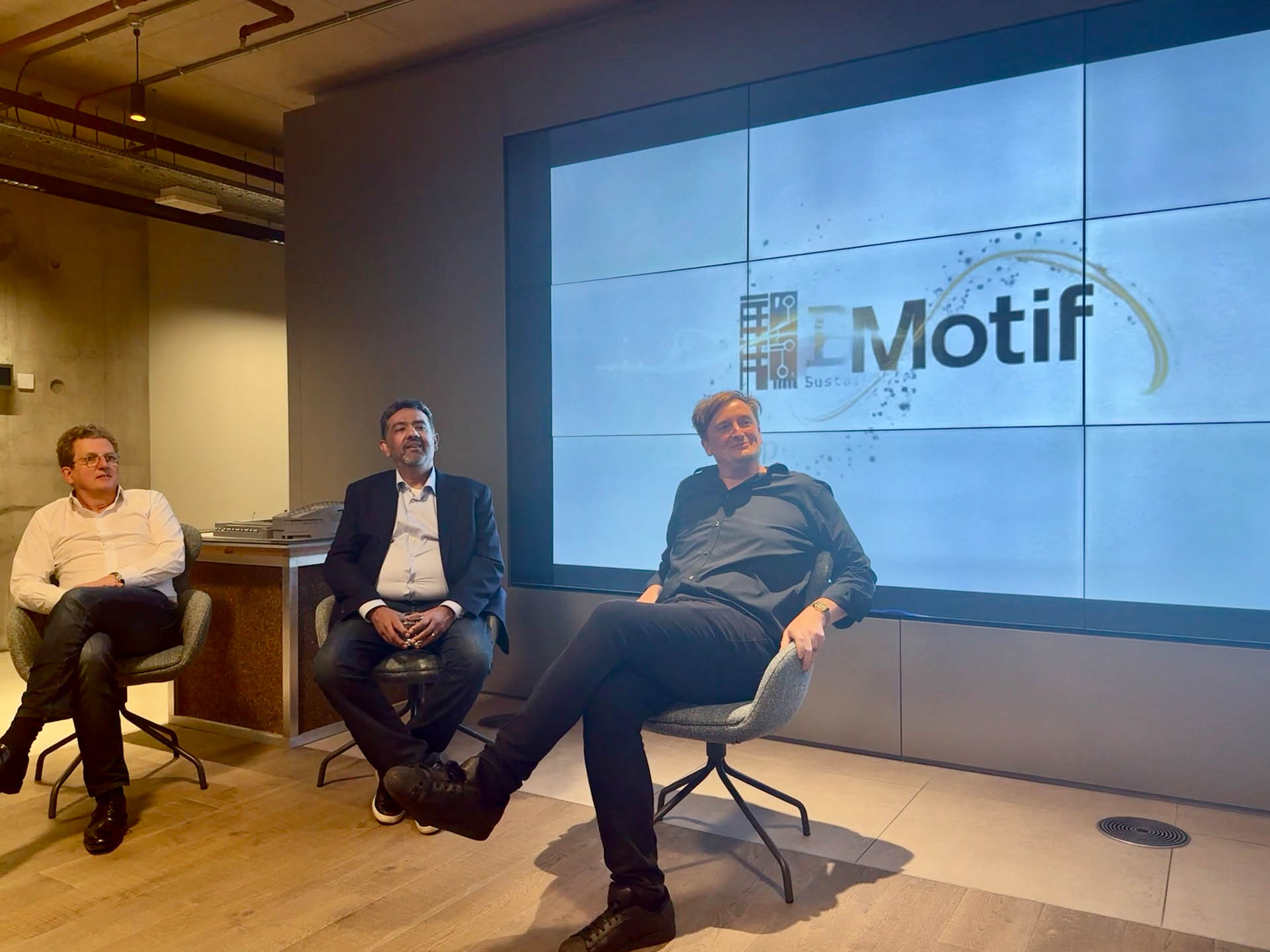
At a recent event held at Buro Happold’s London office, Mangelsdorf was joined by Alain Waha, CTO; Al Fisher, partner and head of computational development; along with Motif CEO, Amar Hanspal, and VP of strategy and industry solutions, Matt Jezyk. The presentations showed the results of their collaboration, including a hackathon in which attendees used sketches, AI prompts and computational methods to develop structural design options and understand the impact on embodied carbon.
Architectural modelling and engineering analysis may describe the same building, but they generally operate in different applications, with different representations, assumptions and computational processes. We have spent decades developing ways to exchange data between the processes, but the intelligence behind the design representation rarely travels with it.
The immediate achievement is impressive, but the longer-term ambition is considerably larger. If the methods used to design, calculate and evaluate a building can operate within the same continuously evolving design environment, the industry’s familiar sequence of disciplinary hand-offs might eventually give way to something more simultaneous. That is the vision, although what has been demonstrated so far is a promising but narrower first step.


Ten years of engineering intelligence
The collaboration has a longer history than the current enthusiasm for AI might suggest. At AEC Magazine’s NXT BLD conference in June 2025 Fisher and Waha joined computational design pioneer Dr Robert Aish to explore the future of open digital collaboration. Fisher demonstrated BHoM’s federated object model and its emphasis on composability and transparent engineering logic, while Aish placed the framework in the wider evolution of computational design. Waha concluded by considering how these capabilities could support AI-driven workflows, a theme explored further in a side event with Mangelsdorf and the Motif team.
Some 525 days later, Waha returned to that discussion, this time with Motif demonstrating a working integration. What had been an exploration of how open computational intelligence might change design was beginning to take shape as an agent-native workflow.
BHoM itself predates these conversations by almost a decade. Developed within Buro Happold and subsequently released as open source, the engineering framework was created to capture and organise the considerable computational knowledge being developed across its engineering practice.
Instead of primarily being a development framework requiring specialist knowledge, BHoM can become a source of engineering intelligence that AI can discover and orchestrate.
Fisher described the frustration that helped inspire it. Engineers would develop sophisticated pieces of code, often solving difficult problems in novel ways, but their usefulness depended on individuals knowing that those tools existed and understanding how to use them. When someone left a project or the business, much of that knowledge could become difficult to recover.
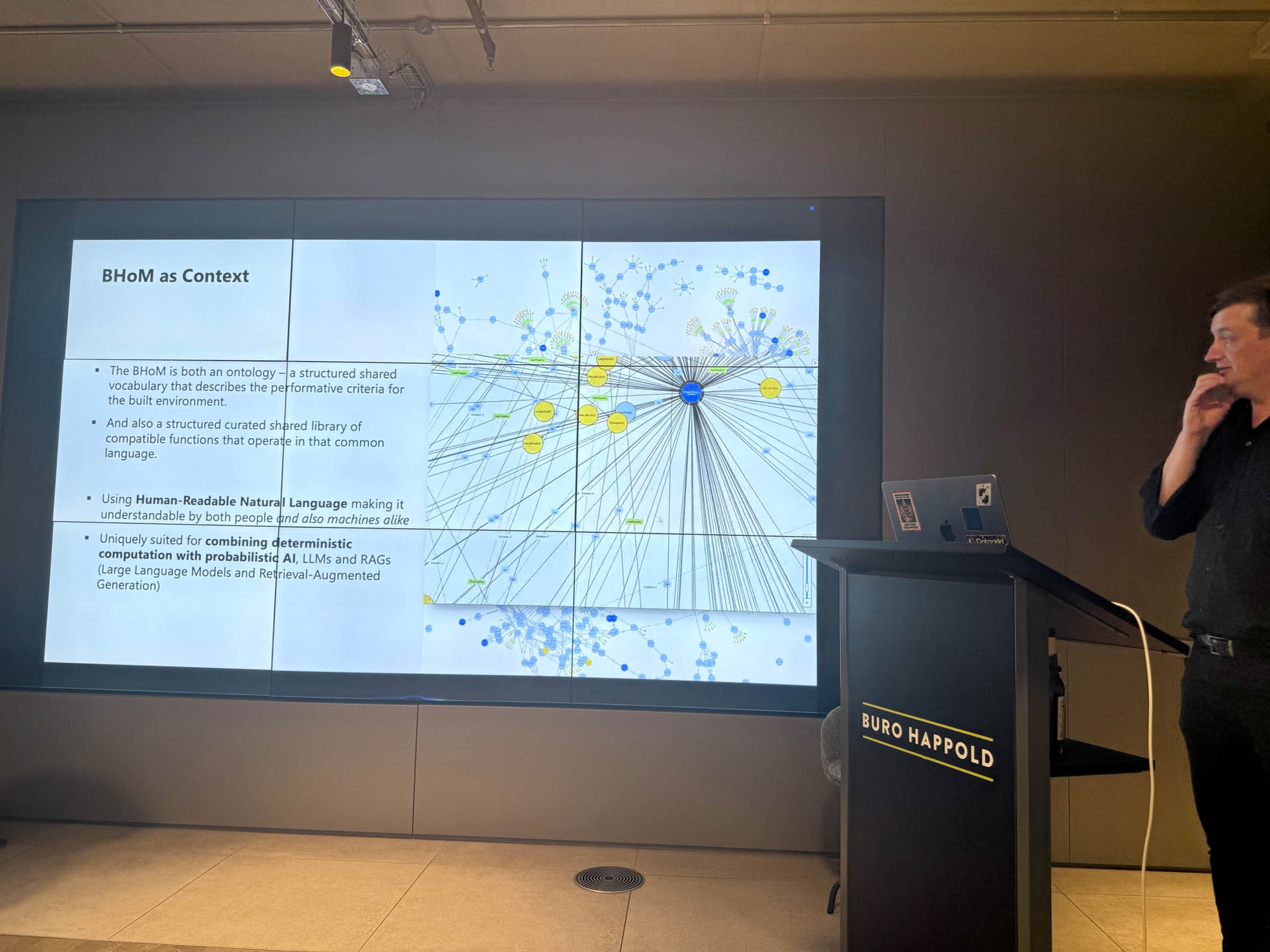
BHoM was an attempt to make that intelligence reusable. It provides a structured, software-independent collection of object definitions, engineering methods, adapters and tools. Its architecture separates the representation of engineering information from the computational methods used to create it, allowing knowledge to be persisted, assembled into workflows and reused across applications.
The framework has grown into an extensive collection of engineering capabilities spanning multiple disciplines. But that success created another problem: discoverability. A firm might possess hundreds of useful computational tools without its engineers knowing which ones exist, where to find them or how best to combine them.
AI potentially changes that equation. BHoM was deliberately structured to make engineering logic readable and understandable to people, rather than hiding everything in opaque software processes. Those same characteristics make it an interesting environment for large language models (LLMs) to interpret, potentially enabling an agent to understand the available methods, identify which are relevant to a task and assemble them into a computational workflow.
Instead of primarily being a development framework requiring specialist knowledge, BHoM can become a source of engineering intelligence that AI can discover and orchestrate. Importantly, the AI does not have to calculate everything itself but can call established engineering methods whose behaviour is explicit, repeatable and testable. This distinction between probabilistic AI and deterministic computation was one of the strongest themes at the event.
Motif’s agent-native proposition
For Hanspal, the collaboration is part of a broader attempt to rethink the architecture of design software. The former Autodesk joint-CEO explained that his decision to return to AEC software development was driven by how little the design technology landscape appeared to have progressed. Despite enormous increases in available computing power, much of the industry remains dependent on applications conceived decades ago.
His criticism extended beyond the familiar limitations of Revit. The entire technology stack, he argued, remains too focused on applications as the centre of design activity. Motif was founded on the premise that data and the intelligence operating on it should take precedence over the software used to display and manipulate it.
Hanspal described successive generations of design software as levels of abstraction. CAD automated drawing, while BIM substantially automated the production of documentation from models. “For all the nonsense that we spoke at Autodesk about BIM, it has really been an automation of document generation,” he said. The next abstraction, he believes, is agent-native design, where software participates in solving the design problem and the model increasingly becomes an output of that process.
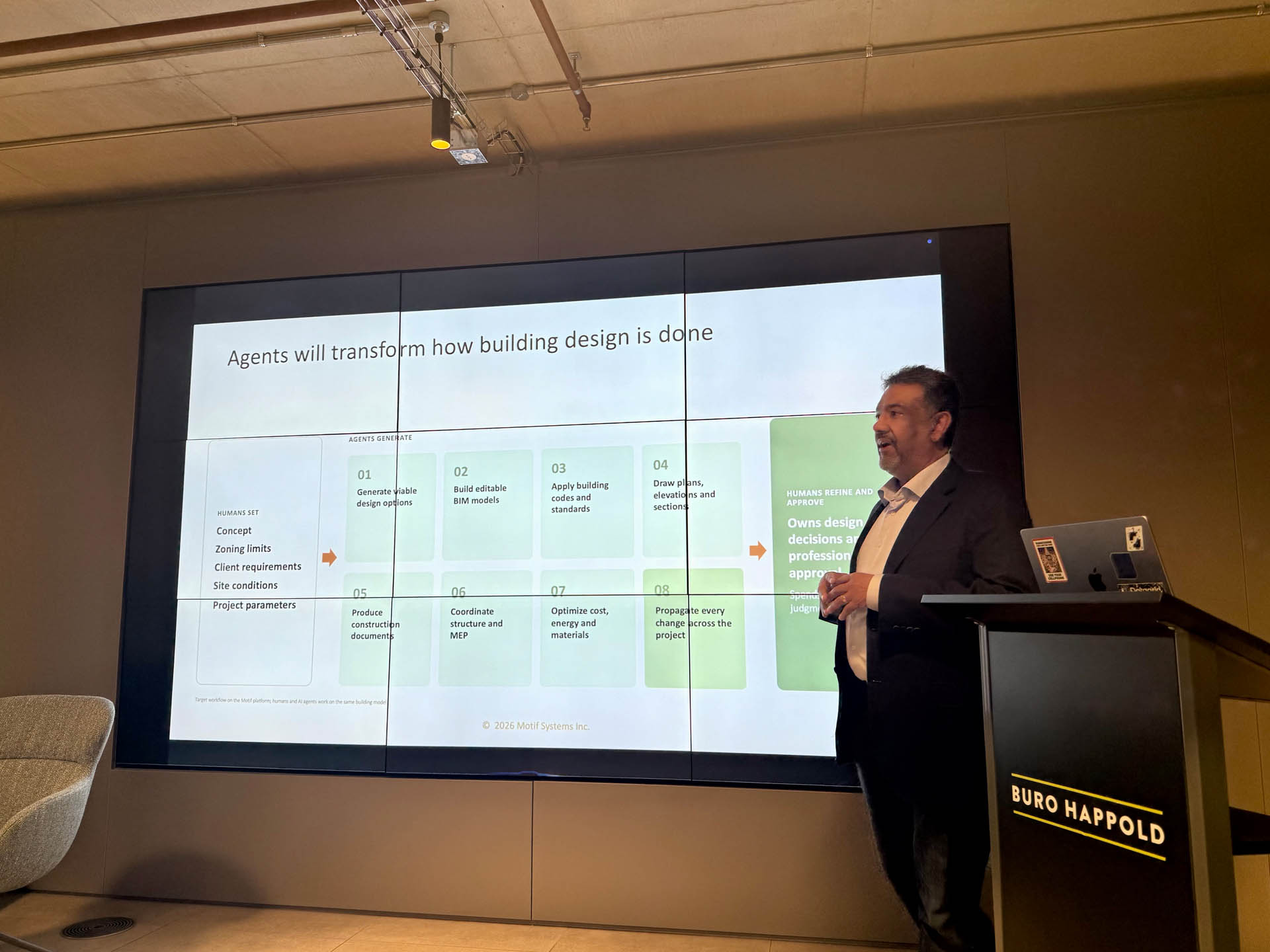
To illustrate the concept, Hanspal showed a retail planning exercise. Starting with an existing floor plan and a collection of business requirements, an agent generated editable building elements, arranged store fixtures, checked spatial rules and produced visualisations and indicative costs. The exercise, he said, had taken roughly 90 minutes, compared with an estimated two weeks using the customer’s existing approach. The comparison was anecdotal, but it demonstrated the intended workflow: the designer provides the constraints, objectives and design judgement, while agents undertake much of the modelling, information processing and rule checking. Motif’s underlying architecture is designed to support this division of labour, with a flexible data model that can accommodate different schemas and object definitions, while its agent infrastructure allows computational processes to operate alongside people.
Hanspal also stressed the importance of firms being able to use their own standards, knowledge and tools rather than relying exclusively on capabilities supplied by the software vendor. This is where BHoM becomes interesting: instead of Motif having to develop its own structural engineering intelligence, Buro Happold can bring an existing, highly-developed computational framework into the environment.
Beyond importing geometry
One of the most telling technical details came from Jezyk, who said Motif’s flexible data model could accommodate around 700 BHoM classes and objects without Motif’s developers having to recreate corresponding native definitions. For anyone familiar with the difficulties of transferring rich design data between BIM systems, that is a significant claim. There is a substantial difference between supporting arbitrary properties on an object and supporting independently-defined objects that can participate in the application’s modelling, querying and modification processes.
Conventional interoperability often requires objects to be translated into whatever classes and properties the receiving application understands, a process in which information is simplified, relationships are lost and specialist intelligence is stripped away. Motif’s approach allows BHoM’s own definitions, including structural elements, materials, section properties and associated engineering data, to be represented in its data environment rather than forced into a predetermined collection of application-specific objects.
Conventional interoperability has largely concentrated on exchanging static snapshots of a design at a particular moment, leaving the logic that generated the result trapped inside the originating application or script. BHoM offers access to that logic itself.
But the integration goes beyond holding information. Motif can also call BHoM’s computational methods, allowing agents to invoke engineering logic rather than simply manipulate geometric representations.
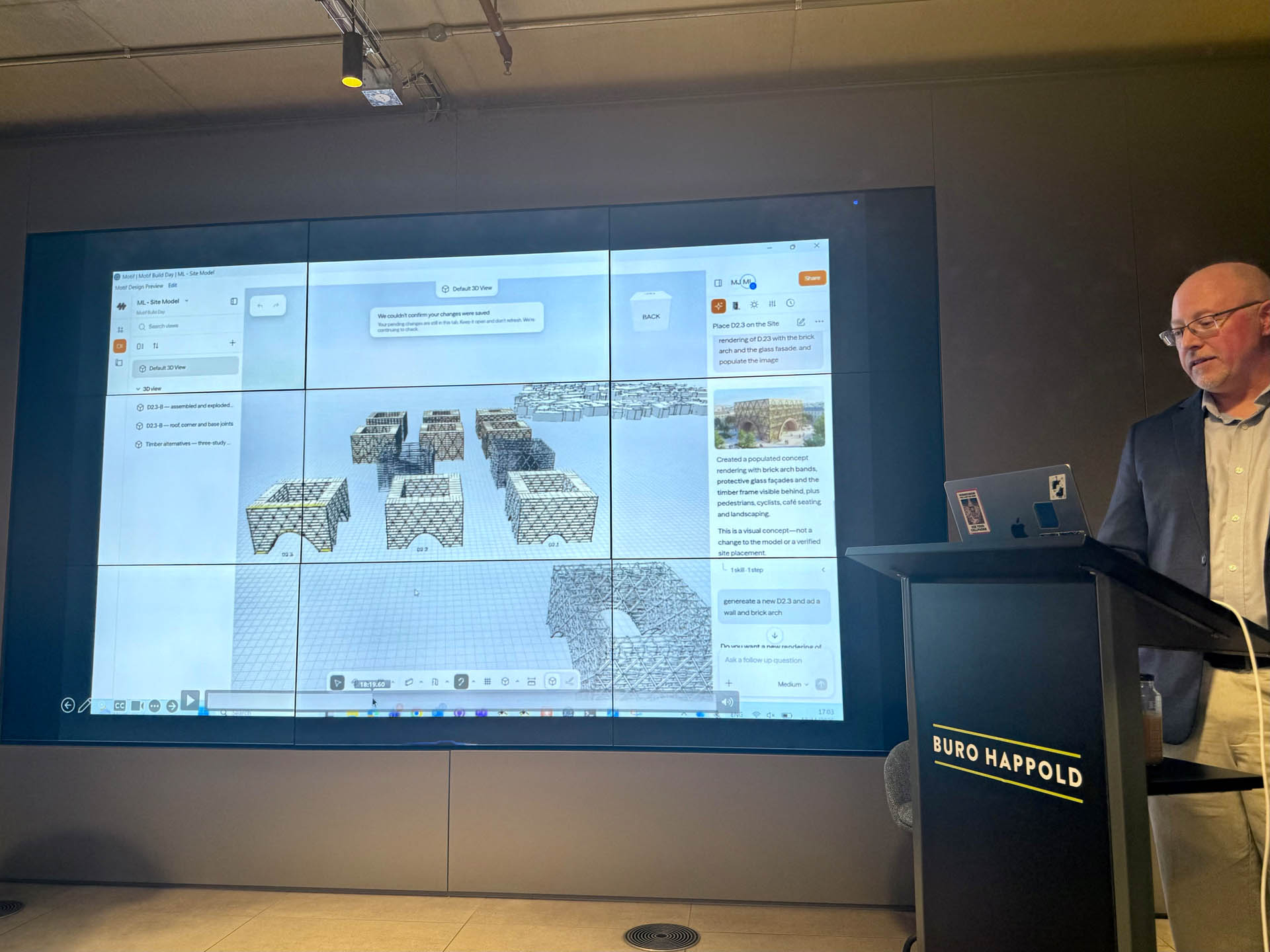
This distinction became clearer during a demonstration of work undertaken by Buro Happold engineers the previous day. A one-day workshop focused on structural design and embodied carbon, with participants experimenting with architectural forms generated through prompts and sketches, then using BHoM to produce structural analytical representations and apply engineering rules of thumb for member sizing. All were Buro Happold engineers, with no outside architect or MEP team involved, and no structural solver was run.
In one example, an engineer took a steelwork building form and sketched an instruction to carve out an arch void. Motif interpreted the sketch, altered the geometry and regenerated the model through its computational workflow, offering a glimpse of how intuitive design gestures might coexist with rigorous parametric processes without requiring the engineer to construct the underlying modelling operations manually. (Jezyk’s own demonstration of the idea, rebuilding the roof of Waterloo International Terminal from a sketch, is described in box-out 1 ‘Back to Waterloo’, which can be found further down the page).
Seeing those steelwork elements update dynamically raised an obvious question about what was happening under the hood. When I asked whether the structural steelwork had simply been imported from BHoM, Jezyk explained that the geometry had been generated through Motif’s agentic and computational capabilities, while BHoM supplied structural definitions, sizing methods and associated data. Fisher reinforced the point, explaining that Motif was exposing BHoM’s objects and computational logic, allowing the design environment to invoke engineering methods rather than simply receiving their geometric output. “The word import doesn’t really give it credit,” he said.
Conventional interoperability has largely concentrated on exchanging static snapshots of a design at a particular moment, leaving the logic that generated the result trapped inside the originating application or script. BHoM offers access to that logic itself.
Rather than exchanging successive versions of a structural frame between an architect, an engineer and a sustainability specialist, a connected environment can invoke the relevant computational methods directly as the design develops.
Fisher also described how AI could assist with an awkward part of environmental assessment: matching materials to environmental product declarations (EPDs). Finding the appropriate declaration for a material often involves interpreting inconsistent descriptions and product information, making it a promising task for AI-assisted interpretation. Once the relevant information has been identified, however, lifecycle assessment can be performed using established deterministic calculations, allowing AI to coordinate processes whose outputs can still be checked and reproduced.
Rather than exchanging successive versions of a structural frame between an architect, an engineer and a sustainability specialist, a connected environment can invoke the relevant computational methods directly as the design develops.
Fisher argued that the industry needs to move beyond accumulating what he described as a “cloud of instances”, where AI must repeatedly infer design intent from a succession of geometric snapshots. Storing and exposing the underlying methods instead means that engineering assumptions and calculations, so often buried in disconnected models and spreadsheets, remain accessible, reusable and modifiable across subsequent iterations.
Motif API
The BHoM collaboration accompanied another important announcement, with Motif opening its underlying platform to external developers. Its new API provides REST access to projects and models, while gRPC and Protocol Buffers expose model entities and components. Developers can query and modify model information, create building elements and register custom components, with support for attaching new behaviours and actions still being developed.
In the case of BHoM, the integration demonstrates what this flexibility can make possible. Motif can represent BHoM’s native object definitions while exposing external engineering methods to its agents, combining the platform’s own modelling capabilities with computational intelligence developed elsewhere.
Motif also outlined work with other developers, including Cityweft for location and contextual information, jifto for environmental computation, and Kinship for content management. The strategy is to assemble specialist capabilities around an open design environment rather than reproduce every function within a monolithic application. Not everything is available yet, however. Hanspal explained that Motif is still working towards allowing customers to plug their own agents directly into the system, although the underlying framework is being developed to support this.
Motif can represent BHoM’s native object definitions while exposing external engineering methods to its agents, combining the platform’s own modelling capabilities with computational intelligence developed elsewhere.
Openness was one of the event’s recurring themes, and not simply as a marketing proposition. BHoM is open source, its computational methods are not dependent on Motif, and other applications and agents can access them. That independence became an important point during the subsequent discussion.
Does this need a new platform?
The obvious question is how much of this requires a new design platform. The growing number of Model Context Protocol (MCP) server integrations for applications such as Revit has already demonstrated that AI agents can operate conventional CAD and BIM systems, invoke commands and call external tools. Sophisticated computational workflows can be assembled around established applications without rebuilding the applications themselves.
I described the current fascination with Revit MCP integrations as “a band-aid on a bullet wound”. Much of the interesting intelligence sits outside Revit, with agents effectively using the application as a glove puppet, driving its commands and populating its objects. The process can be impressive, but in these workflows the traffic is largely one-way: external intelligence instructs Revit to produce or modify something, rather than the design application participating in a richer exchange of computational logic.
The BHoM–Motif integration appeared to offer a different arrangement, where the modelling environment could call external engineering methods and bring their native objects and results back into the design process. But that raised another question: was this a fundamentally different capability, or simply a more integrated implementation of something that MCP could already achieve?
Martha Tsigkari, senior partner and Head of Applied R+D at Foster + Partners, and regular presenter at NXT BLD, challenged the suggestion that the capabilities being discussed were unavailable within existing software. Her team has already developed containerised agents capable of calling modular computational tools within environments such as Rhino and Revit. The combination of an open schema, externally callable methods and agent orchestration is not unique to Motif.
Tsigkari argued that presenting this as something conventional software cannot do was an over-simplification. The stronger story was not merely connecting an AI agent to a collection of engineering functions, but the underlying architecture supporting the resulting collaboration.
Hanspal responded by identifying three areas where Motif intends to differentiate itself. The first is its flexible data architecture, which allows organisations to define their own objects, methods and information structures rather than work exclusively within a fixed set of BIM classes. The second is concurrency, where multiple agents and designers changing elements of the same building need their operations reconciled and their consequences propagated across the design.
The third is the underlying collaborative environment, designed to support people and agents working together through a browser-based application rather than requiring each participant to operate a separate modelling system. This is especially relevant when changes to geometry, engineering properties and analytical representations need to remain coordinated as several processes operate simultaneously.
MCP is a mechanism for making capabilities accessible to agents, but it does not, by itself, define how an application stores design information, manages collaboration or handles concurrent changes. Motif’s potential advantage is therefore not that it makes agentic design possible, but that its architecture has been developed specifically with these requirements in mind. AI can make old applications perform remarkable new tricks, but it does not automatically remove the constraints of the architecture underneath. Whether Motif’s approach proves superior will depend on how effectively it manages shared information, concurrent operations and the changing relationships between different design disciplines. (The technical detail behind that debate, including how Motif’s concurrency model compares to Revit’s, is set out in box-out 2 ‘Is this just MCP with a better interface?’, which can be seen further down the page).
Choosing the right intelligence
Fisher offered another useful way of thinking about the future of engineering software. Rather than placing AI at the centre of every operation, he described three complementary forms of intelligence: human judgement and creativity, probabilistic AI, and deterministic computation.
Each has a different role. Humans are responsible for making design decisions, establishing objectives and exercising judgement, while AI can interpret instructions, discover relevant knowledge and orchestrate workflows. Deterministic methods perform calculations and other processes where reliable, repeatable results are essential.
In the current wave of agentic development, the temptation is to make the language model responsible for too much. Every instruction becomes another inference task, with agents repeatedly interpreting the problem and deciding which operations to execute. Fisher argued that once an agent understands an instruction, it should hand the work to the most appropriate computational process.
AI can make old applications perform remarkable new tricks, but it does not automatically remove the constraints of the architecture underneath. Whether Motif’s approach proves superior will depend on how effectively it manages shared information, concurrent operations and the changing relationships between different design disciplines.
As Jezyk’s Waterloo demonstration showed (see box-out), an LLM can assemble plausible-looking parametric geometry while still getting fundamental structural behaviour wrong, which is precisely why pairing probabilistic generation with deterministic engineering verification is key.
This is not simply a question of reliability. AI inference consumes compute, time and energy, often unnecessarily when an established algorithm can perform the same task more efficiently. As Fisher put it, when considering the environmental costs of AI inference: “Choose your existential crisis.”
He also predicted a renaissance in other forms of machine learning and specialised computational intelligence, with language models increasingly taking on the role of interpreting intent and orchestrating the appropriate methods. Rather than becoming the universal engine of design, the LLM could become the interface through which more efficient, domain-specific computation is discovered and deployed.
I raised the related issue of latency. Many agentic design workflows involve long pauses while instructions travel to remote models, are interpreted and returned as sequences of commands. This can become frustrating when the designer is trying to work iteratively, especially if each small change triggers another round of inference.
Fisher acknowledged that reducing those delays is part of the current development work. With a richer understanding of the available engineering methods, the system should eventually be able to bypass repeated discovery and interpretation. The principle is compelling, even if the performance benefits remain to be demonstrated: language models are useful for understanding intent and selecting processes, but there is little benefit in repeatedly asking an LLM to reconstruct operations that established computational methods can execute directly.
Engineering is more than calculations
For Mangelsdorf, the most compelling opportunity is not simply that engineers could produce work more quickly. He described how the profession has traditionally valued different technical skills, with a good engineer once judged by the quality of their calculations. Later, competence became increasingly associated with the ability to construct and operate sophisticated computational models.
Yet neither the calculations nor the software manipulation is ultimately the purpose of engineering. The value lies in understanding the problem, exploring alternatives and arriving at a solution that delivers the required performance and outcomes. Asked how much time the new approach might save, Mangelsdorf resisted reducing its value to a productivity percentage, suggesting the more important question was “how much quicker can I get to a better result.”
This is where the multidisciplinary possibilities become especially interesting. Much of the industry’s design process is organised around separate disciplinary activities, with architects developing a scheme, structural engineers analysing it, building services engineers developing their systems, and information moving backwards and forwards as each discipline identifies constraints and conflicts.
Digital coordination has improved this process, but the underlying sequence often remains unchanged. Each discipline works within its own environment, generating information that others must subsequently interpret and incorporate. Mangelsdorf envisages a more simultaneous process, where designers and engineers work against a shared evolving design and can bring their analytical methods to bear as decisions are made.
In the current wave of agentic development, the temptation is to make the language model responsible for too much. Every instruction becomes another inference task, with agents repeatedly interpreting the problem and deciding which operations to execute. Fisher argued that once an agent understands an instruction, it should hand the work to the most appropriate computational process.
The potential extends beyond structural engineering. Environmental performance, embodied carbon, building services and other specialist analyses could operate alongside architectural design, with agents helping to coordinate the computational work. It would not eliminate the need for specialists, but it could change when and how their expertise influences the design.
Jezyk later described how Motif approaches this at the data level. Each discipline’s work is held as a separate model that can reference others, so a structural model can be referenced into the architectural model and pinned at a particular version until the team chooses to update it. Individual elements can also carry separate data for each discipline, with Jezyk giving the example of a light fixture whose location belongs to the architect and whose performance metrics belong to the engineer. Shared structural elements are harder, and he described columns as “a tricky one”, which is the same question of ownership raised by Mangelsdorf’s beam. Simultaneous working, in other words, still means separate models that reference one another rather than a single shared model.
Mangelsdorf acknowledged that BHoM already enables some simultaneous disciplinary working, even if much of the process remains relatively manual in the background. Still, if specialist analytical methods can operate on a shared, changing design without repeated model exports, teams could potentially evaluate many more alternatives while the design remains fluid, challenging not only established software workflows, but also aspects of the industry’s sequential design stages and procurement arrangements.
The questions still to answer
There are substantial questions still to be answered, starting with provenance: how can a project team establish precisely what happened when an agent generates geometry, calls engineering algorithms and modifies the result? Motif keeps an immutable history for each model, which Jezyk said can answer “who changed what, when and how”, and agents operate under the same role-based access controls as users. But recording that an operation occurred is not necessarily the same as preserving the full computational evidence behind it. It is not yet clear whether that history distinguishes an agent’s change from that of a person, or records the inputs to an external method such as a BHoM calculation.
I asked whether it would be possible to distinguish the parts of a design generated through AI inference from those produced using deterministic methods. Fisher acknowledged that complete traceability between those processes remains under development and, for engineering, this distinction matters. A designer must be able to establish which calculations were performed, what inputs were used and whether the results remain valid after subsequent changes.
The question of responsibility also emerged during the discussion. An agent may initiate an analysis, but professional liability does not transfer to the language model, and the resulting design must still be checked and justified using appropriate engineering methods. Mangelsdorf emphasised that the attraction of the BHoM approach is precisely that the output can be grounded in established, trusted analytical procedures, with AI changing how those methods are accessed and combined rather than removing the requirement for engineering certainty.
Cost was another concern. Tsigkari pointed out that as AI becomes embedded in everyday design processes, firms will need much better visibility of token consumption and computational expenditure. In a collaborative environment accommodating numerous agents, unmanaged activity could rapidly escalate costs unless usage is tracked and controlled.
There is also the question of practical performance. The workshop demonstrated functioning connections between AI-driven modelling and engineering computation, but it did not establish how the architecture would behave across a large, complex project involving multiple disciplines, extensive analytical models and numerous simultaneous agents. Jezyk has since confirmed that all elements are currently loaded when a model is opened, with demand-loading planned for a future release.
Nor does giving agents access to engineering methods automatically resolve the challenge of coordinating work across disciplines. The next test will be whether the architectural, structural and other analytical processes can interact continuously, while preserving the relationships, history and evidence required for professional design.
For now, the collaboration remains a promising technical demonstration and an experiment in how multidisciplinary design could evolve. The underlying ambition is significant, but the evidence still needs to catch up with the vision.
Conclusion
The significance of the Buro Happold–Motif collaboration is not that another software developer has taught an AI agent to create building geometry. Increasingly, that is becoming a baseline capability. The greater opportunity lies in connecting the computational intelligence used by engineers directly to the environment in which design decisions are being made.
BHoM brings more than a decade of accumulated, structured engineering knowledge. Motif provides a modern design platform in which that knowledge can be exposed, accessed and combined with human and artificial intelligence. Hundreds of BHoM object definitions can already be represented within Motif, and established engineering methods can be invoked to generate and assess design information.
The larger question is whether those capabilities can scale into an environment where multiple disciplines and agents work continuously on an evolving design, each understanding the assumptions, calculations and consequences of the others’ decisions. Motif has not yet demonstrated that future, nor does it hold exclusive access to BHoM’s open-source methods, but the partnership offers a clear testbed for how modern software architecture and established engineering logic might converge.
For decades, the industry has worked to make design applications exchange information more reliably, even if it’s the lowest common denominator. The next challenge is to make the intelligence behind that information accessible, reusable and available to everyone working on the building.
I find it difficult to imagine Revit supporting this vision within its underlying software architecture. Firms already divide architectural models into separate, smaller files simply to maintain acceptable performance. The prospect of bringing all the data from multiple disciplines together, with multiple agents continuously evaluating changes, recalculating engineering consequences and maintaining their dependencies, is almost inconceivable in a system that can struggle with the complexity of an individual discipline. Motif also keeps each discipline in its own model but connects them through versioned references and regenerates changes in the cloud, rather than relying on linked files. This is not simply a question of adding AI capabilities to existing BIM software, but of rethinking the architecture on which it runs.
The real breakthrough will not be getting an AI agent to draw a beam or even calculate one. It will be creating an environment where everyone involved understands why the beam is there, what it needs to do, and how changes to it affect the rest of the building. The future of BIM may be less about which application owns the model and more about which environment can preserve the knowledge, calculations and decisions behind it, keeping them connected and relevant as the design evolves.
Box-out #1: Back to Waterloo
At the Buro Happold event, Motif’s Matt Jezyk offered a demonstration that illustrated both the promise and the pitfalls of agent-native computational design. He revisited the late Sir Nicholas Grimshaw’s Waterloo International Terminal, using one of the architect’s original sketches alongside a diagram by computational designer Shane Burger.
Jezyk recalled meeting Burger at the SmartGeometry event in 2006, where Burger had undertaken a project recreating Waterloo’s roof geometry using Bentley’s GenerativeComponents (GC). For the Motif demonstration, Jezyk supplied the Grimshaw sketch and Burger’s diagram to an AI agent, asking it to research the structural and geometric principles, understand how the system worked and develop the methods needed to recreate it. The result was an editable parametric truss system within Motif. Rather than generating a static visual approximation, the agent produced geometry and computational relationships that could be used to construct the structural arrangement.
The demonstration progressed beyond delivering just an isolated truss, with the agent developing an understanding of the wider bay, façade and associated cladding system. Yet it also exposed a familiar weakness of AI-generated design. The agent initially misunderstood part of the structural arrangement, prompting Jezyk to challenge the result and direct it back towards sketches showing the structure’s underlying principles. The agent subsequently corrected its interpretation, recognising that one of the members should operate in tension.
The takeaway was clear: while an agent can reconstruct a parametric system from historical references and respond to guidance, plausible-looking geometry is not necessarily structurally sound. That is the key reason why deterministic verification, checking AI-generated proposals against established engineering methods, remains essential. Someone still needs to understand the engineering well enough to spot the mistake; nobody escapes liability, however clever your tools.
Jezyk’s broader point was that computational design capabilities previously requiring considerable specialist knowledge could become accessible through more natural forms of interaction. The underlying mathematics and parametric relationships remain, but the designer no longer necessarily needs to construct every part of the computational system manually.
He also questioned why the industry remains so reliant on software architectures developed for vastly less capable hardware. Showing software he had helped develop roughly 28 years earlier for a Pentium processor, he asked: “Why are we still using it today?” Coming from someone who worked on Revit’s original development and later helped build Dynamo, it was a pointed criticism of how little the industry’s core modelling tools have changed despite successive generations of hardware and software.
Box-out #2: Is this just MCP with a better interface?
The discussion at Buro Happold’s event turned on whether Motif’s BHoM integration does anything that an AI agent driving existing software through the Model Context Protocol (MCP) server could not. The detail of that exchange, and of the architecture behind it, is set out here.
I asked Al Fisher, Buro Happold’s Head of Computational Development, what differentiated the BHoM–Motif integration from Autodesk’s Data Exchange service, which can pass BHoM data between applications but not the engineering methods behind it. Fisher replied that the distinction was between ‘design instances’ and ‘design logic’, explaining that an exchange containing a representation of a building does not necessarily preserve the methods used to create it. An agent might reproduce an operation by calling a succession of functions, but unless the workflow itself is recorded, the sequence behind the result can be lost.
Fisher’s argument was that computational processes should become durable, reusable assets rather than being reconstructed through fresh AI inference every time a similar task arises. That would mean retaining the methods and computational history, instead of relying on an agent to rediscover the same workflow whenever a design changes.
Martha Tsigkari of Foster + Partners argued that agents can already call computational tools from within Rhino and Revit, and Buro Happold CTO Alain Waha picked up on an important implication of her comments: BHoM could also be called from an independent agent environment. Fisher subsequently acknowledged that the durable record of computational operations he had advocated could be implemented through MCP, rather than requiring a particular platform. BHoM’s methods are not exclusive to Motif, and MCP does not inherently prevent the capture and reuse of computational logic. Tsigkari also suggested that semantic AI could make transferring semantic information between applications easier, although that point was not developed fully before the discussion moved on.
Autodesk’s own route to granular data illustrates the limits of working from a file-based model. Its AEC Data Model API exposes Revit geometry, properties and relationships as granular cloud data. Ordinarily, this information is generated from uploaded or published models, although a new Forma Connected Client technology preview can update it after Revit “syncs with central”. The RVT remains the parametric authoring source, while API writing is limited to extended properties stored alongside the design rather than direct modification of its geometry or parametric elements.
Motif’s Matt Jezyk later expanded on how the company handles concurrency. Revit, he explained, uses object-level “pessimistic” locking, where whole objects are checked out and each user must reload the latest model and regenerate it locally before saving to central. Motif instead allows editing at the level of individual properties with “optimistic” locking and regenerates the affected parts of the model’s dependency graph in parallel in the cloud, so a change is previewed live, then proposed and committed to the model’s history. Agents run asynchronously under the same arrangement, making changes without locking the interface or other users’ work.