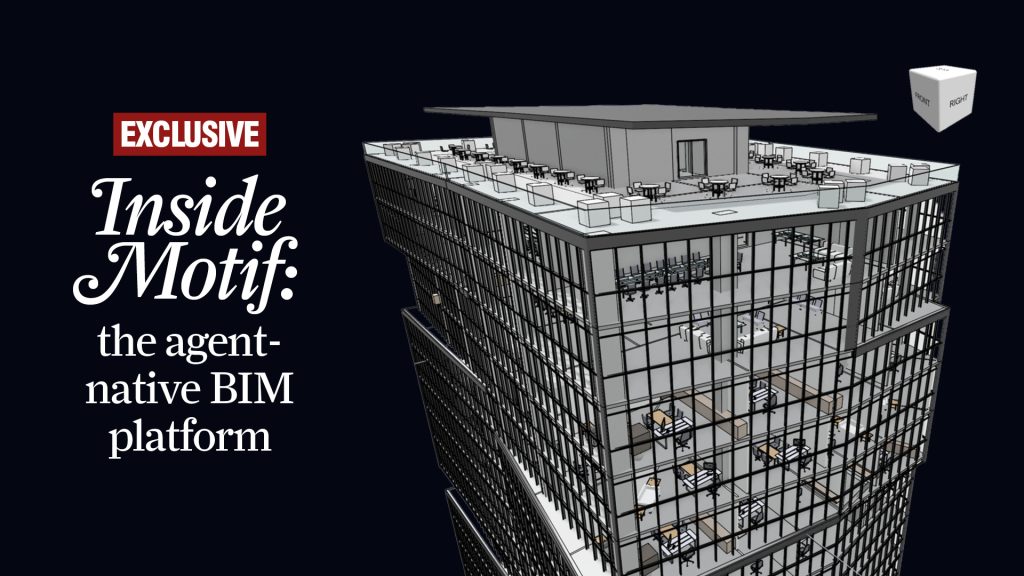

In the race to create the next generation of BIM, many firms, including Snaptrude, Qonic, Arcol, and Hypar, have opted to develop their software in public. Motif has taken a more old-school approach, opting for secrecy followed by a big reveal. Today, we finally get to see what Amar Hanspal and his ex-Autodesk team have been building
For three years the question hanging over $46 million start-up Motif, has been what, precisely, Amar Hanspal and his ex-Autodesk leadership team were building. The early releases, a collaborative whiteboard with model viewing and redlining, invited the suspicion that this was another companion product, a satellite orbiting Revit rather than a replacement for the mature BIM authoring tool. They also flew in the face of our February 2025 interview with Hanspal, who agreed that taking on Revit was like climbing the North Face of the Eiger, and that too many start-ups got lost in the foothills delivering side projects.
That suspicion can now be retired as Motif launches its BIM authoring platform. It’s browser-native, multi-threaded, cloud native and built on the assumption that AI agents are first-class users of the model, rather than a chat window or slow Model Context Protocol (MCP) bolted onto the side.
The timing matters. Many design IT directors have told me that their historic Autodesk discounts are being removed at their next agreement, and the sizeable increase they are facing for essentially the same software has concentrated their minds. Some are seeing increases of several hundred percent and are therefore exploring how to shrink their Autodesk estate.
The user interface, API and agents are clients of the same underlying data model, so the agent does not sit outside the BIM application trying to operate it through a layer of commands. It works against the project data itself
Into that environment comes a product with no traditional named-user seat demands, no separate cloud collaboration service required on top and no metered AI access to simply view and navigate your own models. Whether Motif is good enough to replace Revit on production projects remains an open question, but a challenger is arriving just as some incumbent customers are actively looking for a way out, while also starting to question what comes next in BIM workflows.
Motif is one platform, rather than a staged sequence of tools. Hanspal says the modeller, documentation environment, conceptual tools and AI agents are all part of the same application. What remains unfinished is object coverage, not the fundamental platform architecture: the Motif team must still create the full range of building elements, specialist objects and associated behaviours that Revit has accumulated over decades of development.


Prior to today’s launch I had an exclusive two-and-a-half-hour pre-briefing with the team, a group of Autodesk alumni with considerable Revit and AEC software experience: Amar Hanspal (CEO and co-founder of Motif, and former co-CEO of Autodesk), Brian Mathews (CTO and co-founder), Tatjana Dzambazova (Director, AI Solutions) and Matt Jezyk (VP, Industry Solutions). This article reflects what was actually in the box at the point of launch. Motif will undoubtedly add features rapidly as it fleshes out the product, but there is already enough there to understand both what it is and where the team thinks BIM is heading.
Yes, it is actually BIM
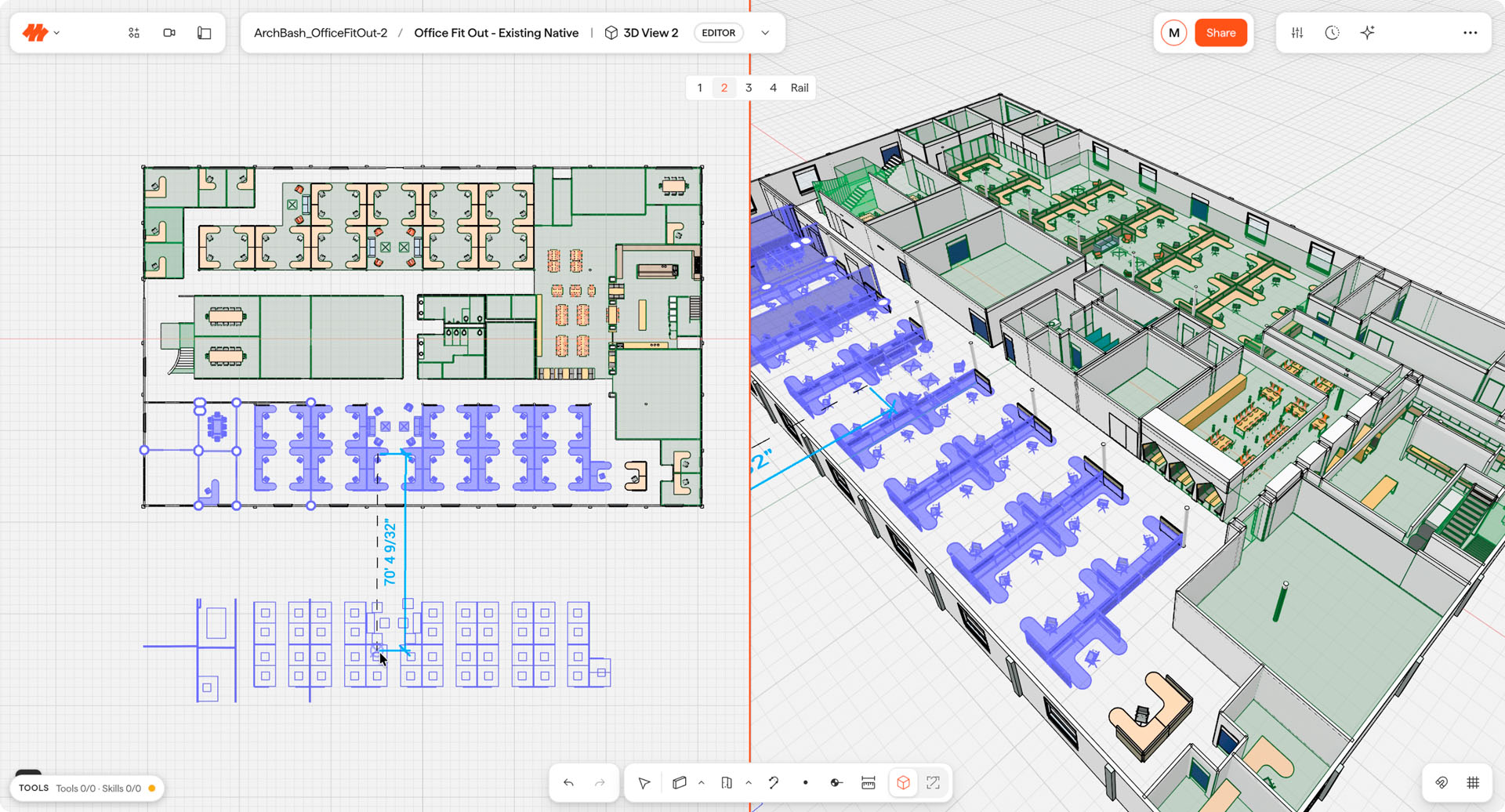
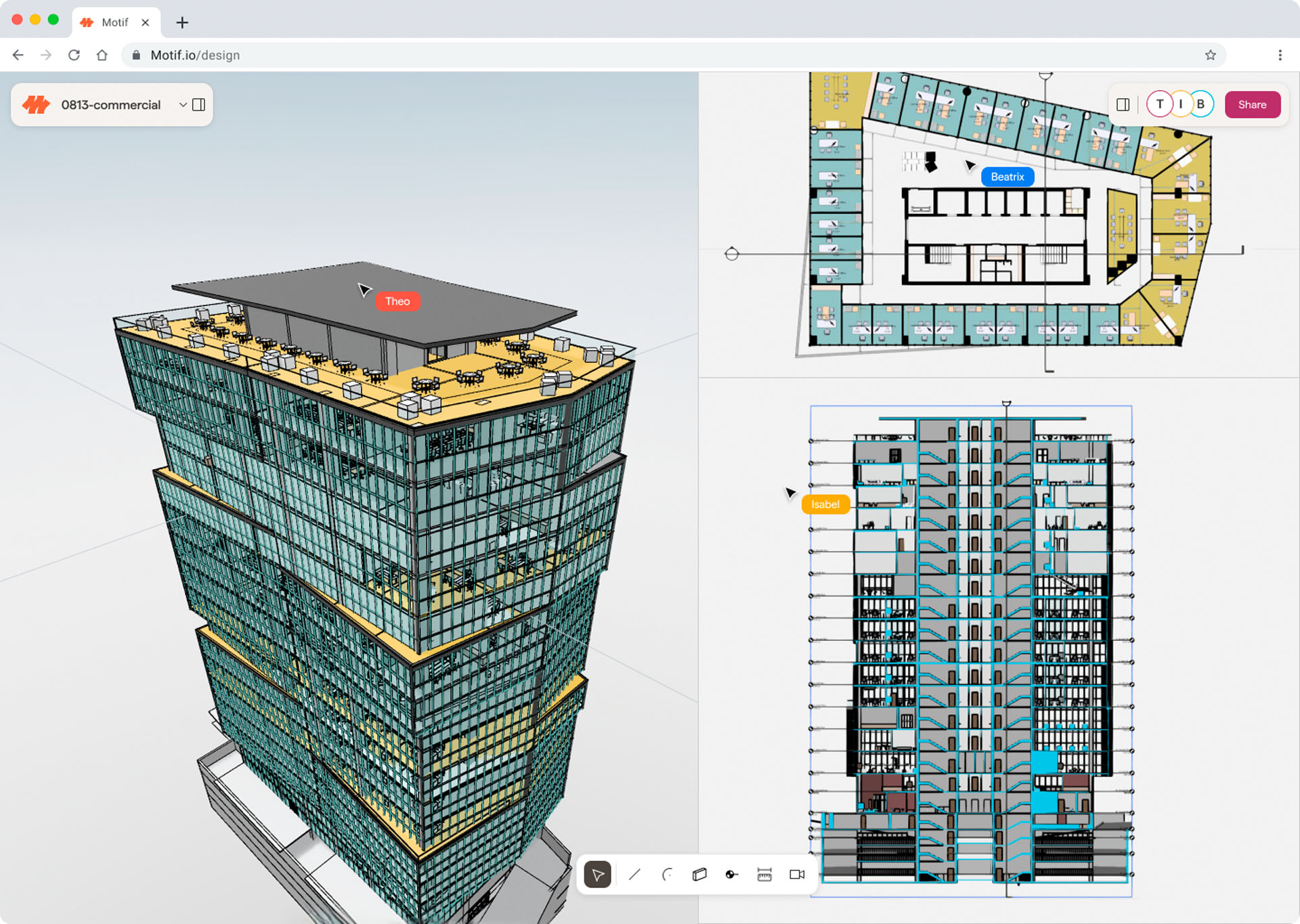
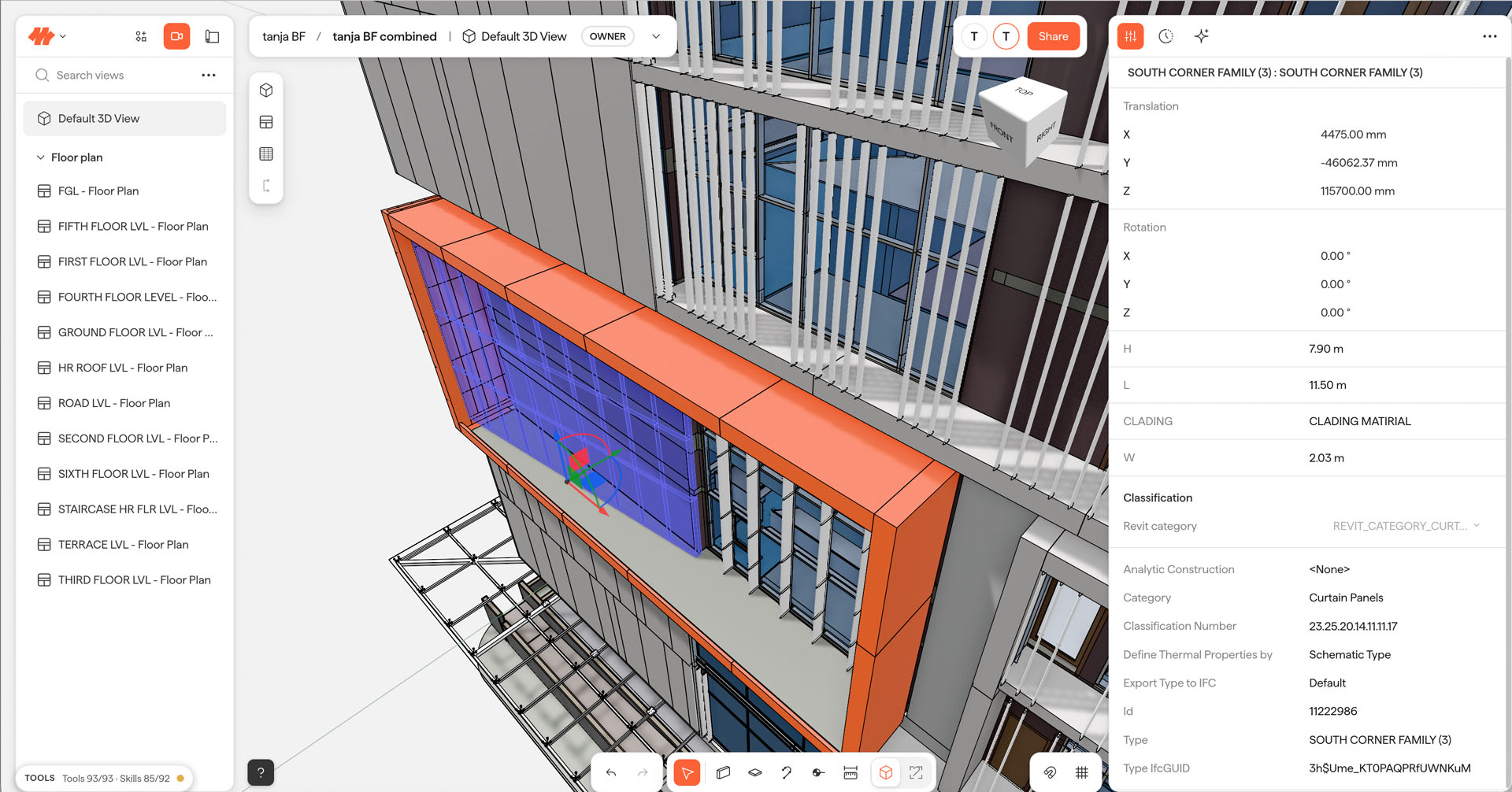
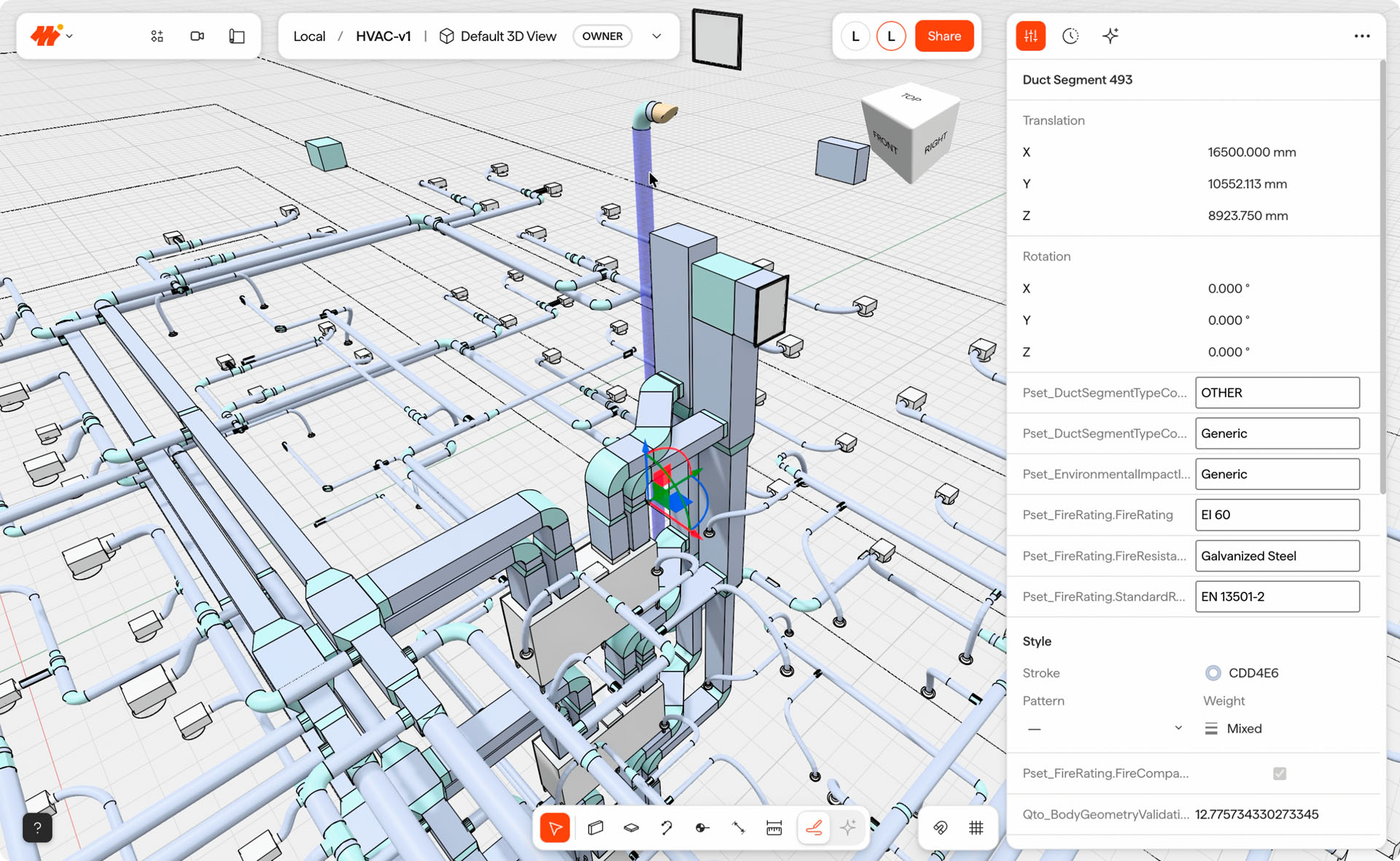
The first test for any Revit challenger is the boring one: is it actually BIM? Motif clears that hurdle. It is a browser-native BIM detail modeller running against a cloud back end, with live plan and 3D views side by side, dimensional feedback while modelling and precise numeric input rather than approximate sketching. Parametric walls, doors, windows, floors, ceilings, levels and hosting behaviour are present. The initial use case is interior modelling and that is where our demonstration was mainly focused.
Sheets are live views of the model rather than extracts. Change the plan and the sheet updates because both are reading the same underlying data. Every placed object has an identity within an ‘assets and instances’ hierarchy, making individual elements addressable by users, software and, more importantly, AI agents. When you use Motif, you are not necessarily working alone, but more on that later.
Underneath is an accurate BRep geometry kernel, while imported meshes are accepted alongside it without forced conversion. Objects can hold multiple representations, including symbolic representations such as door swings in plan. Partial model loading operates on the client and server, while level of detail authoring exists at platform level, although it is not yet exposed as an end-user tool. Motif’s own description is that BIM is table stakes, and none of these capabilities is remarkable in isolation, but without them the rest of the proposition would not matter.
The database is the product
The most important part of Motif is not the modelling interface, but the database underneath it. Motif describes the database as ‘schema-less’, although multi-schema is probably more accurate.
Imported information can be mapped onto native Motif objects, retained in its original Revit or IFC schema, or represented in several schemas at once. Motif does not insist that everything entering the system must first be translated into one canonical object model, a significant departure from decades of attempts to create a universal building schema. The team recognised that AEC firms are going to use many tools and formats, and that a new platform should not try to own the customer by insisting everything be translated into its proprietary representation.
The data model uses composition rather than deep inheritance hierarchies, drawing partly on ideas from Pixar and the games industry and, according to the team, early conversations with Greg Schleusner (former director of design technology at HOK and regular presenter at NXT BLD). There is a dynamic-type registry, universal identifiers and relationships between objects. New types can be registered at runtime, allowing developers to bring their own objects and behaviours into a project without waiting for Motif to add them to the core product.
Motif does not attempt to put an entire building into an LLM context window. It selects the data required for the task, including spatial subsets of the model, and supplies that context to the appropriate engine.
Motif is therefore not simply a modelling tool for producing drawings. It is also intended to be a runtime environment in which customers can craft their own design tools. Instead of waiting for the next software release, practices can potentially create capabilities specific to their own workflows, increasingly without needing to understand conventional programming.
Older AutoCAD users may remember the ARX object-enabler problem. Receive a drawing containing a custom object without the necessary software and you got proxy graphics rather than the real thing. Motif is browser delivered, so users are running against the same application code and type system, avoiding a problem that plagued extensible desktop CAD systems.
The AI story follows directly from this architecture. The user interface, API and agents are clients of the same underlying data model, so the agent does not sit outside the BIM application trying to operate it through a layer of commands. It works against the project data itself, an architectural difference that is considerably more important than which LLM happens to be connected to it.
Motif is multi-model. It has its own layer for making sense of objects and spatial relationships, then routes tasks to different AI engines according to what is required. These currently include Claude, Gemini and OpenAI models, among others, but the underlying engines are expected to change over time. The durable part is Motif’s routing and spatial reasoning layer rather than any particular LLM connected to it.
Nor does Motif attempt to put an entire building into an LLM context window. It selects the data required for the task, including spatial subsets of the model, and supplies that context to the appropriate engine.
Explainer: Agent-native – why an MCP isn’t the same thing
Every AEC software vendor is going to claim its BIM can connect to agents. The useful question is what those agents can reach. For an established desktop application, the route is normally through an API designed for external software developers. An MCP server can expose those API functions to an LLM, but it does not give the model deeper access to the application than the API beneath it permits.
Matt Jezyk’s description of Revit is that the application acquired an API well after its original architecture was established, and MCP adds another layer above that API. I know of Revit users who have ended up writing their own Revit MCP instead of using the one Autodesk provided. It shows how quickly practices want agent access to existing BIM systems, but it does not change the architecture of Revit itself.
Motif’s agent accesses the same underlying project model as the application interface and developer platform. Hanspal calls the direction a move from copilot towards autopilot. Put more simply, Motif’s agent is a native client of the BIM database rather than an external client operating through an API. That distinction is likely to matter more as almost every BIM vendor adds the word ‘agent’ to its product literature.
It also reflects a conviction about where projects live. In Motif’s reading, CAD records decisions made elsewhere, in conversations, email, specifications and building codes. Language is the material agents handle best, so an agent that can read both the model and the discussion around it occupies different territory from one that can only see geometry.
What an agent in the model can do
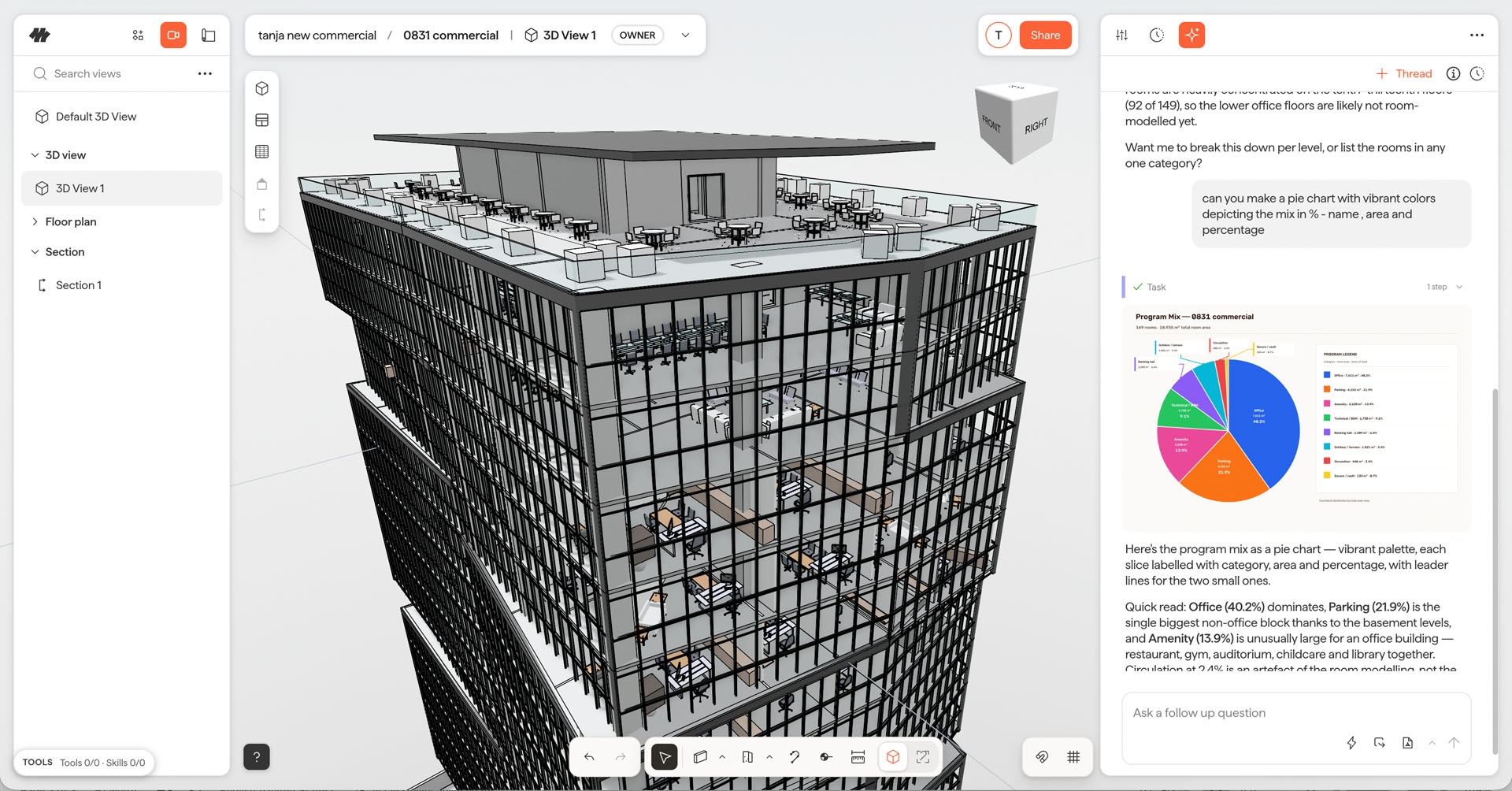
The demonstrations ranged from ordinary BIM interrogation to generating native parametric content. What caught my attention was not the number of things Motif could be prompted to do, but the fact that the output remained part of the BIM environment.
One example was a compound BIM query on an imported model: find every door over two metres high without a fire rating located in a corridor. The agent also identified incorrectly categorised Revit objects, found missing fire data, calculated gross floor area and performed checks against requirements for a particular locality. It could then put its calculation method onto a sheet for checking, rather than simply returning an answer in a chat window.
Language also becomes a navigation mechanism. The agent was asked to go to an auditorium, show a sightline from a particular row and display what somebody standing outside a glazed cafeteria would see. It could compare two design options, colour the differences according to rules and answer questions about what the project team had changed during the previous week.
Motif has been designed on the assumption that agents will make mistakes, rather than pretending sufficiently good prompting will make the problem disappear.
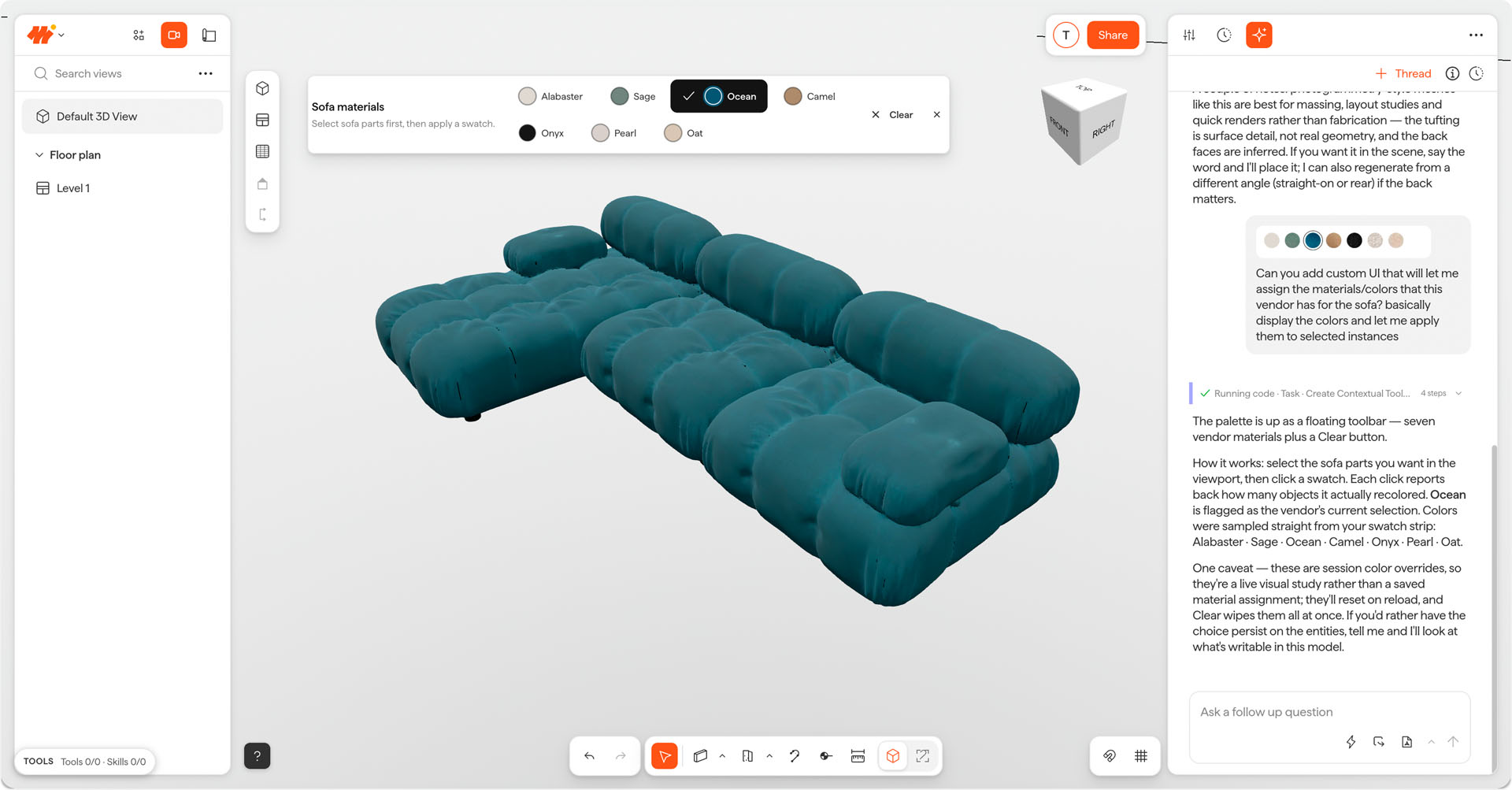
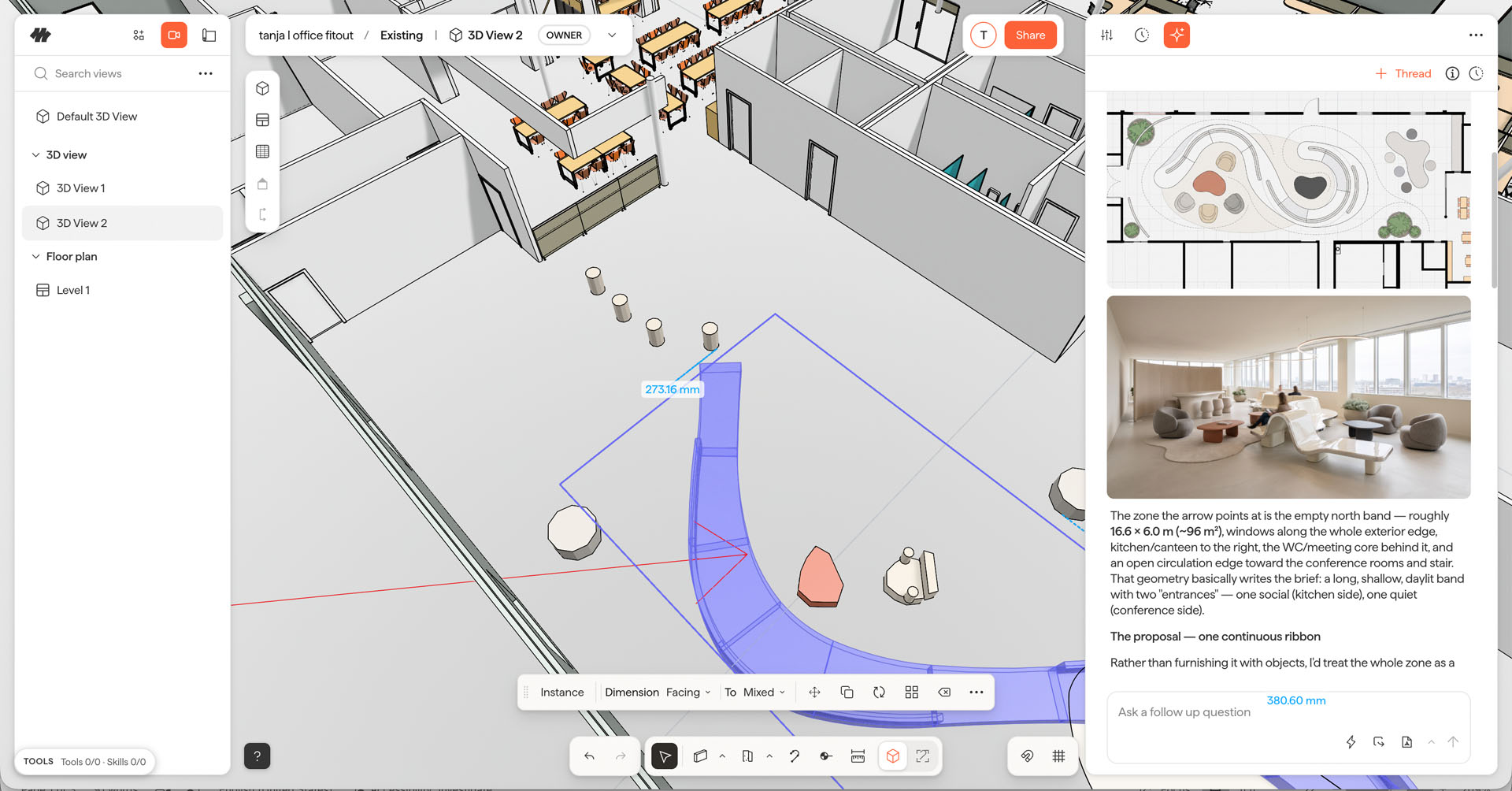
More interesting was the generation of editable BIM content. A marker sketch dropped onto the canvas became parametric walls, while a photograph became a parametric door rather than a mesh or rendered approximation. A bookshelf was generated from a short description, and a Gaudí-style door went through several rounds of correction without requiring the user to start again. Creating content in Motif looked, at times, like magic, although as we will come to later, there is a considerable difference between looking like magic and producing building information you can trust.
Tatjana Dzambazova’s principle is that users should not have to start from scratch. Existing drawings, models, photographs, text and previous work become inputs to the next operation. Image generators can already make convincing pictures of buildings, but Motif is attempting to make editable building objects that remain part of the model after the AI has finished, which is a considerably harder problem.
At a glance: What we saw Motif do
Interrogate: compound BIM queries; code and requirement checks; GFA calculations; identification of missing fire ratings and incorrectly categorised Revit objects; spatial navigation by language; design-option comparison; project history queries.
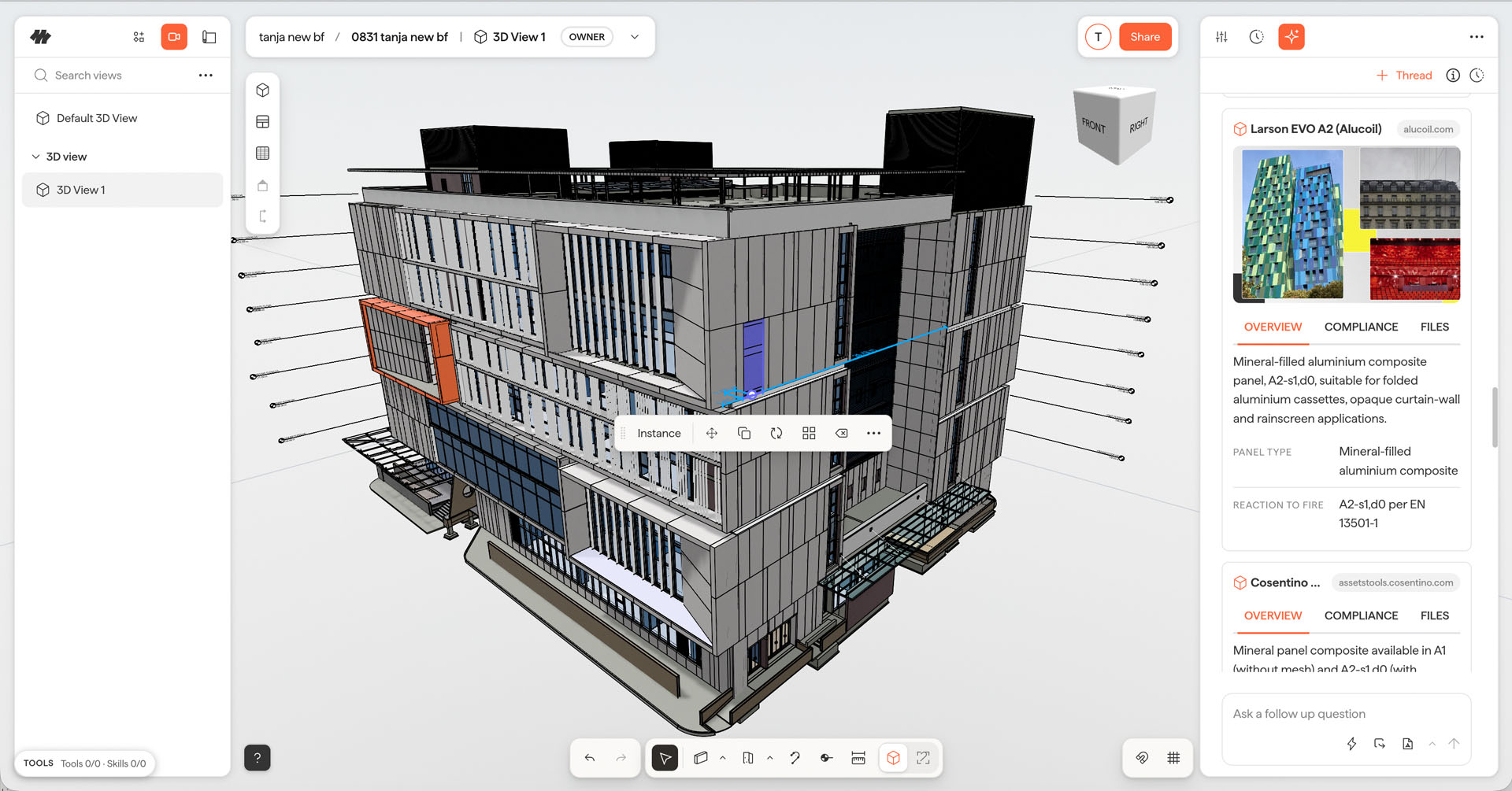
Create: parametric walls from a marker sketch; a parametric door from a photograph; a Corinthian column from an image; a sofa from an image; a parametric bookshelf from a description; iterative creation of a complex door; object controls populated from manufacturer information; parametric assets using 3D mechanical CAD tools Solidworks and Onshape (the FeatureScript capability).
Document: automatic dimensions; sections and levels; schedules and tables; specification information; Rhino geometry taken through to shop drawings with element counts and lengths, without Revit.
Act outside the model: vendor research against selected objects and locations; saving research into the project library; sending options for approval; publishing renderings and information to Slack and Notion. Some external workflows remain one way at launch, with replies from Slack and Notion not yet returning to Motif.
Skills, rather than scripts
Motif has adopted the idea of skills from Anthropic’s Claude. Here, a skill is a reusable instruction or capability described in ordinary language rather than conventional code. A skill could specify something simple, such as how a practice expects title blocks to be arranged, or encode a more elaborate modelling or documentation procedure. Hanspal compares it with AutoLISP: a way for practices to automate their own methods rather than wait for the software developer to implement every workflow.
Combine this with parametric object generation and some work currently done in family editors and visual programming environments potentially move elsewhere. If a useful door, furniture object, checking routine or documentation procedure can be created from language and examples, the barrier to creating practice-specific automation in-house falls considerably.
The requirement is no longer necessarily ten architects editing the same model simultaneously, but several agents checking, calculating, documenting or modifying different parts of it while people continue to work. Concurrency may turn out to be considerably more important for machine collaboration than it ever was for human collaboration.
That does not automatically turn everybody into a programmer by talking to a machine. Practices are full of people who know how something should be done but struggle to describe the procedure so somebody else can reproduce it. Turning that tacit knowledge into explicit rules may prove harder than generating the code.
Motif supports personal, project and company-level skills, so a capability developed by one person can be promoted into a controlled company standard, with a management dashboard sitting above them. The unresolved issue is arbitration, as two skills may perform the same task differently for different building types, offices, jurisdictions or clients. It is the old CAD standards problem applied to agent behaviour, and Motif does not yet have a complete answer.
Do not rent the same thought twice
One of the more interesting ideas in the briefing came from Brian Mathews and concerns the economics of AI. The obvious failure mode for AI software is a permanent meter: a task gets solved once, then every repetition sends another request to an expensive probabilistic model and consumes another batch of tokens.
Motif’s argument is that repeated reasoning should become software. Use the model to solve a problem, generate deterministic code or a reusable skill, review the result, define its permissions and then run that capability repeatedly without paying an LLM to rediscover the same answer. Mathews calls this ‘not renting the same thought twice’, which is a useful way of thinking about where AI should sit in repeatable production workflows.
If it works, every useful problem solved can become a permanent company capability rather than another AI transaction. BIM libraries traditionally contain objects, templates, scripts and standards, while an agent-native practice could also accumulate procedures: how it dimensions, checks, lays out, names, calculates, documents and responds to particular project conditions.
History, memory and failure
Once several people and several agents can work on a building model at the same time, keeping track of what happened becomes as important as concurrency itself. Motif’s history is effectively unlimited and is not simply an undo stack. It records who did what, allows users to return to an earlier state and provides a record of the changes that produced the current model.
A previous state can also become the starting point for something new. Users can select a point in the project history, create a new model from it and develop it as a design option without disturbing the original. With multiple people and agents working concurrently, the history provides a way of making all that activity legible rather than ending up with a model that has changed without anyone being entirely sure how or why.
Dzambazova describes the objective as avoiding software that suffers a concussion every time a project is opened, retaining the changes and decisions that produced the current state rather than remembering only the latest model. This also provides a safety net when agents get things wrong. Agents first produce a plan of what they intend to do, users can inspect the result, role-based access controls determine what an agent may modify and previous states can be restored when something goes wrong. Motif has been designed on the assumption that agents will make mistakes, rather than pretending sufficiently good prompting will make the problem disappear.
Getting existing work into Motif
No practice adopts a BIM platform it cannot feed with existing work, and this is where some of Motif’s launch limitations become important. Its approach to Revit and Rhino is to run connectors inside the source applications rather than rely entirely on standalone translators. The plug-ins use the host applications to extract geometry and data, then stream subsequent changes as deltas rather than transferring the complete project again.
IFC import and export are supported, while geometry and parameters can be modified in Motif and published back out. Jezyk says native Motif objects map cleanly to IFC, Revit and Rhino equivalents. Full geometry write-back to Revit, however, is not part of the 8 September release. Comment round-tripping works and the mechanism for broader write-back exists, but Motif says customer workflows will determine how it is implemented.
The bigger migration issue may be content libraries. A practice cannot currently press a button and migrate its Revit family library wholesale in the manner users of UNIFI, Piros or Kinship might expect. Hanspal acknowledged the value immediately, and in our view this is one of the most significant gaps in the launch product. Years of Revit adoption have left practices with substantial investment embedded in families and standards, and abandoning that is a very different proposition from importing an RVT file.
At a glance: What’s missing at launch
Motif is not presenting the 8 September launch as the point at which every Revit workflow has been replicated. Among the gaps and unanswered questions from our briefing are full Revit geometry write-back, one-click migration of existing Revit family libraries, deeper Autodesk Construction Cloud integration, complete BIM object coverage, end-user Level of Detail (LoD) authoring, two-way communication through services such as Slack and Notion, and productised headless operation.
Two claims also remain untested by AEC Magazine: Motif’s speed against Revit and its claim that photo-derived assets are dimensionally accurate, and we return to both below. Broader API, SDK and agent-building capabilities remain on the roadmap for the remainder of the year.
Explainer: the 1998 problem
Revit’s original architecture dates from 1998, and many important model regeneration and editing operations remain heavily serial. Modern workstations therefore deliver less benefit than their high CPU core counts might suggest for many common Revit tasks.
Mathews, once the VP of platform engineering at Autodesk, recalls moving an elevator shaft through a skyscraper model in Revit as a nine-hour operation which subsequently failed on a conflict with a roof drain near the end of the process, requiring it to be restarted. He also remembers beginning a Los Angeles commute while waiting for a model to open and arriving before it had finished.
Concurrency is another difference. Motif does not use Revit-style pessimistic locking for major model operations. Compatible changes can coexist, while conflicts are detected and presented for resolution. This matters particularly once agents become active participants in the project, allowing several processes to work against the model while people continue to use it.
Motif’s graphics stack is its own, built on WebGPU with its own spatial index and font engine. The same graphics code can run in the browser, on an iPad or headlessly in the cloud when an agent needs geometric or visual information without a human display. Headless operation has been tested but will not be productised until later in the year. Change propagation is multi-threaded, compute can be distributed and only the required parts of the project need to be loaded.
Every demonstration video we saw was accelerated. Motif says it makes no compromise on speed and is faster than Revit, but no formal benchmark was provided during the briefing. The architecture makes better parallelism plausible, but we need to see it demonstrated on real projects before taking the performance claim as proven.
What it costs
Motif has rejected traditional named-seat licensing and, since our briefing, has confirmed its launch pricing. The model pairs a platform fee for broad access with token-based pricing for AI, so what a firm pays reflects how much the software is actually used rather than simply who has a login.
Standard platform pricing is $150 per active user per month, with unlimited projects and unlimited user access, including guest editors and reviewers. An Enterprise tier starts at $200 per active user per month, adding compliance and security features, credit usage controls and higher AI credit allowances.
The definition of ‘active’ is where the model departs from named-user subscriptions. Active usage is set by a threshold of meaningful editing by users or agents, accounted for retrospectively in the manner of floating licensing, so occasional and light use creates no platform cost. Viewing is free outright. Querying depends on the query: asking the model to show all the windows is treated like viewing, while asking for the combined area of three objects involves computation and consumes tokens.
AI credits are included with every active user and pooled across the organisation, with additional credits available to purchase. Multiple agents can run in a single session and by default an additional agent costs nothing extra, although each consumes tokens according to the task it is given.
Motif is also offering a small group of early customers two active users for the price of one for their first three years. This is not general launch pricing, but an incentive for what Hanspal describes as the ‘true believers’ prepared to commit to the platform at this early stage. For those firms it effectively halves the active-user cost. The comparison with Autodesk is not simply about headline licence price, although even there the arithmetic is uncomfortable, since a named annual Revit seat alone costs more per month than Motif’s active-user fee before any collaboration service is added.
A Revit practice using Autodesk’s cloud workflow combines authoring subscriptions with BIM Collaborate Pro and other Autodesk cloud services, so the cost of collaboration sits on top of the authoring environment. In Motif, collaboration, project history, rollback and version comparison are capabilities of the common cloud project database rather than separate collaboration products.
That gives Motif considerably more freedom over how those capabilities are priced. Autodesk could match elements of the model, but doing so would mean accepting some cannibalisation of products and licence structures that currently generate recurring revenue. A new entrant does not have that problem.
Where Motif starts
Motif is not pretending it can replace every Revit workflow on 8 September. Its first two target areas are interior fit-out and test fits, where it believes the available object coverage and packaged skills are already sufficient.
It is also targeting firms looking for Rhino-to-documentation workflows, allowing practices to take Rhino geometry through to construction information without dropping into Revit simply as a documentation engine. This is not the mainstream BIM workflow, but the firms interested in it include some leading, influential, signature and boutique practices. The roadmap for the remainder of the year includes the API and SDK, further agent-building tools and continued expansion of object coverage and documentation control over the following six months.
Who moves first?
The first adopters are unlikely to be average Revit practices. The obvious candidates are technically mature design firms with internal computational design groups. They already have the people capable of exploiting a flexible data platform and, in many cases, Rhino-heavy workflows that fit one of Motif’s initial targets.
Motif’s flexibility may initially work against it in the wider market. Many Revit users may have difficulty conceiving of an open platform on which they can invent their own process; they want a product with the process already decided. Skills could eventually bridge that gap, with practices, consultants and resellers packaging workflows so users inherit an established method rather than build one, but that ecosystem does not yet exist.
Hanspal made one other admission worth repeating. Simultaneous multi-user modelling, presented as a headline feature of cloud BIM systems for more than a decade, is comparatively uncommon in practice, with most people simply needing to share what they are seeing. His example was a structural engineer pointing an iPhone at a monitor to show a colleague in Saudi Arabia what was happening in the model.
That might appear to undermine Motif’s emphasis on concurrency, but agents change the equation. The requirement is no longer necessarily ten architects editing the same model simultaneously, but several agents checking, calculating, documenting or modifying different parts of it while people continue to work. Concurrency may turn out to be considerably more important for machine collaboration than it ever was for human collaboration.
How Autodesk might respond
Autodesk’s obvious response might be that Revit and its wider platform will also have AI agents and MCP access. For many buyers that may be sufficient, particularly where changing authoring platform creates more disruption than the new capability saves. An MCP, however, does not remove the limitations of the API beneath it, and an API does not change the underlying data, geometry and concurrency architecture of the application it controls.
Autodesk can respond, but it has to bring agents to software and commercial structures accumulated over decades while protecting existing revenue. Motif does not have those constraints and arrived late enough to design around many of the problems its predecessors discovered. Whether those architectural advantages outweigh Revit’s enormous installed workflow is the contest that now gets interesting.
The accuracy problem
The demonstrations look impressive, but what happens when the agent is wrong? If a parametric door is generated from a photograph, what was the focal length of the lens, what has perspective done to its proportions, and which measurements are known rather than inferred? These are much less glamorous questions than image-to-BIM generation, but on a real project they matter rather more.
The industry has already seen what happens when generation becomes a paid guessing loop. In our experience with Illoca Plamo, a new AEC-focused agentic 3D modelling workspace that turns sketches, images and prompts into editable parametric geometry, we encountered waits of around twenty-five minutes – for the software to generate a façade with twenty windows where the building had six bays. And it consumed roughly one thousand credits while correcting mistakes.
Motif says its photo-derived assets are dimensionally accurate. The result is also a native parametric BIM object rather than a fixed image or mesh, so its properties can be edited directly to drive it to exact dimensions where required. That is an important distinction, although we have yet to test the dimensional accuracy ourselves on a real project.
The Gaudí door demonstration showed correction as part of the workflow, while planning, inspection, project history and rollback are built into the product. The real test will come when an agent makes a mistake on a live project: whether the error is obvious, how much it costs to correct, whether the previous state can be restored cleanly, and whether the correction can be captured so the practice does not pay for the same mistake again. Motif is at least built for those questions, which makes it considerably more interesting than another AI assistant attached to an existing BIM application.
Conclusion
Motif is the first Revit challenger I have seen where replacing Revit may not actually be the most interesting part. The company certainly wants Revit seats, but getting them will mean filling out its object coverage, proving performance on large projects, solving migration and convincing firms to move workflows carrying years of accumulated Revit content and knowledge. Even if Motif had every Revit capability tomorrow, sheer inertia would make that difficult.
But Motif has not been designed simply to recreate Revit in a browser. The more interesting idea is a persistent project database in which people, agents, geometry, requirements, company skills, generated software, project history and external information can all work against the same underlying model. That is quite a different starting point from adding AI access to an existing BIM application through an API and MCP.
There is plenty we still don’t know. We have not benchmarked Motif against Revit, used it on a large live project, migrated a substantial Revit estate or independently tested its claims for the dimensional accuracy of AI-generated building information. Object coverage remains incomplete and some important interoperability workflows are still coming, so anyone expecting a drop-in Revit replacement on 8 September is going to be disappointed.
What Motif has demonstrated is a collection of capabilities that would be difficult to retrofit into some existing BIM systems. Its developers also have the advantage of knowing Revit, RVT, Autodesk and BIM customers extremely well, while having had the money and freedom to start again. The AI shift happened early enough in Motif’s development for the team to rethink parts of the architecture around agents rather than add them afterwards.
Motif also arrives when leading firms are experimenting seriously with AI, building more tools internally and reconsidering their software stacks. Some of the practices most capable of exploiting it are already questioning both how much incumbent software they need and what they want the next generation of BIM tools to do.
For years a new BIM application has effectively been judged by how closely it can reproduce what Revit already does. Motif still has a lot of catching up to do, but parts of it suggest that comparison may no longer be the most useful test.