
How Autodesk and AMC Bridge Operationalize Autodesk Platform Services (APS) Across AEC & Manufacturing
From prototypes to production-ready systems across AEC and manufacturing environments, addressing the gap between platform capabilities and real-world operationalization
By Igor Tsinman, President and CEO, AMC Bridge
Most APS projects fail between prototype and production scale.
In our work with enterprise engineering organizations, we see a recurring pattern: the platform decision has been made, the APIs are available, initial prototypes show promise, and then the project stalls. Not because of missing capabilities, but because of everything that surrounds them: authentication models, cost governance, CI/CD pipelines, long-term maintainability, and the effort of moving from a working demo to a system hundreds of users depend on daily.
That gap – between what a platform can do and what an organization actually operationalizes – is where most of our work at AMC Bridge begins.
APS as a framework, not a product
Since evolving from Autodesk® Forge, Autodesk® Platform Services has matured into something more than a set of APIs. It is a modular framework that supports industry-specific cloud workflows across Forma Data Management (Formerly Autodesk Docs)®, BIM 360®, and Autodesk Forma for Construction (formerly Autodesk Construction Cloud). The real value is composability: organizations assemble data management, automation, visualization, and interoperability services differently depending on the problem they need to solve.
What we often encounter is not a lack of tools, but a lack of clarity about how to compose them into architectures that hold up under real enterprise conditions, where data volumes grow, user bases expand, and requirements shift faster than initial assumptions anticipated.
What operationalizing actually requires
As an Autodesk Platform Services Certified Partner, AMC Bridge has maintained and evolved APS-based systems through multiple platform transitions, from Forge to APS, through API versioning changes, authentication updates, and new service introductions. That continuity is not incidental. Enterprise customers need assurance that their platform investments will remain functional and current across the full solution lifecycle, not just at launch.
In practice, this means proven methods for CI/CD, observability, cost governance, and security (OAuth 2.0, JWT-based access control), applied consistently, not retrofitted after the first production incident.
Patterns we see across engagements
Across large AEC and manufacturing environments, a consistent set of solution patterns emerges, not because they are templated, but because the underlying enterprise challenges are strikingly consistent:
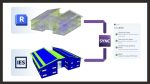
- Cross-platform connectivity: APS-driven bridges to construction management, PLM, ERP, and CRM systems that synchronize design and project data for end-to-end lifecycle management. The goal is not just data movement, but governed, traceable data flow that both engineering and operations teams can trust.
- Automated compliance and QA: Webhook-triggered validation on new model versions, with issues created and linked directly to the Viewer for rapid triage. This compresses review cycles and catches problems before they propagate downstream.
- Browser-based configurators: APS-powered tools that apply parametric rules, standards, and design options to generate validated variants and downstream documentation, extending engineering capability to non-CAD stakeholders without requiring desktop software or specialized training.
- Unified data hubs: Consolidating model metadata with business data to support reporting, quantity takeoffs, and KPI tracking in a single governed environment, replacing fragmented spreadsheets and manual data reconciliation.
These patterns reflect what we deliver, maintain, and evolve at scale, not theoretical frameworks.
A closer look: bridging BIM and construction management
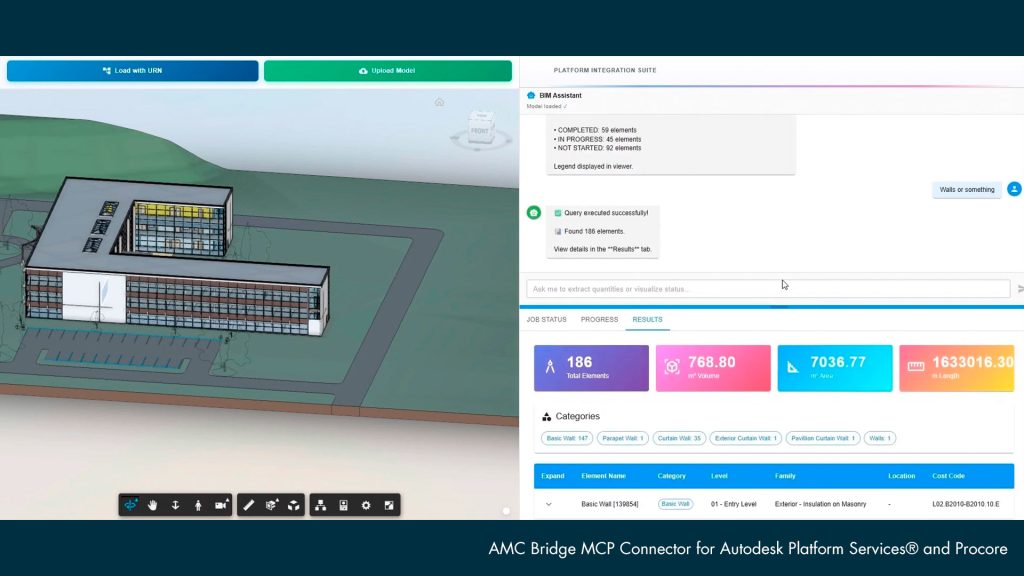
One of our recent technology demonstrations illustrates this operational thinking in practice. The MCP Connector for Autodesk Platform Services and Procore® was inspired by recurring client requests to eliminate cumbersome manual quantity takeoff workflows, and by a broader industry movement toward AI-assisted design-to-field coordination.
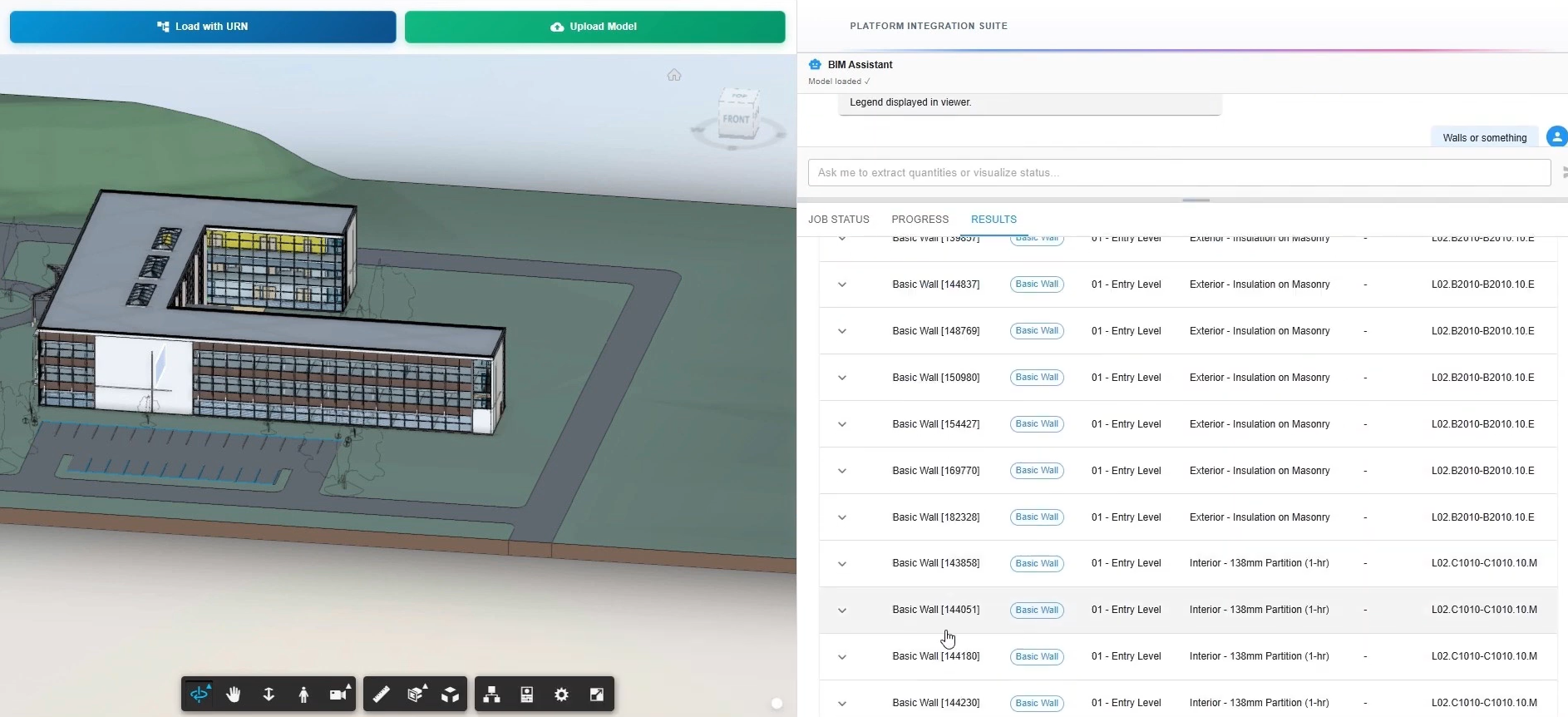
What makes this work notable is not just the integration itself, but the approach. Instead of rigid, point-to-point scripts that break when project structures change, the connector uses the emerging Model Context Protocol and AI-powered natural language processing to dynamically orchestrate multi-step workflows across both platforms. Users can query BIM models conversationally, extract element properties and quantities, post results directly into Procore® budget items, retrieve construction progress by location or cost code, and visualize real-time status in color-coded 3D, all within a unified interface.
The architectural idea matters more than any single technology choice: APS serves as the connective layer between design intent and field execution, turning engineering data into something operational teams act on rather than something locked inside authoring tools.
MCP Connector demonstration: integrating BIM data with construction workflows through APS and Procore®
A broader portfolio of APS-based work
The MCP Connector reflects one application of a consistent approach. Our APS work spans design automation, coordination workflows, and browser-based tools across both AEC and manufacturing:
- Putting a Building Security Expert on Every Architect’s Desk – integrating security analysis directly into the Autodesk Revit® design workflow, so architects access specialized expertise without leaving their BIM environment.
- Floor Plan Generator for Autodesk® Revit® – streamlines the design process and improves outcomes in real estate development, interior design, and facility management.
- Construction Coordination Issue Tracker – demonstrates how coordination issues from Procore® can be exported into Revit®, reducing the communication lag between design and construction.
- Concrete 3D Printing for Autodesk® Revit® – showcases a seamless workflow for concrete 3D printing, automating production and reducing construction time through model analysis and engineering artifact generation.
- Architectural Chatbot for Revit® – generates preliminary architectural designs in Revit® with minimal involvement from human architects.
What this means for enterprise leaders
For platform and engineering leaders evaluating APS investments, success depends less on individual API capabilities and more on system-level decisions – how authentication, automation, visualization, and interoperability combine into architectures that remain maintainable and cost-effective as adoption scales.
For business stakeholders, the outcomes are tangible: reduced manual rework, faster design iterations, broader model access for non-CAD users through browser-first delivery, and stronger traceability from engineering through operations. But those outcomes materialize only when implementation decisions align platform capabilities with delivery realities and organizational readiness.
As an Autodesk Platform Services Certified Partner, AMC Bridge focuses on exactly that operational layer, turning APS building blocks into governed, production-grade systems that deliver measurable results across AEC and manufacturing. For more information, visit amcbridge.com.