
Nomic is helping Arcadis automate engineering reviews, but AI’s next bottleneck may be the senior engineers still responsible for checking them. Martyn Day spoke with Nomic CEO Andriy Mulyar and Arcadis global AI enablement director Freek Matheij to learn more
Andriy Mulyar, founder and CEO of Nomic, recognises the problem inside his own company. As AI accelerates software development, he says the constraint becomes “the mental bandwidth of our senior engineering staff’s ability to review things.” He applies the same reasoning to global design and engineering consultancy Arcadis, where Nomic’s software supports engineering reviews: preparing the work takes less time, but accepting responsibility for it remains a human job.

I was introduced to Mulyar by Freek Matheij, global AI enablement director at Arcadis, who had contacted me the previous week to discuss the firm’s AI strategy. I had expected another conversation about Microsoft Copilot, but Matheij was far more enthusiastic about software that could work directly with project and asset data. “Nomic is maybe not the most sexy AEC platform out there, but it really helps in terms of everything in the asset life cycles,” he explained.
Drawing review had helped get adoption of Nomic moving, with applications extending into specifications, tenders and submittals. Nomic describes a first pass through drawings, specifications and models, each finding linked to its source. Matheij’s priority was accuracy on large, complex documents and drawings, though he said no outcome can be fully trusted: engineers decide what matters.
Discover what’s new in technology for architecture, engineering and construction — read the latest edition of AEC Magazine
👉 Subscribe FREE here
The Arcadis interest
Arcadis is not just a customer. It has backed Nomic with a strategic investment and long-term commercial partnership, so its endorsement is not disinterested.
Arcadis reports that 86% of participants in its six-month, 12-country trial said Nomic changed how they approached their work. At its Capital Markets Day in September 2026, it said Nomic had been used in three winning technical tenders with contract values above €25 million.
While the number of participants in the initial trial was only 150, representing less than half a per cent of a workforce (Arcadis is huge with 34,000 people), Nomic is now official enterprise software anyone can request, Matheij says, with licensed users up to almost 500 since July and more than 750 workflows built, about half of all runs inside project workspaces.
A leaderboard, he says, rewarded use on project work and reuse of colleagues’ workflows, to change behaviour, build AI literacy and keep spend tied to project budgets. The trial was a reason to expand, not a measure of what the entire business has gained.
Arcadis was not starting from nothing. Its people already use Microsoft Copilot, and some teams work with Copilot Cowork. Last month it announced an expanded collaboration with Autodesk, and it lists Nomic among its focused partnerships alongside Microsoft, Autodesk, Bentley and Nvidia. Matheij describes Copilot and Nomic as complementary: a productivity agent and an AEC project agent. Nomic works within platforms including Autodesk Forma and Microsoft Sharepoint, with Bentley Systems integration in progress.
A crowded engineering inbox
Nomic is entering an area the established AEC software vendors have been working on for years. Autodesk acquired Pype in 2020, bringing automation for submittals and closeout into its construction portfolio. Pype AutoSpecs extracts requirements from specifications and generates submittal logs. That is a narrower task than assessing whether a proposed product meets the requirements, but it puts Autodesk in the same workflow and in front of the same customers.
Procore is a more direct comparison. It acquired Datagrid in January 2026, explicitly identifying autonomous submittal review, RFI drafting and access to information across different systems as part of the rationale. In May 2026, it announced agents powered by Datagrid and embedded within Procore, including submittal and contract-review capabilities. Nomic’s proposition of agents working across project information is therefore also being pursued by a vendor with an established construction-management customer base.
Nemetschek’s Bluebeam has also bought talent and technology from mbue, a startup specialising in drawings, submittals and construction AI. Alongside the platform vendors are companies such as Togal, concentrating on detecting, measuring and counting from drawings. There is competition for both the individual tasks and the broader project workflow.
Mulyar sees distribution as a major challenge. Getting the technology to work is only part of the job; Nomic must then get it into firms and across their projects. The company offers individual licences as well as company-wide deals, giving AI researchers inside firms a way to try it. Alternatives such as Procore already have customer relationships and a place in the daily workflow. Nomic has to earn that access, establish trust and persuade engineers to adopt another product, which makes the Arcadis relationship valuable well beyond the investment. It also helps explain Nomic’s potential appeal to an acquirer with established distribution: the buyer would gain both a working product and a team with specialist engineering and AI experience.
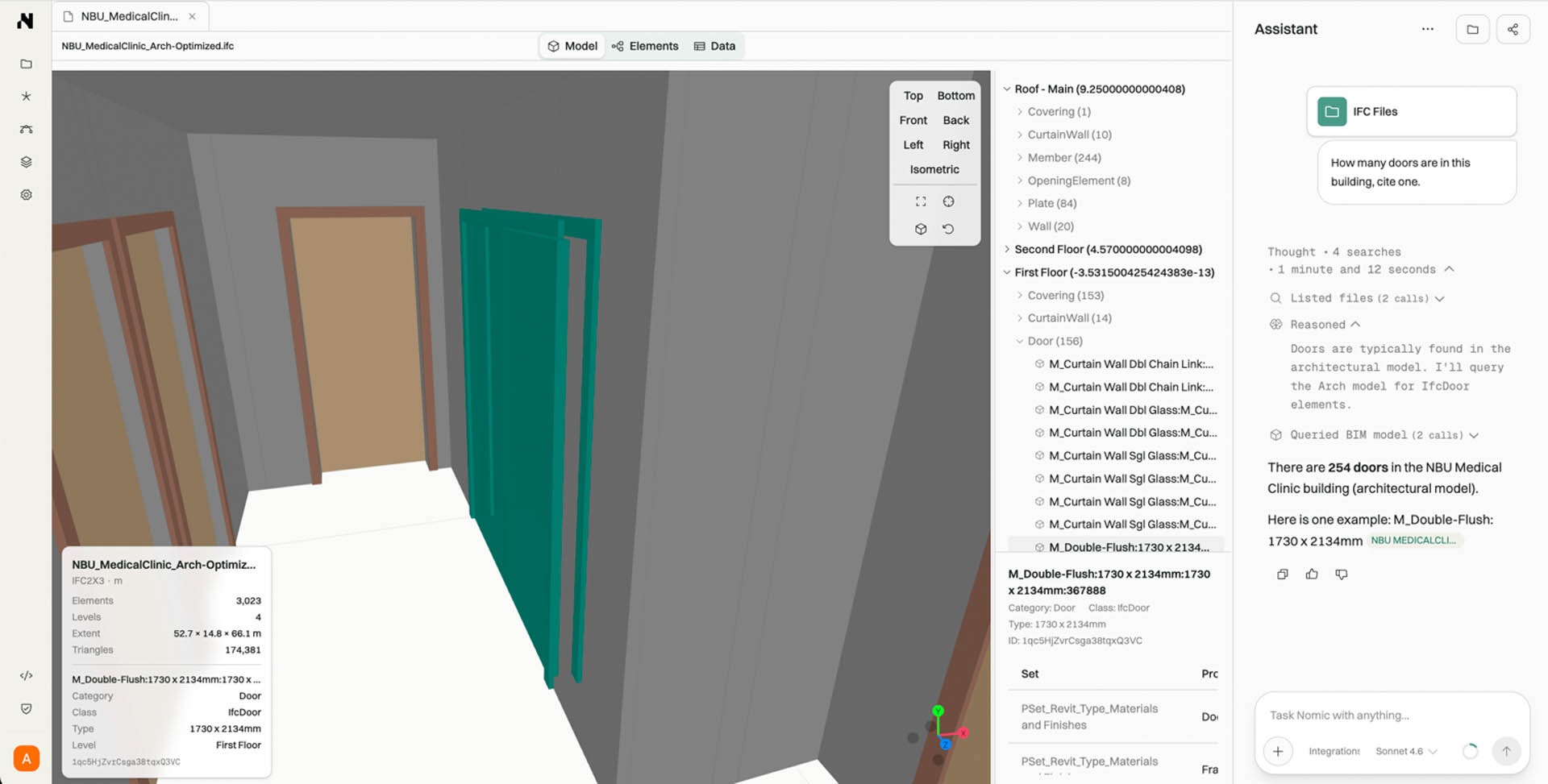
Its independent position gives customers a choice. Arcadis can use Autodesk’s authoring and project systems without taking all its engineering AI from Autodesk, while Nomic can work with information connected from several sources. But choosing a different AI supplier does not remove dependence on the systems holding the data. The usefulness of that choice still rests on what those systems’ connections and permissions allow an external agent to reach.
Arcadis’s parallel investment in Nomic and expanded collaboration with Autodesk illustrates how this can work in practice. A firm can retain its existing tools while looking elsewhere for the software that checks and coordinates their output. For Nomic, the commercial test is whether the quality of that work justifies another product alongside the platforms customers already pay for.
An earlier encounter with AI
Mulyar’s route into AEC began elsewhere. An early engineer at RadAI, he trained multi-billion-parameter language models to assist radiologists and was also a PhD student at NYU’s Courant Institute of Mathematical Sciences. The radiology work showed him how specialist data and professional expertise could make AI useful within a demanding workflow, without requiring it to perform the whole profession.
Nomic, where Mulyar previously served as CTO, was founded in New York in 2022. Its early products included Atlas and GPT4All, followed by open embedding models, reflecting his interest in making AI and its training data more accessible. The company raised a $17 million Series A led by Coatue in 2023, before turning its attention towards AEC.
That change of direction was not simply the discovery of a promising market. Mulyar said revenue in the earlier business had flattened as capabilities Nomic sold became part of the foundation-model providers’ offerings. “The product we were building got consumed by the foundation model companies into their API layer,” he explained. Nomic had already experienced the threat facing many AI startups: the next model release can absorb what used to be your product.
The search and retrieval work nevertheless had an application in engineering. “Our models can find the right pieces at the right time at the right moments,” said Mulyar. A question about a project may require only a handful of details, but those details can be scattered across thousands of pages. Finding them and preserving their context is a large part of getting a useful answer.
Whose drawings are in the dataset?
Drawings introduce problems that ordinary text retrieval does not solve. Dimensions, symbols, geometry and notes have relationships that need to survive interpretation, while references lead to other sheets and requirements elsewhere in the specification. A model that can describe a plan convincingly may still be unreliable at measuring it or following a detail through the document set.
Mulyar described one source for Nomic’s development material: licensed datasets purchased from commercial vendors, including information originating from construction businesses that are no longer operating, alongside historic project packages and correspondence.
Nomic then employed domain specialists to make the material useful. “We hired internal structural engineers, mechanical, electrical, plumbing engineers, architects that literally sit there and help us strip mine the data and make sure it’s a high enough quality to build really good evaluations from,” said Mulyar. The work involves establishing engineering tasks and acceptable answers, giving the developers something against which to measure the system.
This is more involved than cleaning drawings and feeding them into a training run. The team needs to know what information a task depends on and what constitutes a correct result. Otherwise, changing the model or adding another tool may produce a more convincing answer without producing a better one.
A question about a project may require only a handful of details, but those details can be scattered across thousands of pages. Finding them and preserving their context is a large part of getting a useful answer
Nomic has published part of its approach through AEC-Bench, covering drawing understanding, reasoning across sheets and project-level coordination. The release includes the dataset, agent harness and evaluation code. It is a vendor-authored benchmark rather than independent certification of the product, but it makes part of the company’s technical approach inspectable.
The harness supplies the tools, procedures and context around the underlying AI model. Nomic uses frontier models within that system while developing specialist capabilities of its own. Mulyar says enterprise customer data is excluded from model training, distinguishing the information a customer supplies for a live project from the material Nomic procures for development.
The value in submittals For Arcadis, Mulyar identifies submittal review as a particularly strong area of expansion. A contractor’s proposed equipment or materials must be checked against the project’s requirements, which can involve navigating drawings, specifications and supporting documentation. “That’s a place where they really trust it,” he said of Arcadis’s use. It is also, in his account, releasing significant engineering capacity.
Matheij sees the benefit of having the relevant information assembled around the project. “It’s kind of a knowledge database based on projects, and then you can have the right context, and that makes it very cheap to ask questions,” he said. The engineer spends less time searching for requirements and more time dealing with the findings.
How that becomes a financial return depends on the contract and the work available. Released capacity could support more projects, more attention to design, or more time with clients. The commercial effect will differ between hourly billing, fixed-fee commissions and percentage-based fees. Fewer hours spent producing or reviewing work do not automatically translate into higher revenue or margins.
Mulyar also described agents periodically checking connected project information for changes and initiating tasks without waiting for a prompt. In the submittal example, he said, “we can kick off those things autonomously before the human even sees the email, and then they just get the end document to review sitting in the SharePoint folder.” That changes the engineer’s starting point from a new request to a prepared review.
It is also how the queue at the senior engineer’s desk could fill up. A person asking an assistant to perform a task controls when the work begins; background agents can prepare several reviews while that person is occupied elsewhere. The benefit depends on how much checking those outputs still need. Producing them overnight is useful, but it does not create extra hours in the reviewer’s morning.
’s account placed greater emphasis on engineer control: “Always human in the loop.” The interviews leave open exactly which background operations are enabled across Arcadis, but the distinction practitioners need to make is clear. Permission to start a check is different from permission to change a design or approve a contractor’s proposal.
There are also limits to what any project agent can know. When I asked how Nomic could operate across all the companies involved in a building, Mulyar acknowledged that “you can never have full understanding of the entire system.” Its job is to improve the view available through the information an organisation can access. He said direct communication between separate companies’ Nomic agents was not something the product currently provided.
What comes next
Drafting is outside Nomic’s immediate focus, while takeoff is an area Mulyar wants to push further. He believes specialist model development can improve results beyond what the harness achieves, but acknowledged that the strongest general models were not yet producing the quality a construction team would need to rely on. Getting most of a drawing right leaves plenty of scope for an expensive mistake.
During our conversation, Mulyar showed an older layout-understanding approach, then explained that Nomic was removing that layer from its production stack. It turns out that Nomic is also developing its own large language model for project delivery, drawing on the specialist data and engineering tasks it has assembled. That would extend its work beyond providing tools and context around other companies’ models, allowing it to address some of those tasks through training the model itself. The work is still in development, with coordination and review the immediate focus rather than automated drafting.
That willingness to replace its own technology matters in a market moving this quickly. Nomic’s earlier experience shows how improvements elsewhere can undermine a product, while its internal development can also make previous work redundant. The continuing job is to evaluate what works, remove what is no longer needed and concentrate on the engineering tasks that remain difficult.
Conclusion
The quality of what reaches the engineer’s desk will determine how much time AI actually saves. A long list of weakly evidenced, poorly prioritised issues could consume much of the time saved in preparing it. A review that identifies the important issues, links them to the relevant drawing and requirement, and makes uncertainty visible has a better chance of reducing the total workload.
That also changes what firms should measure. The time taken to generate a review is only part of the calculation; the time taken to check, correct and approve it determines whether the work has actually moved faster. Senior engineers may also find themselves dealing with a higher concentration of difficult decisions once the routine preparation has been removed.
Arcadis gives Nomic a credible foothold in that process, while its investment gives the vendor a customer with an interest in shaping what follows. The wider market is already competing for the same work, with established platforms acquiring specialist teams and adding agents of their own. For all of them, the useful test is how much effort remains before an engineer can confidently sign off the result. That is where faster AI must become faster engineering.
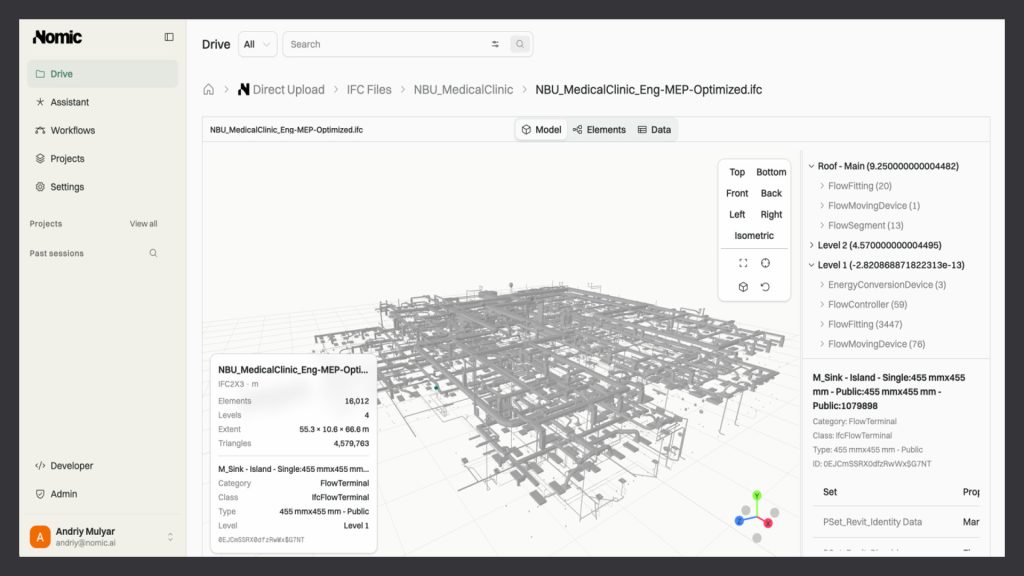
Main image: IFC view of a medical clinic