
Revizto now has a Model Context Protocol (MCP) server, but more interestingly packaged it with reusable Claude skills by learning what project teams actually do. Martyn Day spoke with CPO Marc Schuetz about getting more from BIM data without giving customers another job — or another bill.
Adding an MCP server is becoming another item on the AEC software developer’s checklist. Connect the application to an AI assistant, demonstrate some natural-language queries and announce that customers can now talk to their projects. After watching a few of these demonstrations, I usually have the same question: what are the actual benefits?
Marc Schuetz has been asking much the same thing. Revizto’s chief product officer, whose appointment was announced in January 2026, previously worked at Bentley Systems and PTC. He described watching compressed videos of lengthy AI tasks and wondering whether the work could have been done faster conventionally. “What’s the benefit of it?” is a fair question when the demonstration needs speeding up to hold your attention.
Schuetz summed up the customer problem as “there’s an ambition about digitalisation, and there’s the reality of no one has time.” Project teams are already busy. Asking them to work out what an AI connection is good for, develop the prompts and check the results, adds work before it removes any. Revizto has been looking at customers’ roles and daily tasks to establish where an assistant might actually earn its keep. Schuetz says he hired “three to four times more user experience people than product managers”, and wants everyone involved in development to understand the jobs customers are trying to get done.
He also believes customers should choose their own AI tools and expect software suppliers to fit around them. “It’s your process; it either fits in or it doesn’t.” Increasingly capable customers are already setting their own pace. Recalling a Foster + Partners presentation, Schuetz described his reaction: “If we as the software vendors don’t get our shit right, they will do it themselves. They are doing it themselves.”
Discover what’s new in technology for architecture, engineering and construction — read the latest edition of AEC Magazine
👉 Subscribe FREE here
Beyond the connection
AEC has no shortage of information. We create models, attach properties, generate drawings and record coordination issues, then spend more time finding, interpreting and reporting on what we have produced. Much of the knowledge needed to make sense of it remains in the heads of the people who did the work. Revizto brings multidisciplinary models and drawings together with clashes, issues, responsibilities and the discussions surrounding their resolution. An assistant can therefore query information about the building alongside the record of people trying to deliver it. Model properties alone will not tell you why an issue has been open for three months.
MCP provides a common way for AI applications to call tools and retrieve information. It does not make missing data appear, speed up a slow API or decide what a project manager needs for Monday morning’s meeting. Schuetz’s team drew on practitioner knowledge, including that of Revizto’s chief innovation officer Jason Howden, alongside the RIBA Plan of Work and ISO 19650. They examined the tasks different people do during the day and the information required. A project manager preparing a briefing and a coordinator working through clashes may be looking at the same project, but they have different questions.
Revizto encoded this work into reusable Claude skills. These provide instructions and background knowledge to help the assistant select information and interpret what comes back, saving users from having to explain the job every time. Schuetz said the team had written around 40–50 internal skills and used them to explore whether Revizto could support the tasks. “We need to improve the following APIs because we can’t get the answers,” was how he described some of the findings.
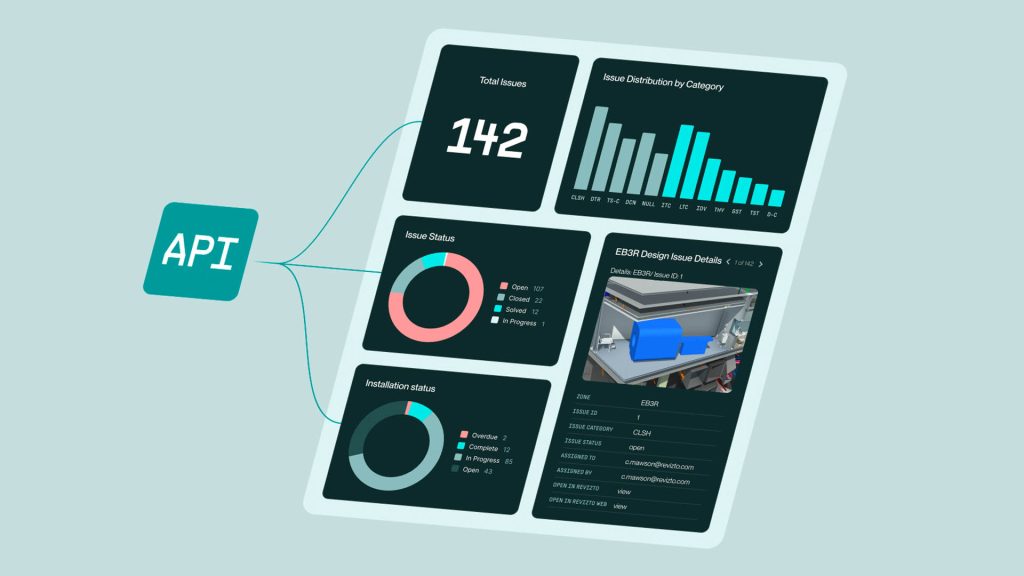
To put that research to work, Revizto built the Project Intelligence Blueprint, a dashboard running in Claude Cowork. It uses skills to help turn project data into briefings, coordination analysis and proposed actions for different roles. A project manager’s morning briefing gave the team a practical test: could the assistant retrieve the information, make sense of it and return something useful? The Blueprint became both an example customers could adapt and a way for Revizto to test its own APIs.
The volume of information was one immediate problem. Schuetz cited a project containing 500,000 issues, where loading everything into memory was impractical. The API needed to provide counts, samples and rules for working with the results. He said the development team had reported changes that made returning issues fifteen times faster. “We’re running this to pressure test our MCP and APIs,” he explained.
From briefing to action
Revizto deliberately made the Project Intelligence Blueprint something customers could take and adapt. “Customers should just take it and do whatever they want to do with it,” Schuetz explained. Delivered as a Claude Cowork artefact, the public package includes three skills covering installation, platform knowledge and API knowledge, with views for briefings, project checks, comparisons, coordination analytics, questions and actions. Firms can alter it to suit their own roles and working practices, using Revizto’s research as a starting point.

Schuetz demonstrated a briefing that picked out accumulated critical issues, a low closure rate and an apparent concentration of responsibility on one person. The user could then prepare changes to issue assignments, priorities and deadlines, and approve the updates. This is where the demonstration became more interesting. A report that tells you there is a problem still leaves you with the administration; being able to approve and apply the resulting changes could remove some of that work.
The public Blueprint documentation describes this write-back capability. It opens read-only each session, with writing enabled by the user and proposed changes reviewed before approval. Access through MCP follows the user’s existing Revizto permissions.
The demonstration used sample project data, so it offered no measure of time saved on a live job. What interested me was where this could lead. Revizto already brings together model information and the record of coordination work. That gives it the potential to become the place external agents go to query a project and carry out defined tasks, without repeatedly opening the authoring application. Briefings and issue updates are an immediate use; the larger opportunity is to support more of the automated work firms are beginning to develop themselves.
Too much information
Selecting the right information affects both response time and processing cost. “Why do you need the full house and the full 3D model information if you need one room and what’s in there?” Schuetz asked. The Blueprint takes headline totals from Revizto’s counts and uses labelled samples in detailed panels, showing how much of the underlying information has been included. This gives the assistant a manageable selection to work with, alongside the project-wide totals.
At the time of our conversation, Revizto was still preparing to expose object properties through MCP. Schuetz said the team was adding filtering at the API level so the assistant could retrieve the information it needed without being overwhelmed by the volume. The current documentation lists scene and model properties as available, with object-level properties accessible when Extended API access is enabled for the project. Images, webhooks, project and account logs, and model import/export remain outside the MCP server’s documented scope. Other compatible AI clients can connect to the server, while the packaged Blueprint dashboard and its installation workflow are built for Claude Cowork.
Publishing still matters
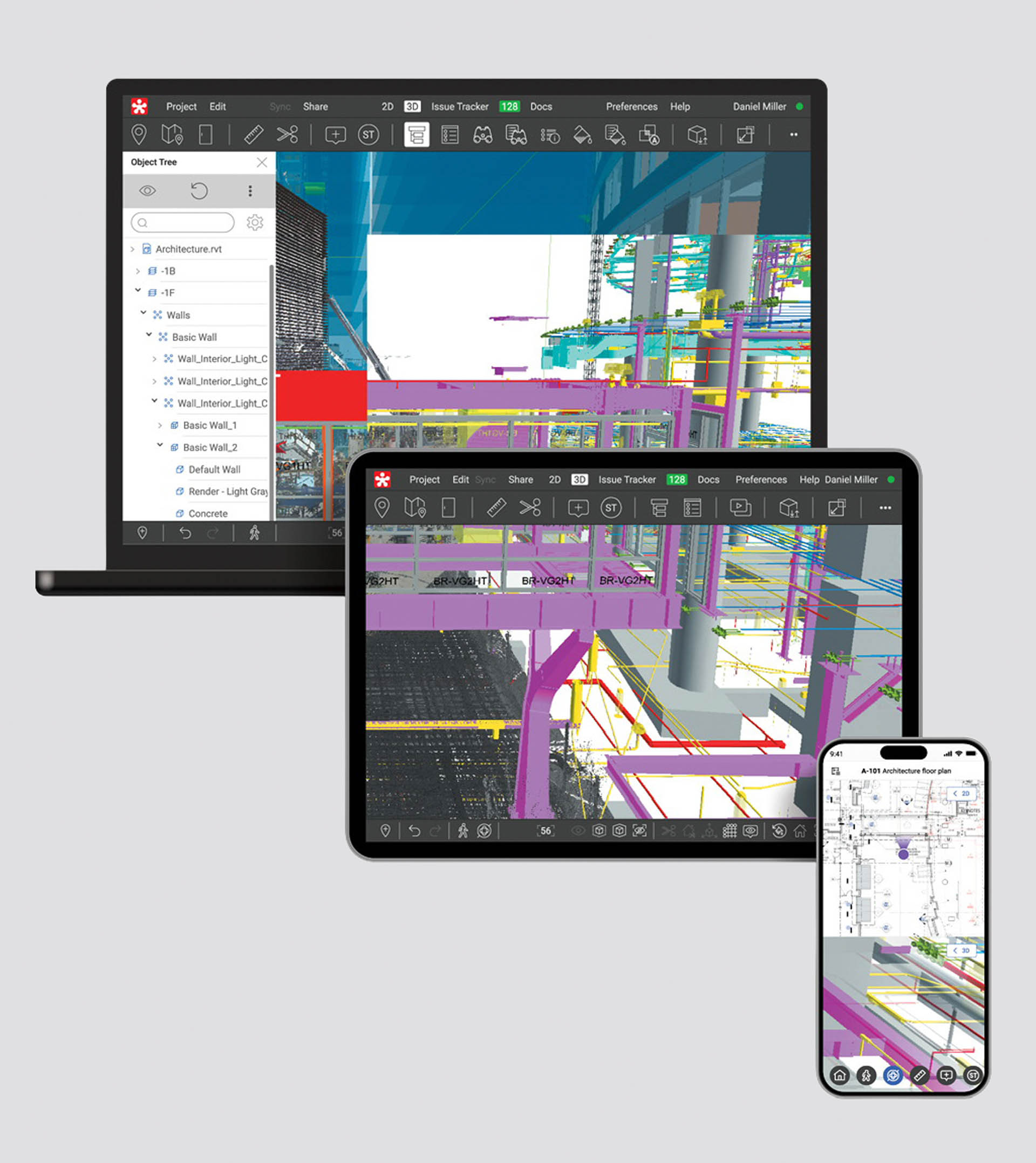
There is a less glamorous dependency underneath all this: publishing the model. Revizto’s documented Revit workflow requires both applications to be installed on a computer, using the plug-in to publish models and sheets. The Scheduler can run publishing tasks out of hours, but the machine doing the work still needs the authoring application installed. An AI querying Revizto sees the model information last published there, making the publishing schedule part of the AI workflow.
Revizto currently retains full model versions, something Schuetz wants to improve. “I would like to go way more to delta updates,” he said, capturing what has changed to “compress the amount of information”. He described the volume of data on very large projects, particularly in the Middle East, as pushing the software towards its limits. More granular updates would reduce the amount it has to handle. Autodesk’s AEC Data Model offers a different route to model information, querying supported Revit models held in its cloud without a separate desktop extraction process, as outlined in the box-out below.
Subscriptions, tolls and control
I put it to Schuetz that Revizto’s own price increases were becoming a complaint among the design IT directors I speak to. Whatever savings a vendor can demonstrate, its subscription still has to fit within a finite software budget. Autodesk’s increases leave less room for everyone else, and Revizto cannot assume that customers will welcome another charge simply because it has added AI access.
Schuetz said the company had examined several pricing models. “We decided to not increase the price, to not introduce tokens, to not introduce a different licence.” Providing the infrastructure had cost more than he initially expected, but Revizto had decided to absorb that expense. Customers would continue to pay for their chosen AI service. “I also don’t want to charge people to get access to their own data,” he added. Access still needs to be configured: the documentation requires API access and activation of the MCP server app, with Extended API access enabled on projects where object properties are required.
Autodesk’s approach to some data services is different. Its AEC Data Model API pricing took effect on 6 October 2026, with monthly usage allowances included in qualifying subscriptions and paid options beyond those allowances. The published AEC rates apply to “Data Out”, where data moves from the AEC Data Model to external data stores. Imports, administration and product-to-product API use within Autodesk are not charged under those rates. The charging applies to qualifying data access, rather than to MCP connections as such.
Frequent queries across a portfolio could consume those allowances faster than occasional questions about a single project. Firms building these connections into everyday work will have to account for that usage alongside the cost of their AI service. Schuetz’s commitment to avoiding an additional access toll is welcome, particularly given the pressure on customers’ existing software budgets. It gives firms more room to experiment with automation without having to account for another layer of usage charges.
Putting the ‘I’ to work
We spend years producing structured BIM information, then flatten much of it into drawings for downstream consumption. We are now applying AI to those drawings to recover some of the meaning we discarded. As Schuetz put it, “We have all this information in the model already. We just need to make it accessible more easily.”
Revizto’s skills work addresses who needs that information and what they intend to do with it. It also exposes gaps in the software and in the data customers supply. Missing properties and uncertain revisions become difficult to overlook when somebody expects a dependable answer before the next meeting.
Revizto has an opportunity to become the place customers turn to for everyday project questions and coordination work. Understanding those jobs, and helping with the administration they generate, gives it something more useful to demonstrate than a conversation with a model. Whether it earns that position will depend on the quality of its answers, the time it saves and whether its commercial promises survive growing use.
Revizto versus Autodesk
Revizto and Autodesk approach coordination from different directions. Revizto brings multidisciplinary models, drawings, clashes and issue management into one environment.
Autodesk combines Navisworks’ desktop model aggregation and clash detection with the shared coordination and construction records in Forma. Its Coordination Issues add-in connects the two, allowing teams to create and respond to issues arising from the desktop clash work.
Autodesk has an advantage in access to Revit data. Its AEC Data Model API can query elements and properties from supported models hosted in Forma, and search and compare model versions, without running Revit on a desktop. Revizto’s documented Revit publishing workflow still requires the authoring application. Revizto, meanwhile, provides a common coordination environment for models from multiple authoring systems, with the discussions, assignments and decisions attached to their issues. Autodesk also supports multiple formats, but its ability to extract granular Revit data is a particular strength.
Both are now applying AI to the work surrounding those records. At Autodesk University 2026, Autodesk announced beta Document and Sheets agents for finding information, alongside a beta Submittals Evaluation Agent for comparing submissions against specifications.
Revizto’s Blueprint concentrates on project briefings, coordination analysis and approved updates to issues. Its role-based skills give customers a starting point they can modify, while the MCP server lets them connect compatible assistants of their own choosing.
Autodesk’s wider construction platform gives its agents access to tasks beyond Revizto’s coordination focus. Revizto’s proposition is more concentrated: use the information already gathered for coordination, make it accessible to the customer’s AI tools and help act on the findings. The choice will depend partly on where a firm’s project records already sit and how much it wants to build around them. Neither approach removes the need to keep those records current.