
Blending high-performance 1:1 hardware with streamlined software deployment and smarter energy use, this workstation-as-a-service startup is hard to ignore, writes Greg Corke
In the world of CAD workstations, ‘the cloud’ often comes with compromises: shared virtual GPUs, lower-frequency CPUs, complex licensing, and unpredictable performance. Meanwhile, energy use is hard to understand, let alone control.
Computle is taking a fundamentally different approach. Instead of pooling resources and slicing them up virtually, the UK startup delivers dedicated one-to-one workstations in a fully managed datacentre, built on consumer-grade hardware but delivered as a subscription-based service.
The result, Computle argues, is better performance, lower costs, and a clearer path to energy and cost optimisation — especially for architecture, engineering and construction firms.
This article is part of AEC Magazine’s 2026 Workstation Special report
Computle’s approach is both economic and technical. On the economics side, there are fewer software licensing costs, which can be significant in traditional virtualised environments. “If you were taking a traditional graphics card and carving it up, you have to then pay Nvidia virtual workstation licences, whereas because we have dedicated (1:1) graphics cards, there’s no licensing costs associated to that,” explains CEO and founder Jake Elsley.
By leaning on open-source technology, Computle also saves money on the platform side, “Because we can move away from commercial solutions such as VMware, we can essentially use hypervisors built into our free, open-source software stack, so we can get the same performance without all the sort of overhead and costs associated with that, and no noticeable performance impact for the user,” he says.
The net effect is that, instead of each user having a slice of a larger machine, they each get their own dedicated workstation housed in a fully managed datacentre, with monthly billing typically spread over a three-year term.
And because the core components are pretty much the same as those found in a custom desktop workstation, for architecture and engineering firms used to physical machines under desks, this maps neatly to existing expectations.
The hardware setup
Instead of using a high-end server or workstation CPU (such as AMD Epyc or AMD Ryzen Threadripper Pro) and subdividing its resources through virtualisation, Computle offers individual workstations, each dedicated to a single user.
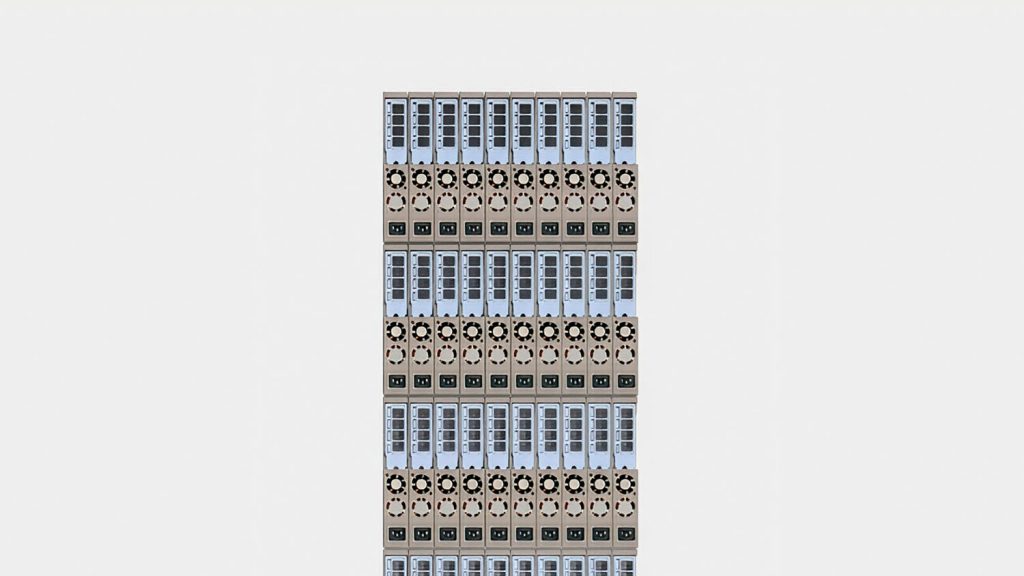
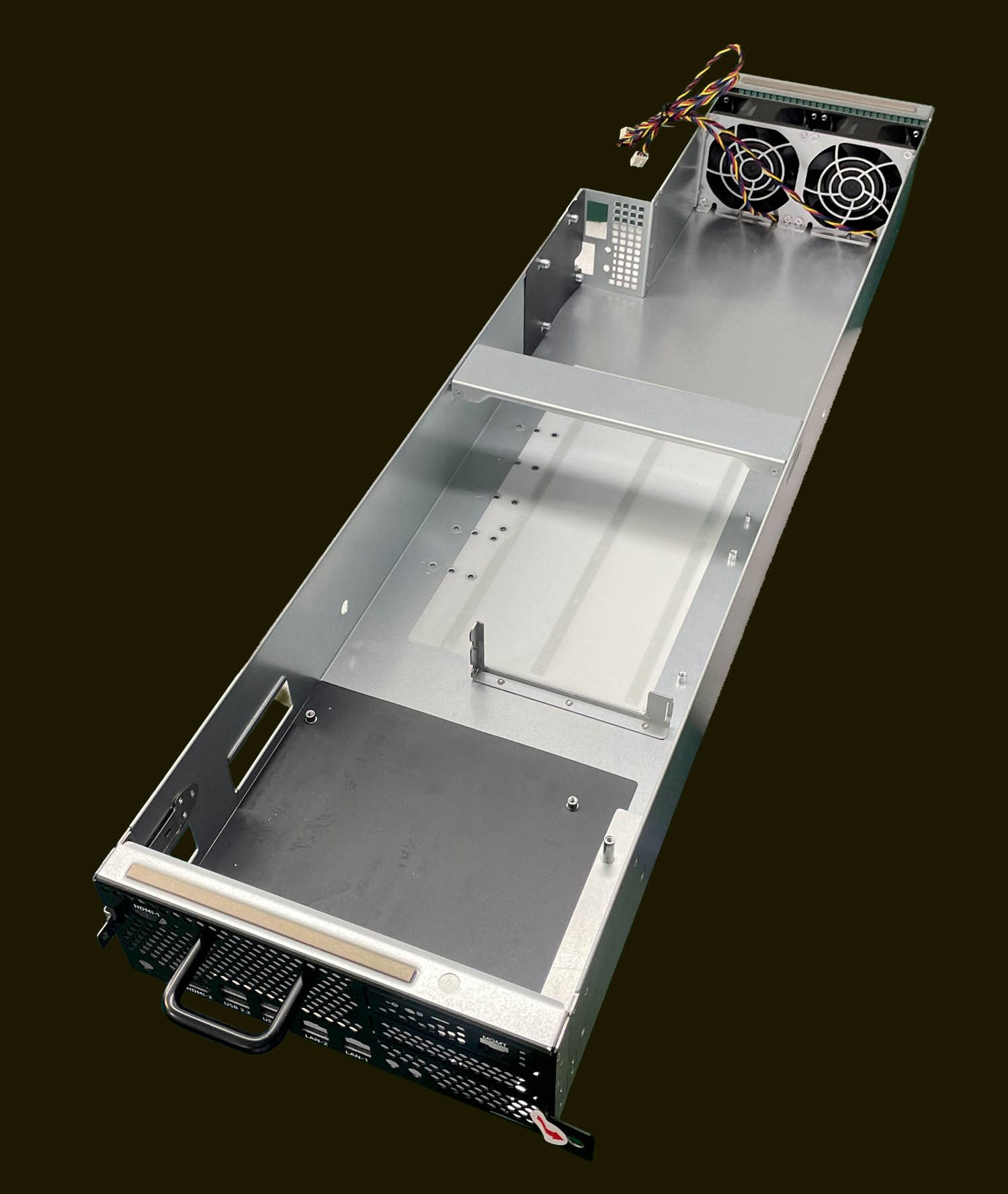
These custom blades, which slot into a rack, are purpose-built for the datacentre, and come with their own dedicated CPU, GPU, RAM and NVMe SSD storage. Computle primarily uses consumer-grade processors, such as Intel Core, which can reach the high frequencies that CAD workflows demand.
Customers can choose from four standard configurations, each built around the Intel Core i7-14700 CPU (up to 5.4 GHz Turbo), 64 GB RAM, and a 2 TB SSD. GPU options range from the new Nvidia ‘Blackwell’ RTX 5050 (8 GB) up to the RTX 5090 (36 GB). Pricing is aggressive, starting at £123 per month for a 3-year term.
For more flexibility, a full online configurator lets customers mix and match components, including the Intel Core i9- 14900, AMD Ryzen 9 9950X and a choice of AMD Threadripper Pro processors up to the 96-core 7995WX. There’s also a large choice of professional GPUs, such as the CAD-focused Nvidia RTX A2000 or super high-end Nvidia RTX Pro 6000 Blackwell (96 GB), along with options for more memory and expanded storage.
Pools and hot spares
With fixed hardware in each blade, Computle may not offer the same flexibility as a fully virtualised solution, but with the right planning, IT teams can still maintain a good level of adaptability.
Each user can be mapped to one or more specific machines, and organisations can create pools of differently specced workstations for different workflows — say, lighter CAD/BIM-only boxes alongside heavier visualisation rigs.
“We have users that have, for example, a set of [Nvidia RTX] 5090s and then a set of 5080s and a set of 5070s,” says Elsley. “We also have some customers who have a majority of low-end machines, and then a few high specs, so you can fully customise it across each location as required.”
Crucially, Computle also bakes in redundancy at the workstation level, as Elsley explains. “[On request] we provide hot spares, so, if there’s any issues connecting to a machine, you have access to two or three extra devices.”
Streaming, clients and thin devices At the heart of Computle’s user experience is its own custom coded client application, available for Windows and macOS, which wraps and simplifies access to the underlying pixel streaming protocols.
“There’s two options for the customer,” says Elsley. “We have Nice DCV, which is a protocol owned by Amazon, and then we have Mechdyne TGX, which is suitable for dual 5K [monitors], so it comes down to what the customer wants.
“Rather than having the user install multiple applications and set up VPNs, etc., we fully streamlined it [the client application].
“It’s custom coded from the ground up to integrate natively with those two protocols, giving them a much easier connection experience.”
While most remote users connect via their laptops or desktops using Computle’s client software, the company also offers its own thin client devices, preloaded and ready to go.
[For energy reporting] we’ll be able to give you a graph per user, what they’re doing, etc., and we can really drill down, because that’s what drives decisions Computle CEO and founder Jake Elsley
Meanwhile, for firms with historic investments in platforms like VMware Horizon, Computle can still slot into those environments — but Elsley notes there is a clear trend away from these older stacks towards their native client and DCV/ TGX-based delivery.
He then goes on to reveal that Computle is also developing its own streaming protocol, built to support multiple 5K monitors and multiple connection devices, such as iPads and tablets.
Close to compute, multi-site by design
Computle is more than just ‘a workstation in the cloud.’ The company offers a range of storage solutions from enterprise-grade file servers to intelligent caching systems from the likes of LucidLink, Panzura, and Egnyte.
Storage is charged at a flat fee and resides in the same datacentre as the workstations for fast access. “We offer two tiers — all flash based on NVMe drives, and then a slower archiving tier,” says Elsley. “And what we tend to find is that customers will engage us to do an all-flash setup, one per location.”
Computle deploys its hardware in datacentres across the world. For customers with multiple offices and regions, Computle works with LucidLink and Panzura to offload backend data to AWS or Google Cloud, with data constantly syncing down. Panzura caching nodes can be placed in the same rack as the workstations. “There’s no hidden charges, no bandwidth costs. It’s all just based on the storage consumption,” says Elsley.
For some customers, Computle also serves as an introduction to these technologies. “We recently had a client that had no understanding of cloud storage solutions. We were able to bring in some partner firms to get LucidLink set up for them and then deploy Computle across three locations.” says Elsley.
Sustainability / energy-aware billing
One of the most distinctive aspects of Computle’s roadmap is its plan to rethink how customers are billed. Today, most cloud workstation providers bundle power costs into a flat monthly fee, based on assumed average usage. Computle aims to change this.
“What we’re planning for next year to really upend the market even further is a move towards consumption-based billing on the electricity side,” says Elsley. “So, moving towards two costs. You have a hardware cost, which is a fixed cost every month, and then a cost based on actual data centre charges.”
In its current model, Computle typically bills for 12 hours of usage a day, but as Elsley explains, for firms that might only be actively working on machines 9-to-5, the new model could cut costs substantially.
With dedicated 1:1 hardware, featuring high-frequency CPUs and the latest Nvidia Blackwell GPUs, Computle promises cloud workstations that feel just like desktops under the desk
“For the typical architect, they’ll be able to lower their costs probably by 20 to 30%. So, if you have 100 machines with that, that’s going to be a good cost saving.” Underpinning this is granular control of power states, implemented at the software stack level. For example, Computle can detect when GPU-heavy applications are no longer in focus and drop machines into energy-saving modes or enforce scheduled power throttling overnight. “You have full control of the entire software stack,” says Elsley. “But it’s about giving people choice because some customers like to use it as a render farm overnight.”
Beyond billing, Computle is also looking at energy analytics, so customers can see exactly where power is being consumed and why.
“They’ll be able to see the real time data. We’ll be able to give them a report of how many kilowatts they’re using. We’ll also be able to give them trends. So, we can say ‘OK, you’re using this much overnight, have you considered using our new way to standby your machines overnight?’ So, lots of ways we can help them reduce that down.”
Computle is also exploring energy reporting at a more granular level. “We’re looking at some hardware and software options that give us that per machine level of information,” says Elsley. “So we’ll be able to give you a graph per user, what they’re doing, etc., and we can really drill down and give that data, because that’s what drives decisions.”
For firms under pressure to reduce reported energy use and emissions — while simultaneously ramping up GPU-heavy tasks like real-time visualisation and AI — this kind of visibility could be very important.
Computle is also exploring other ways to bring down costs. In 2026 it will introduce Computle Flex, offering customers the opportunity to save 50% on their idle workstations, as Computle’s Hannah Newbury explains, “A company can reduce their footprint costs by sleeping or suspending their machines during quieter times,” she says. “Credit is then applied to the bill at the end of the term. For example if you have a 50 person firm, you could be spending £7K monthly. If you suspended 50% of them in monthly blocks you would get £1,750 off.”
Estate management: beyond imaging
Another area where Computle is investing heavily is in streamlining application deployment and workstation management.
“One of the things that our customers have struggled with historically is looking after their estate,” says Elsley. “The historical way of doing services would be image-based deployments.
“If you have a 200 person architects they will spend, typically a week or so, updating an image and building it, and then within a month, that image will be out of date.”
Instead of constantly rebuilding and rolling out full images, Computle has plans to introduce its own version of Microsoft Intune, allowing admins to orchestrate CAD application deployment at scale.
Admins upload installers for common CAD, BIM or viz applications once to a central portal, then provision each machine on the fly. “Taking that admin time down from many hours to minutes is our vision, and that’s going to be a free add on for all of our customers,” says Elsley.
“The way it works is, there’s the software catalogue, where the end user can pick from a curated list of applications, for example, Revit, and then there’s a back end for the admin so they can say, OK, when this machine is built, these are the applications I want to get installed.”
Global footprint, aggressive ambitions
While Computle is still heavily UK-focused, it also operates out of datacentres in New York, Dubai, Hong Kong, and Sydney.
UK capacity is currently in a wholesale datacentre in the North of England, but change is on the horizon.
“We plan to build our own facility, probably in the next one to two years, so we can then get even greater savings for our customers, with the view that this will then get us to our 100 million workstation goal.”
That goal, which Elsley later confirms as 100 million workstations in just ten years, seems overly ambitious, even for a tierone OEM, let alone a startup — especially considering that market research firm IDC forecasts total global sales of desktop and mobile workstations will only exceed 8 million by 2026. Even so, Elsley’s bold vision is impossible to ignore.
Conclusion
With dedicated 1:1 hardware, featuring high-frequency CPUs and the latest Nvidia Blackwell GPUs, Computle promises cloud workstations that feel just like desktops under the desk. But its approach isn’t just about outperforming virtualised machines — the company also deserves much credit for addressing other key challenges, such as smarter energy use and streamlined software deployment — all combined with aggressive pricing.
While its growth targets are ambitious to say the least, there’s no question that this UK startup is emerging as a credible challenger to established cloud and VDI workstation providers, certainly making it one to watch for 2026.
Hands-on with Computle
We took one of Computle’s most powerful cloud workstations for a test drive, connecting from our London office to a datacentre in the North of England using Computle’s Windows-based client and the Nice DCV protocol.
Machine specs
• AMD Ryzen 9950X CPU
• Nvidia RTX 5090 GPU
• 128GB DDR5 RAM
• 2TB NVMe SSD
Running Revit and Twinmotion at 4K, the viewport felt just as responsive as a local desktop. Single-threaded CAD benchmarks matched our fastest liquid-cooled Ryzen 9950X desktop, while multi-threaded performance lagged slightly — 7% slower in V-Ray and 13% slower in Cinebench.
The RTX 5090 topped our charts for GPU rendering in Twinmotion and V-Ray. Overall, a cloud workstation experience that felt every bit as capable as a top-end local rig.
This article is part of AEC Magazine’s 2026 Workstation Special report
Features
- The rise of the 1:1 remote workstation
- Memory – shortages and rising prices: how to navigate the current crisis
- Computle: rethinking remote workstations
- Lenovo Access: simplifying remote workstations
- Creative ITC – a hybrid future
- How does your workstation setup compare? Results from our 2025 survey.
- Best enterprise-class workstation laptops 2026
- Can a small workstation really handle big BIM, CAD and viz?
- Why GPU memory matters for CAD, viz and AI
Reviews
- HP Z2 Mini G1a workstation
- Lenovo ThinkStation P3 Ultra SFF Gen 2 workstation
- CyberPowerPC Intel Core U7WS Workstation
- AMD Ryzen Threadripper 9000 Series processors
- Scan 3XS GWP-B1-TR192 workstation
- Nvidia RTX Pro Blackwell Series GPUs
- Intel Arc Pro B50 GPU