
This London-based firm is now taking a hybrid approach to remote workstations blending virtualisation with 1:1 access, giving AEC firms flexible desktops that balance cost, performance, and global access, writes Greg Corke
Creative ITC has earned its reputation by focusing deeply on the complex needs of the AEC sector — something that many IT providers only claim to do. Its founders know these challenges well, having spent large parts of their careers at global engineering and design consultancy Arup.
That key sector focus has helped shape Creative ITC’s evolution from value added reseller into a leading provider of high-performance Virtual Desktop Infrastructure (VDI) solutions – installed on-premise or delivered as a fully managed cloud service through a global network of Equinix data centres.
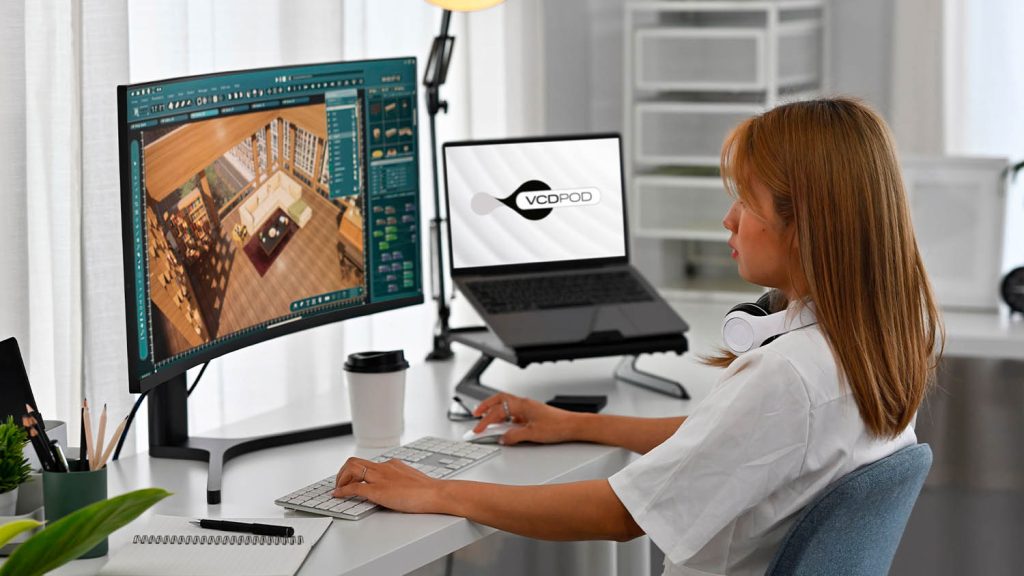
Over the past 18 months in particular, the company has doubled down on its desktop as a service (DaaS) strategy, refining its established VDIPod platform and, crucially in Autumn 2025, adding VCDPod, a complementary layer of dedicated one-to-one remote workstations for the most challenging workloads.
This article is part of AEC Magazine’s 2026 Workstation Special report
VCDPod was born out of the demands of high-end practices like Zaha Hadid Architects and Foster + Partners, where huge models, intensive visualisation, and increasingly complex workflows exposed the limits of a purely virtualised workstation strategy.
Creative ITC found that while VDI can offer high-performance GPUs for graphics-intensive workloads, the cost escalates quickly. “When you breach the top end of our [vGPU] profiling, it becomes very expensive,” admits Creative ITC’s John Dawson.
However, delivering better price– performance on GPUs is not the only appeal. As more customers learned of VCDPod, it quickly attracted a second audience: those running single-threaded applications such as Autodesk Revit, where high CPU clock speeds are critical to performance.
Finding the right mix
The introduction of VCDPod does not signal the end of VDIPod at Creative ITC. Far from it, it simply adds choice.
In a large engineering firm where single-threaded bottlenecks aren’t a major concern, “Your use case absolutely would be VDI, 100% across the board,” says Dawson. “There would be no real need to have any VCD.”
At the opposite extreme, for a high-end architectural practice, “Where you are battering every application and product, you’re probably a pure VCD play,” he adds.
Most AEC organisations fall somewhere in between. In this “middle ground” for practices such as Populous, WilkinsonEyre, or Scott Brownrigg, Dawson envisions “a little bit of both,” with an “80/20 rule” applying in many architectural and construction firms. One 500-seat customer, he notes, is buying just 20–30 VCDPods alongside 470 VDI desktops.
A single portal
While Creative now offers two distinct technology platforms, for customers that straddle both, the user experience remains consistent. “The ability to log into the same system, access data, applications in a consistent way, that was a major goal for us,” says Creative ITC’s Dave Adamson.
In practice, that means users continue to launch via the Omnissa Horizon client. On login, “They’ll just see the eligible types of desktop experience that they can access, which could be one or multiple flavours of VDI and indeed, VCD,” he says.
A BIM generalist might see only a standard VDI desktop; a senior visualiser could see both a VDI desktop for everyday work and a VCDPod for heavy Enscape sessions or end of project crunch.
Flexibility through choice
For the launch of VCDPod, Creative ITC has partnered with Lenovo, using the exact same physical workstations typically found on desktops. Creative ITC has chosen the Lenovo ThinkStation P3 Ultra SFF (read our review) as its current VCDPod workhorse, which speaks to the balancing act between performance, density and manageability.
“We can put seven [P3 Ultras] in a 5U space in a rack,” says Adamson. “We found with some of the competitors we could maybe get six. By the time you scale that into hundreds across the datacentre footprint, that’s [a saving] worth having.”
Equally important is the quality of Lenovo’s out of band management. “What Lenovo have done really well is deliver a desktop form factor PC with almost a kind of server grade management tool in their BMC [card],” says Adamson.
“Essentially, they’ve taken their Xclarity platform, which is what they use for their server management, and produced an appropriately cut down version for desktop, which works really well in our experience.”
Crucially, though, Creative ITC is not committing itself to one chassis or provider in the long term. The VCDPod platform has been architected for flexibility, as Adamson explains. “Should we choose to bring in another form factor in the future, be it a larger PC, be it a 1U pizza box server type approach, we’ll just be able to drop it in.”
Where workstations live
All of this sits against a backdrop of where AEC firms want to locate their workstations. Dawson sees some trends emerging. “The middle ground or lower tier enterprises are quite happy to get out of their datacentres and move away”, he says. By contrast, other organisations “have made large investments and [are] quite happy on prem.”
A common pattern is hybrid. For UK firms, infrastructure stays on prem, while offices in the Far East, North America or elsewhere come into Creative ITC’s hosted environment.
From the end user’s point of view, location is irrelevant. A machine could be on prem in London or in an Equinix cage in Amsterdam; the user simply sees a desktop in Horizon and can request or be assigned either on prem or hosted capacity as the business requires.
For multi site deployments across continents, however, fully hosted often wins out. With Panzura backed ‘file as a service’ and virtual desktops co located in Equinix, Creative ITC can better guarantee datacentre to datacentre bandwidth, place data close to users and avoid the challenges that often surround office-to-office links.
Creative ITC’s goal is not to position VDI or physical 1:1 remote workstations as inherently “right” or “wrong,” but to align each workload, user group, and region with the most appropriate mix at any given time
Security is another differentiator. Creative ITC holds multiple ISO certifications and a high level Cloud Controls Matrix (CCM) accreditation that Dawson says places the company “four tiers above” what most of its customers could realistically achieve internally. That really matters in an industry where IT departments are often under funded and overstretched.
“There are some customers we see that scare the living hell out of me, that do it themselves,” admits Dawson. “They are unfortunately ripe for cyber breaches and cyber attacks.”
From a commercial standpoint, Creative mirrors the reservation based economics of the hyperscalers. Customers can opt for pay as you go or commit to one , three or five year terms. “I would be honest, the majority are three years, because to get the TCO and the value,” Dawson says. Many mix commitments, reserving a core of seats on three year terms while placing additional users on one year or pay-as-you-go contracts to cover project peaks.
Creative ITC is still finalising the details for VCDPod, but it expects the platform to be somewhat more rigid at launch. “I think it will start as standard three years, with the option of a fourth year,” notes Dawson, with more flexibility likely as the installed base grows. Underpinning that stance is confidence that the current generation of VCDPod hardware will remain fit for purpose for at least three to four years in most AEC environments.
A hybrid future It is encouraging to see Creative ITC, a long-time proponent of VDI, expand its workstation portfolio in response to evolving AEC workloads. The goal is not to position VDI or physical 1:1 remote workstations as inherently “right” or “wrong,” but to align each workload, user group, and region with the most appropriate mix at any given time, while maintaining a consistent user experience as those balances evolve.
Viewed through that lens, the combination of VDIPod and VCDPod, unified through a single portal, feels like a coherent strategy for the next phase of remote workstations for AEC: continue to virtualise where it makes sense; deploy dedicated GPU and high-frequency CPU capacity where it doesn’t; and abstract that complexity behind a single, cloud-delivered, fully managed service.
Hands-on with VDIPod
For our testing Creative ITC provisioned a pair of VDIPod virtual machines (VMs), based on a virtualised “Zen 3” AMD Ryzen Threadripper Pro 5965WX CPU and a virtualised “Ada Generation” Nvidia L40 GPU. The systems were accessed via the Omnissa Horizon client using the Horizon Blast protocol, with both the client and datacentre located in the London area.
Each VM was configured with a different vGPU profile. Creative ITC recommends the Nvidia L40 8Q profile for CAD and BIM workflows, and in our testing the viewport was perfectly responsive, delivering a desktop-like experience in Autodesk Revit. By contrast, the Nvidia L40 24Q profile which is better suited to visualisation, offered a fluid experience in Twinmotion with performance broadly comparable to a desktop Nvidia RTX 5000 or RTX 6000 Ada Generation GPU.
Basic lightly threaded CPU tests showed both VMs to be around 42% slower when opening a Revit file and 65% slower when exporting a PDF compared with one of the fastest liquid-cooled desktop workstations we’ve tested, based on a “Zen 5” AMD Ryzen 9950X processor. However, given the two-generation gap between the CPUs and the fact that the Threadripper Pro does not boost into turbo, this is to be expected.
For customers where single-threaded workflows represent a significant bottleneck, Creative ITC recommends VCDPod, where the latest Intel Core processors in the Lenovo ThinkStation P3 Ultra SFF boast superior Instructions Per Clock (IPC) and can sustain high turbo clock speeds.
This article is part of AEC Magazine’s 2026 Workstation Special report
Features
- The rise of the 1:1 remote workstation
- Memory – shortages and rising prices: how to navigate the current crisis
- Computle: rethinking remote workstations
- Lenovo Access: simplifying remote workstations
- Creative ITC – a hybrid future
- How does your workstation setup compare? Results from our 2025 survey.
- Best enterprise-class workstation laptops 2026
- Can a small workstation really handle big BIM, CAD and viz?
- Why GPU memory matters for CAD, viz and AI
Reviews
- HP Z2 Mini G1a workstation
- Lenovo ThinkStation P3 Ultra SFF Gen 2 workstation
- CyberPowerPC Intel Core U7WS Workstation
- AMD Ryzen Threadripper 9000 Series processors
- Scan 3XS GWP-B1-TR192 workstation
- Nvidia RTX Pro Blackwell Series GPUs
- Intel Arc Pro B50 GPU