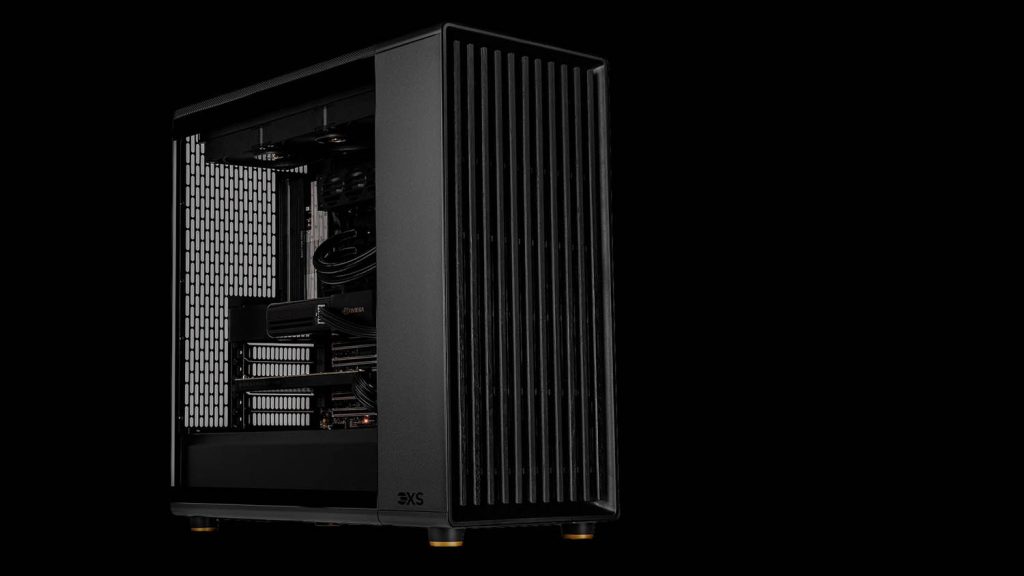
Scan 3XS GWP-B1-TR192 workstation

Review: Scan 3XS GWP-B1-TR192 workstation

11 0

This super high-end desktop pairs AMD’s 96-core Threadripper Pro chip with a 96 GB Nvidia Blackwell GPU to tackle the most demanding workloads confidently, writes Greg Corke


High-end workstations tend to fall into two camps: those tailored to specific tasks, and uncompromising systems built to deliver maximum performance across almost every conceivable workflow. The Scan 3XS GWP-B1-TR192 sits squarely in the latter category. This sizeable desktop is aimed at users with the most demanding workloads — from advanced visualisation and engineering simulation to large-scale reality modelling and AI. With a price tag of £23,333 ex VAT, it is very much a premium proposition, but the specification leaves no doubt about its intentions.

Searching for bottlenecks

At the heart of the machine is the 96-core AMD Ryzen Threadripper Pro 9995WX processor (see review here), paired with 256 GB of Micron DDR5-6400 ECC memory and the 96 GB PNY Nvidia RTX Pro 6000 Blackwell Workstation Edition GPU (see review here). On paper, it’s about as powerful a desktop configuration as you can currently buy without going down the multi-GPU route.

This combination means strong performance regardless of whether applications rely on multi-threaded CPU horsepower, GPU acceleration, or a mixture of both.

This article is part of AEC Magazine’s 2026 Workstation Special report

➡️ Subscribe here


The memory configuration is particularly well thought out. The 256 GB of DDR5-6400 ECC RAM is spread across eight 32 GB DIMMs, taking full advantage of Threadripper Pro’s eight-channel architecture to maximise bandwidth. This is especially important in engineering simulation, particularly computational fluid dynamics (CFD).

For stability, Scan runs the memory at 6,000 MHz rather than its rated maximum of 6,400 MHz — a pragmatic decision for a professional system where reliability matters more than squeezing out the last few percentage points of performance.

Thermals are well considered too. Each bank of four DIMMs has its own custom three-fan Scan 3XS cooling solution to keep temperatures under control during sustained workloads.

Advertisement
Advertisement

Of course, in today’s market, a large amount of high-performance ECC memory doesn’t come cheap. The system RAM alone adds around £3,700 ex VAT to the bill – roughly one sixth of the total system cost — but for those working with colossal design, engineering or viz datasets, it’s an essential investment.

96 cores under control

Cooling a 96-core, 350W processor is no trivial task. Scan uses the ThermalTake AW360 AIO liquid cooler, an all-in-one unit with a 360 mm radiator and three built-in fans that exhaust warm air directly out of the top of the chassis.

In practice, it does an excellent job. During extended CPU rendering tests in V-Ray, with all 96 cores fully taxed for more than two hours, temperatures never exceeded 55°C – an impressively low figure for such a high-end chip. We did see occasional 69°C spikes during certain stages of our Finite Element Analysis (FEA) simulation benchmark, as it uses fewer CPU cores at higher frequencies, concentrating heat into a smaller section of the chip. But 69°C is still nowhere close to the processor’s rated 95°C maximum, a temperature we’ve seen reached with some aircooled Threadripper Pro 7000 Series workstations.

Power draw peaks at the CPU’s stock 350W, exactly as expected, although it feels like this could be pushed higher, as we’ve seen in the past with some Threadripper Pro 7000 Series workstations.

Acoustically, the machine is also well behaved. There is a gentle, constant fan noise at idle, but it’s not intrusive. More notably, that noise level barely changes under heavy load, and the fans only really ramp up during certain phases of our FEA benchmark. Even when rendering for long periods in V-Ray, the system remains remarkably consistent and controlled.

Enter the 600W beast

If the Threadripper Pro processor is demanding, the Nvidia RTX Pro 6000 Blackwell Workstation Edition GPU is on another level entirely. With 96 GB of onboard memory and a 600W power rating, it presents serious thermal and power challenges.

Given the size and weight of the card, Scan fits a custom Stealth GPU bracket to keep it level and secure in the chassis – a sensible addition, particularly during delivery.


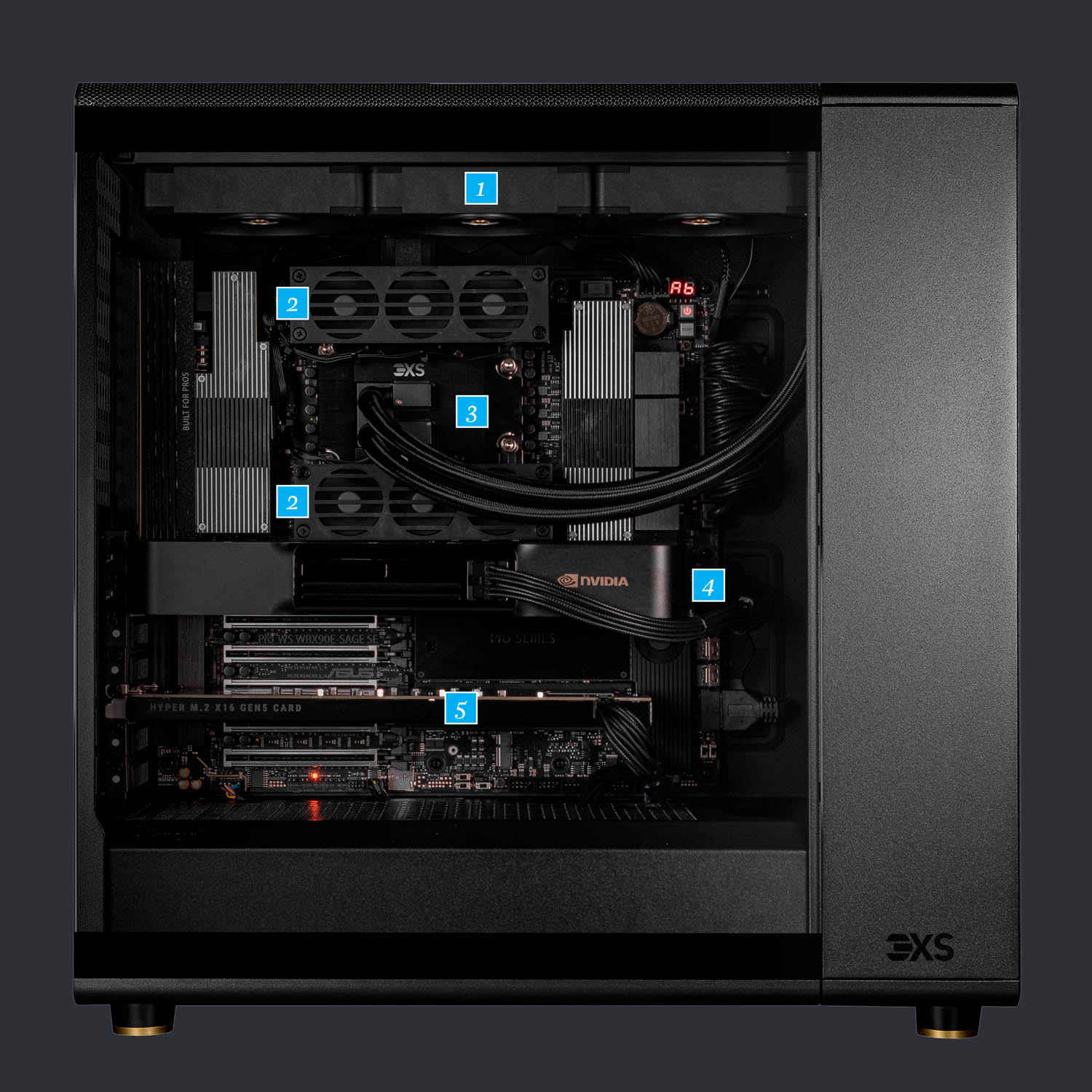
Scan 3XS GWP-B1-TR192 workstation
1 ThermalTake AW360 AIO liquid cooler radiator and fans 2 Bank of four DDR5 memory modules with custom Scan 3XS cooling solution 3 AMD Ryzen Threadripper Pro 9995WX processor 4 PNY Nvidia RTX Pro 6000 Blackwell Workstation Edition GPU with custom Stealth GPU bracket 5 Asus Hyper M.2 PCIe 5.0 card, with four 2 TB Samsung 9100 Pro SSD

The cooling design of the Blackwell card is also different from that of traditional workstation GPUs. Instead of a blower-style fan that exhausts hot air directly out of the rear, it draws air from underneath and vents it out of the top of the card. This approach helps keep the GPU itself cooler under sustained heavy workloads but inevitably increases temperatures inside the chassis.

In testing, the setup proved effective. During more than an hour of GPU rendering in V-Ray, the card barely reached 70°C, with only a very small increase in fan noise.

To push things further, we ran several tests in combination – on the GPU, rendering in V-Ray and generating images in Stable Diffusion, while on the CPU, rendering in Cinebench and simulating in rodiniaCFD. Under this extreme, if not entirely realistic, multi-tasking workload, the processors drew close to 1,000W, but temperatures peaked at 75°C on the CPU and 72°C on the GPU, while the machine remained responsive and no louder than before.

Performance

As you’d expect, performance is first-class. In CPU rendering the Scan 3XS sits at the very top of our charts, surpassed only by the Comino Grando workstation RM we reviewed last year, which pushed the 96-core Threadripper Pro 7995WX to its absolute 800W limits using an extreme custom liquid-cooling system.

In single-threaded workflows, the picture is more nuanced. The system is between 0–17% slower than the fastest Intel Core Ultra 9 285K-based workstation we’ve tested, and 8–13% behind the quickest AMD Ryzen 9 9950X-based machines. However, considering this workstation is built around a 96-core processor optimised for massively parallel workloads, that’s an incredibly impressive result. For a deeper dive, see our full Threadripper 9000 review here.

On the GPU front, however, the 3XS GWP-B1-TR192 has no real peers. Compared to the previous-generation RTX 6000 Ada Generation, the new RTX Pro 6000 Blackwell Workstation Edition is around 1.5× faster in many ray tracing workflows and up to 2× faster in some AI workloads. See full benchmark details in our dedicated review here.


Streamlined storage

The Scan 3XS doesn’t just rely on immense CPU and GPU power – it’s also engineered to keep those processors fed with data at high speed. Alongside a single 4 TB Samsung 9100 Pro PCIe 5.0 SSD for the operating system and applications, Scan includes an ultra-fast RAID 0 striped array for secondary storage. RAID 0 can be particularly beneficial for workflows that depend on sustained read/write performance, such as simulation, reality modelling, and video editing.

The RAID 0 array is built using an Asus Hyper M.2 PCIe 5.0 add-in card, populated with four 2 TB Samsung 9100 Pro SSDs. At around £70 for the card, it’s an extremely cost effective way to achieve multi-drive NVMe performance. However, it lacks the enterprise-class credentials of a dedicated hardware RAID solution from a specialist such as HighPoint.

Unlike the Asus card, which relies on CPU-based software RAID, HighPoint controllers feature a built-in hardware RAID engine, making them arguably better suited to a workstation at this level.

Even so, the performance of the Asus setup is impressive. In CrystalDiskMark, the RAID array delivered 36,216 MB/sec read and 51,110 MB/sec write, comfortably outpacing the single 4 TB Samsung 9100 Pro, which achieved 14,536 MB/sec read and 13,388 MB/sec write. However, when all 96 CPU cores were fully taxed during V-Ray rendering, throughput dropped significantly to 9,616 MB/sec read and 8,602 MB/sec write. This kind of performance reduction is less likely with a dedicated HighPoint card, thanks to its onboard RAID processing that operates independently of the CPU.

The whole system is powered by a 3,000W Corsair WS3000 ATX 3.1 PSU, providing stable and reliable power across the high-end components. In theory this gives plenty of power headroom for upgrades, but even though there’s space on the Asus WRX90E-SAGE motherboard for more GPUs, adding a second Nvidia RTX Pro 6000 Blackwell Workstation Edition would probably present some serious thermal challenges.

A sensible chassis

All of this hardware is housed in the brand new Fractal North XL: Momentum Edition chassis. The case has a sophisticated, understated look, with distinctive brown/ black wooden strips on the front panel – a refreshing contrast to the aggressive styling often seen on high-performance systems.

The front and top I/O includes a single USB 3.2 Gen 2×2 Type-C port (20 Gbps), two USB 3.0 Type-A ports, and separate audio and microphone jacks. There are plenty more USB ports on the rear, along with superfast dual 10Gb Intel Ethernet.

More importantly, the chassis delivers excellent front-to-back airflow thanks to three large low duty Momentum fans, which is essential when cooling components capable of drawing close to a kilowatt of power.

Final thoughts

Few AEC or product development professionals genuinely need this level of performance, and fewer still will have the budget for it. But for those working with complex simulations, huge reality models, high-end visualisation or AI development, training or inferencing, the Scan 3XS GWP-B1-TR192 provides an enormous amount of compute power in a single, well-engineered box.

What’s impressive is not just the raw specification, but how controlled and stable it remains under load. Despite the extreme hardware inside, it runs cool, stays relatively quiet, and never feels stressed – except in CPU workflows when there is no core prioritisation or pinning and applications end up fighting for resources.

For organisations and professionals that require this level of capability, it represents a carefully assembled, thoroughly engineered solution – albeit one with a price tag to match.

However, as with all Scan workstations, it’s fully customisable, and depending on your workloads there are many ways to bring down the price.


Specifications

  • AMD Ryzen Threadripper Pro 9995WX processor (2.5 GHz, 5.4 GHz boost) (96 cores, 192 Threads)
  • PNY Nvidia RTX Pro 6000 Blackwell Workstation Edition GPU (96 GB)
  • 256 GB (8 x 32 GB) Micron DDR5-6400 ECC memory
  • 4 TB Samsung 9100 Pro PCIe 5.0 SSD + 8 TB RAID 0 (Asus Hyper M.2 PCIe 5.0 card, with 4 x 2 TB Samsung 9100 Pro SSDs)
  • Asus WRX90ESAGE motherboard
  • Corsair WS3000 ATX 3.1 PSU
  • Fractal North XL: Momentum Edition chassis (L x W x H) 503 x 240 x 509 mm
  • Microsoft Windows 11 Pro 64-bit
  • 3 Years warranty – 1st Year Onsite, 2nd and 3rd Year RTB (Parts and Labour)
  • £23,333 (ex VAT)
  •  scan.co.uk/3xs

This article is part of AEC Magazine’s 2026 Workstation Special report

Advertisement